By Salini Krishnan

Ecuador’s tax authority has issued a $154 million assessment against Lundin Gold over the calculation of the state’s share of benefits from the Fruta del Norte gold mine, opening a dispute that could test the country’s fiscal framework for large-scale mining.
The assessment includes $73 million in proposed payments for the 2023 fiscal year and $81 million in potential fines and penalties, excluding interest, according to Lundin Gold’s disclosure and Ecuadorian tax authority statements reported by local media.
The total is equivalent to about C$215 million.
Lundin Gold, which operates Fruta del Norte through its Ecuadorian subsidiary Aurelian Ecuador S.A., said it disagrees with the calculation. The company said the assessment is inconsistent with the methodology set out in its exploitation agreement with the Ecuadorian government.

Fruta del Norte continues to operate normally, Lundin Gold said. The assessment does not currently affect production guidance, exploration and expansion plans or the company’s capital return strategy.


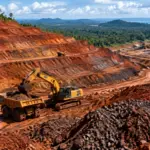
Illustrative view of gold ore processing infrastructure.

Dispute centers on Ecuador’s 50% benefit rule
The case concerns Ecuador’s “sovereign adjustment” mechanism, a provision intended to ensure that the government receives at least half of the cumulative economic benefits generated by a large-scale mining project.
Under the terms described by Lundin Gold, the company’s benefits are calculated using the net present value of Fruta del Norte’s actual cumulative free cash flows from the start of the project. The government’s benefits are calculated using the present value of cumulative payments, including corporate income taxes, royalties, state profit sharing, nonrecoverable value-added tax and any previous sovereign adjustment payments.
If the government’s calculated share falls below 50%, the company is required to make an annual payment to close the gap.
The disagreement is over how those benefits should be measured and discounted under the exploitation agreement. Lundin Gold said it believes the tax authority has misinterpreted the calculation methodology.
“The assessment results from a misinterpretation of the calculation methodology set out in our Exploitation Agreement,” Chief Executive Officer Jamie Beck said in the company’s statement. He added that Lundin Gold intended to use the appropriate channels to protect its rights under its agreements with Ecuador.
The company’s agreements also establish the broader fiscal and legal framework for Fruta del Norte. Lundin Gold said the mine is subject to a 22% corporate income tax rate, a 5% net smelter return royalty, a 12% state share of taxable profits and other statutory taxes and charges.
The assessment does not necessarily represent a final amount payable. It is a proposed determination that Lundin Gold is disputing.
Fruta del Norte is a cornerstone asset
Located in southeast Ecuador’s Zamora Chinchipe province, Fruta del Norte is an underground gold mine and one of the country’s flagship mining operations. Lundin Gold describes it as one of the highest-grade operating gold mines globally.
The company’s project overview says the mine began commercial production in 2020. It has a processing capacity of about 5,000 tonnes of ore per day and produces gold concentrate and doré.
Lundin Gold acquired the project in 2014 and developed it under a set of agreements negotiated with the Ecuadorian government before construction began. Those agreements were intended to provide a stable framework for taxation, investment protection and dispute resolution over the life of the mine.
That framework is now central to the dispute.
Ecuador has sought to expand its formal mining industry and attract capital into gold, copper and other mineral projects. Fruta del Norte is among the most significant operating mines in that effort, making the outcome important beyond the financial exposure of a single company.
The case also comes as Ecuador’s gold sector is gaining importance for government revenues and foreign investment. A report by Ecuadorian news outlet Primicias described Aurelian Ecuador as one of the country’s largest companies by revenue.

Illustrative aerial view of a remote Andean mining complex.
Why the calculation matters to miners and investors
The sovereign adjustment mechanism is designed to protect the state from receiving a smaller share of project benefits than anticipated when mining agreements are signed. For companies, however, the result can depend on assumptions about project cash flows, the timing of tax payments, eligible investment and the discount rate used to calculate present values.
Those assumptions can have a significant effect on the amount considered payable in any given year.
In Fruta del Norte’s case, the proposed $73 million sovereign adjustment is separate from the $81 million in potential fines and penalties. The combined figure of $154 million does not include interest, according to the company’s disclosure.
| Component | Amount |
|---|---|
| Proposed sovereign adjustment | $73 million |
| Potential fines and penalties | $81 million |
| Total assessment, excluding interest | $154 million |
| Approximate Canadian-dollar equivalent | C$215 million |
Source: Lundin Gold disclosure and Ecuadorian tax authority statements as reported.
The financial effect will depend on how the assessment proceeds and whether the parties reach an agreement or pursue formal challenges under the contractual dispute-resolution framework. Lundin Gold has said it remains confident in its interpretation of the exploitation agreement and will take further steps as the matter develops.
Neither side has indicated that mine operations are at risk in the immediate term.
A test for Ecuador’s mining regime
For Ecuador, the dispute raises questions about how the state’s minimum-benefit provisions should be applied to long-life mining projects, especially when commodity prices, investment cycles and production profiles change over time.
For operators, the case will be closely watched because it involves more than a routine tax disagreement. It touches on the reliability of negotiated fiscal terms, the treatment of past capital investment and the extent to which a government can revise or reinterpret a project’s benefit-sharing calculation.
The outcome could influence perceptions of Ecuador’s investment regime at a time when the country is seeking additional mining development. It may also be relevant to companies assessing projects elsewhere in the Andean region, where governments are balancing efforts to attract private capital with demands for a larger share of mineral wealth.
Any resolution will likely need to clarify how cumulative free cash flow, taxes, royalties and prior payments are valued under the agreement. It could also set a reference point for future negotiations between Ecuador and mining companies developing large-scale gold and copper projects.

Illustrative gold-bearing rock samples prepared for analysis.
For now, Fruta del Norte remains in production, while the tax dispute moves through the applicable channels. Investors and mining executives will be watching for further filings from Lundin Gold, additional statements from Ecuador’s Servicio de Rentas Internas and any indication of whether the matter advances toward formal litigation or arbitration.
Skillings will continue tracking the case as part of its latest mining news coverage, with particular attention to its implications for gold producers, critical minerals investment and fiscal policy across the Andean region.