Key Takeaways

- Zangge lithium production halt in Qinghai ordered due to regulatory non-compliance.
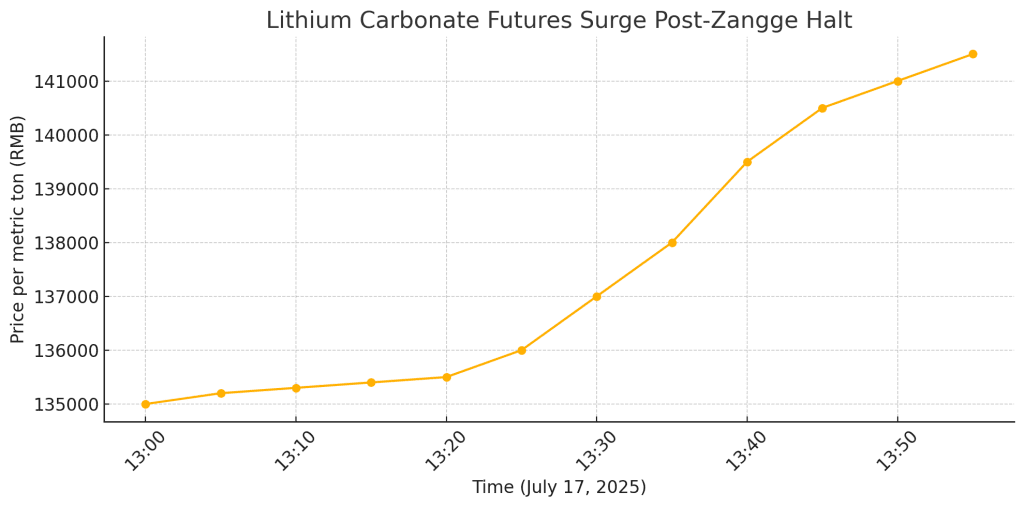
- Lithium carbonate futures surged 4% on Guangzhou exchange following the news.
- Unspecified compliance violations cited; resumption requires government approval.
- Zijin Mining, Zangge’s parent, faces reputational exposure amid broader scrutiny.
- Market analysts expect further volatility and possible expanded crackdowns.
The Zangge lithium production halt in Qinghai province has rattled global metals markets, exposing the growing weight of China’s regulatory hand in strategic mineral supply chains.
On Thursday, Zangge Mining disclosed that local authorities in Qinghai issued an immediate suspension notice for its lithium subsidiary due to undisclosed compliance violations. The Zangge lithium production halt affects a facility central to China’s brine-based lithium extraction efforts, which had been on track to deliver 11,000 metric tons of lithium carbonate this year.
The result: a sharp reaction on the Guangzhou futures exchange, where the most active lithium carbonate contract surged over 4% by mid-afternoon. The shock suspension has reignited fears of supply disruption in an industry increasingly tethered to China’s lithium mining crackdown.
“This wasn’t on anyone’s radar,” said Yan Li, analyst at Benchmark Mineral Intelligence. “It shows Beijing is willing to risk short-term pain to enforce its green mining agenda.”
More Read

Zangge lithium production halt: From Strategic Asset to Regulatory Target
Zangge, majority-owned by state-run Zijin Mining, holds a crucial position in China’s lithium strategy. The Zangge lithium production halt in the salt-rich Haixi region—a core of domestic lithium carbonate output—has disrupted plans despite producing 5,350 tons in the first half. The company now says it has no timeline for resuming operations.

“The impact on the company cannot be predicted for the time being,” Zangge wrote in its filing, signaling uncertainty for partners and buyers downstream.
While the filing didn’t clarify the precise breach, industry watchers cite increasingly aggressive enforcement of environmental and water-use protocols as part of the ongoing Qinghai lithium regulatory action. In particular, Qinghai’s salt lake mines have drawn scrutiny over brine discharge practices and project permitting.
More Read
Zijin Faces Broader Exposure
Though Zangge represents only a slice of Zijin’s vast mining portfolio, the action marks a reputational flashpoint. Zijin Mining’s suspension complicates its narrative as a pillar of China’s green materials transition.
“We’re entering a phase where compliance isn’t just expected, it’s enforced,” said Dr. Huang Xia of Peking University. “And even state-linked firms are not exempt.”
EV Supply Chains on Alert
The broader concern lies in the EV battery supply chain. China produces roughly three-quarters of the world’s lithium, and even small production halts ripple outward. EV makers and cathode producers remain highly sensitive to brine-sourced feedstock constraints.
“It’s a reminder of how geopolitics, regulation, and climate policy are colliding over critical minerals,” said Isabella Greene of CRU Group.
Traders echo that sentiment, calling the price spike a sentiment shock, not just a supply one. “We’ll see more volatility if Beijing expands audits,” said one Hong Kong-based commodities trader.
Looking Ahead
There is no indication yet of a national-level directive, but recent suspensions at rare earth and graphite mines suggest the Zangge lithium production halt could foreshadow broader clean-up efforts. Industry insiders anticipate new compliance metrics and public tracking initiatives to emerge from Beijing in coming months.
For now, the Zangge lithium production halt is a high-profile stress test for China’s dual ambitions: secure battery materials and enforce green standards.