Key Takeaways
- Guinea bauxite concession revoked from UAE-based EGA, reassigned to new state-backed miner.
- Government cites violations of mining code and unmet refinery obligations.
- Part of broader push by military-led West African states to assert control over resources.
- EGA’s bauxite exports fell sharply after 2023 suspension.
- Investors face heightened political and regulatory risks in strategic minerals.
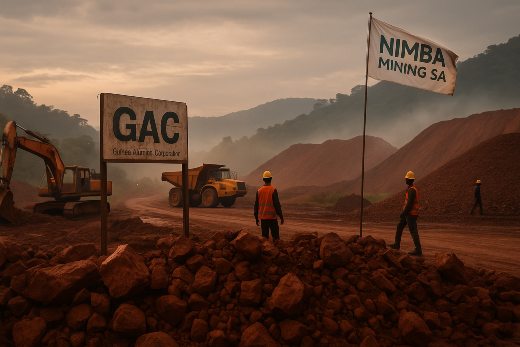

Guinea bauxite concession revoked — that was the unexpected headline from Conakry on Monday night as the government stripped Emirates Global Aluminium of its mining rights, transferring them to a new state-backed entity. The move marks a sharp pivot in Guinea’s resource strategy, signaling deeper state involvement in the mineral sector under its military-led administration.
“This is not just a resource seizure. It’s a recalibration of who gets to benefit from Guinea’s minerals,” said a mining analyst at the African Natural Resources Institute. “We’re seeing a hardening of positions across the Sahel — a post-colonial correction, if you will.”
UAE’s Loss, Guinea’s Gain
The concession, held by EGA’s Guinea Alumina Corporation (GAC), spans 690 square kilometers and contains approximately 400 million tonnes of bauxite. EGA launched operations in 2019 and exported 14 million tonnes of ore in 2022.
But in late 2023, Guinean authorities suspended the firm’s operations, citing violations of the mining code — particularly a failure to build local refining infrastructure. That suspension slashed exports to 10.8 million tonnes in 2024, according to EGA data.
The government has now handed the concession to Nimba Mining SA, a newly created company backed by the state. No operational plan or structure for Nimba has been disclosed.

Bauxite Exports from GAC (2022–2024)
| Year | Exports (million tonnes) |
|---|---|
| 2022 | 14.1 |
| 2023 | 12.7 (partial) |
| 2024 | 10.8 |
Regional Trends: Nationalism Rising
Guinea’s decision to revoke the concession is not an isolated move. Military-led regimes in Mali, Burkina Faso and Niger are similarly asserting control over natural resources — revising contracts, halting exports, or expelling foreign firms.
More Read
Fatoumata Diallo, a mining economist at the Centre d’Études Stratégiques in Dakar, said: “This is a message to all foreign miners. If you do not deliver beneficiation, if you treat African countries as export zones, you will face resistance — legal or otherwise.”
Investor Uncertainty Mounts
EGA and its parent firms in the UAE did not comment. The silence has only deepened investor anxiety. Without clarity on Guinea’s legal frameworks and how Nimba Mining will operate, analysts say more companies may delay capital commitments.
“This isn’t just a local dispute — it’s a signal to every foreign operator in the region,” said one mining executive. “The political calculus is changing fast.”
Strategic Minerals, Strategic Shifts
Guinea holds the world’s second-largest reserves of bauxite after Australia. As aluminium demand accelerates, any disruption to bauxite supply carries global consequences.
Whether Guinea can successfully transition from export dependence to domestic processing remains uncertain. But for now, Guinea bauxite concession revoked is more than a headline — it’s a harbinger of an era in which resource control may matter as much as resource abundance.