When Russia’s invasion of Ukraine erupted in 2022, the immediate global headlines were about energy shocks and food security. Less visible but equally disruptive has been the ripple effect on industrial explosives—specifically TNT—an essential input for America’s mining and construction supply chain. The United States has not manufactured trinitrotoluene domestically since the mid-1980s. Today, with imports cut off and military needs taking priority, U.S. quarries are grappling with a scarcity that could slow infrastructure projects from Virginia to California.

TNT: From Military Surplus to Industrial Mainstay
For decades, TNT underpinned both war efforts and civilian infrastructure. At its peak during World War II, U.S. production exceeded 100,000 tons per month, according to Defense Department records. Even as late as the 1970s, TNT sold for as little as 50 cents per pound, powering everything from artillery shells to rock blasting at construction sites.
But the chemical’s production leaves behind dinitrotoluene and other carcinogenic byproducts. By 1986, the Pentagon shuttered the last U.S. plant, citing environmental liabilities and regulatory costs under the Resource Conservation and Recovery Act (RCRA). Since then, commercial demand has been met through two channels: imported TNT, largely from Poland, and surplus U.S. munitions disassembled under Pentagon demilitarization programs.
That system worked—until war returned to Europe.

War Diverts Supplies to Ukraine
Poland had been the Pentagon’s sole authorized foreign supplier, but Eurostat data show its output has been almost entirely redirected to Ukraine’s defense industry since 2022. Russia and China, once significant exporters, have cut off Western markets altogether. Meanwhile, the U.S. Army has slowed the dismantling of obsolete munitions, preserving stockpiles for potential transfer to Kyiv rather than releasing TNT back into civilian supply.
More Read

“The world as we know it does not exist without industrial explosives,” said Clark Mica, president of the Institute of Makers of Explosives (IME). “Nine times out of ten, explosives are involved in some way for anything that is mined.”

Quarry Economics Under Pressure
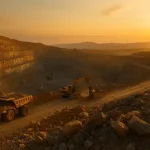
The immediate pinch is being felt in aggregates, which account for roughly 75% of all U.S. mining by tonnage (U.S. Geological Survey, 2024). Every blast in a granite or limestone quarry consumes tons of high-energy explosives. With TNT scarce, operators are forced to rely on more expensive blends of ANFO and emulsions.
At one Virginia granite site, blasting 100,000 tons of rock in a single shot now costs 25–30% more than it did before the war, according to quarry managers. Cement producers are equally exposed. Limestone and gypsum quarries underpin concrete and drywall production, both of which are critical to federally funded projects under the $1.2 trillion Infrastructure Investment and Jobs Act.
More Read

Metal mines and coal operations are better insulated because their blasting programs already rely on ANFO, which is less powerful but easier to source. Still, rising demand for substitutes is inflating costs across the explosives sector, eating into operating margins.
Infrastructure Delivery at Risk
The shortage arrives just as U.S. construction activity is accelerating. Federal Highway Administration data show $120 billion worth of projects are in the pipeline for 2025–2026, including bridges, roads, and renewable energy installations. Any bottleneck in aggregate supply risks delaying those projects and raising bid prices.
“Without reliable explosives, quarries can’t keep up with demand,” said one senior aggregates executive, speaking on condition of anonymity. “And if quarries fall behind, every bridge, road, and housing project in America feels it.”
No Near-Term Relief
Congress has allocated $435 million for a new Army-run TNT plant at the Blue Grass Army Depot in Kentucky, slated for completion in 2028. But Pentagon filings clarify that the facility will serve exclusively military requirements, with no commercial output earmarked for industry.
Private producers argue that commercial-grade TNT capacity must eventually return to U.S. soil, even if modern plants require cleaner processes and new EPA permitting regimes. Others see opportunity in research: safer substitutes such as ammonium nitrate–based emulsions, or experimental green explosives with reduced toxic byproducts.
Until then, America’s dependence on foreign explosives remains an overlooked vulnerability—one that links geopolitical conflict directly to the price of gravel under a highway or cement in a school building.
Skillings analysis
- Strategic blind spot: The TNT shortage highlights how mining supply chains are tied to defense policy. Few operators accounted for explosives as a geopolitical risk factor.
- Margin squeeze ahead: Higher blasting costs will erode profitability in aggregates and industrial minerals, sectors where margins are already thinner than in precious metals.
- Policy question: Without a commercial TNT revival, the U.S. risks undercutting its own infrastructure agenda—a contradiction that policymakers will eventually be forced to address.
Looking Forward
Industry executives do not expect significant relief before 2028. In the meantime, miners are lobbying for expedited permitting of substitute explosives and exploring joint procurement pools to stabilize costs. With demand for aggregates set to peak during the next two years of federal infrastructure spending, the sector’s resilience will depend on how quickly it can adapt to a world where TNT is no longer cheap, plentiful, or assured.
Editor’s note (Sept 4, 2025): We updated the lead image to reflect best-practice blasting stand-off and exclusion zones. Thanks to the Institute of Makers of Explosives (IME) for the safety reminder