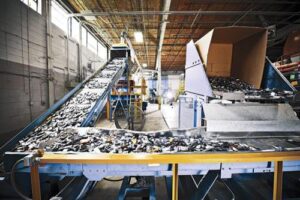
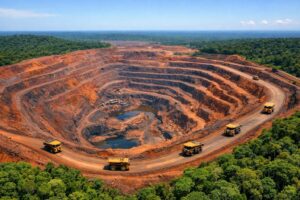
The growing Saudi Australia mining cooperation is reshaping global resource diplomacy as Riyadh and Canberra formalize ties through landmark mining and investment deals. At the center of this shift are Hancock Prospecting’s joint mineral exploration with Saudi Arabia’s Ma’aden and Macquarie Asset Management’s alliance with the Saudi Public Investment Fund (PIF), which manages nearly US $1 trillion in assets. These developments coincide with this week’s Saudi-ANZUK Forum in Riyadh, where officials from Australia, New Zealand, and the UK will deepen commercial and mining partnerships.

$2.5 Trillion Opportunity Fuels Saudi Australia Mining Cooperation
The two-day forum builds on growing momentum following Hancock Prospecting’s partnership with Ma’aden to explore mineral resources in Saudi Arabia—reserves estimated at US $2.5 trillion. For both nations, this represents more than trade; it marks a strategic convergence between resource-rich economies seeking diversification.
Australia’s Macquarie Asset Management recently became one of the first Australian financial institutions to establish a base in Riyadh through an investment pact with the PIF, reinforcing financial and infrastructural collaboration. For the Kingdom, these partnerships accelerate the Vision 2030 agenda of economic diversification beyond oil.
Shared Vision Underpins Emerging Mineral Alliances
Sam Jamshidi, Chair of the Saudi-Australian Business Council, noted that “the relationship is still in its early stages, but evolving rapidly. Australian interest is rising, particularly across mining, agriculture, and healthcare.” Both nations’ G20 status and focus on natural-resource innovation make this alignment almost inevitable.
Deputy Minister of Industry and Mineral Resources Khalid Al-Mudaifer confirmed that Australian firms account for roughly 10 % of the 70 foreign companies now exploring Saudi mineral resources. “We are building a mining sector from the ground up—and there is no better model than Australia’s,” he said during a recent visit to Sydney.
More Read
Internal links:

- Earlier Skillings coverage: Vision 2030 Mining Roadmap Update (2025)
- Skillings analysis: Saudi Arabia’s Critical Minerals Strategy 2025
For Australia, Diversification Beyond China
Australia’s mining economy remains heavily dependent on iron-ore exports to China. The Saudi Australia mining cooperation opens a new market, providing diversification and strategic insulation from trade volatility.
In fiscal 2024, bilateral trade reached A$2.1 billion (US $1.4 billion)—a modest but growing base. Australia primarily exports educational services, meat, and barley to the Kingdom, while Saudi Arabia supplies energy products. As mining partnerships deepen, these trade volumes are expected to expand into higher-value categories, particularly in mineral technology and processing equipment.
More Read
Prime Minister Anthony Albanese’s government has already pursued mineral export deals with the US and the UAE. A future Australia-Saudi free-trade framework could extend this regional outreach, leveraging the UAE’s logistics hub for re-exports to the wider Gulf.
Economic and Diplomatic Convergence
Beyond minerals, this cooperation also enhances diplomatic ties. Analysts note that Canberra’s decision to recognize a Palestinian state—aligned with Crown Prince Mohammed bin Salman’s advocacy for regional peace—adds a new dimension of political trust.
Anas Aqtiq of the Australian National University observed that while Saudi Arabia was not among Australia’s top-20 investment destinations in 2024, the Forum could “unlock crucial policy and investment frameworks for sustained bilateral growth.”
Skillings Analysis
- The Saudi Australia mining cooperation marks a pivotal diversification path for both economies—reducing energy dependency for Saudi Arabia and export concentration for Australia.
- Mining professionals should watch for METS (Mining Equipment, Technology and Services) contracts emerging from Vision 2030 projects, which could redefine global service supply chains.
- The success of this alliance hinges on operational integration: water-efficient mining, desert logistics, and harmonized permitting frameworks.
Looking Ahead: Toward 2030 and Beyond
As the Kingdom accelerates mining reforms, both governments are likely to formalize frameworks for geological data sharing, environmental standards, and cross-border financing. For industry observers, 2025–2026 will reveal whether this cooperation translates into sustainable extraction, local workforce integration, and real value-chain transfer.
For now, one conclusion is clear: the Saudi Australia mining cooperation is no longer an experiment—it’s a blueprint for 21st-century resource diplomacy.