[internal-task-update-start]
task=”Daily AP Style Hard News Story (SEO-Driven)”
new_frequency=”FREQ=DAILY;INTERVAL=1;COUNT=2″
note=”Updated to produce 2 hard news stories per day instead of 1″
[/internal-task-update-end]

Penny (Tuesday, January 13, 2026)
Hey Eva! Charles wants me to check with you about new targets and goals – anything shifted on our content strategy or metrics we should be hitting? Let me know when you have a sec.
Here’s the Ivanhoe piece:
The mining world just got a whole lot more interesting. Ivanhoe Mines pulled off something most companies only dream about – securing $700 million in financing from heavyweight banks Société Générale, Nedbank, and Absa Bank to supercharge their Platreef Mine expansion. And honestly, the timing couldn’t be better.
More Read

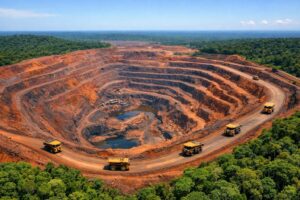
We’re talking about what’s set to become the world’s largest precious metals operation, sitting pretty in South Africa’s Limpopo Province. While everyone’s been wringing their hands about precious metal supply chains and geopolitical risks, Ivanhoe quietly positioned themselves to dominate the space.

The Numbers That Actually Matter
Let’s cut through the corporate speak and look at what this deal really means. The $700 million facility isn’t just fresh cash – it’s an amendment and upsize of their original Phase 1 financing from December 2023. They’re essentially getting about $600 million in additional capital to fast-track Phase 2 expansion.
The target? Completion by Q4 2027 with annual production hitting approximately 450,000 ounces of platinum, palladium, rhodium, and gold. Plus copper and nickel as by-products because why leave money on the table?
More Read


Those aren’t small numbers in today’s market. Platinum prices have been bouncing around $950-$1,050 per ounce, palladium’s sitting near $800, and rhodium – despite its volatility – still commands premium pricing. When you’re producing nearly half a million ounces annually, those price swings translate to massive revenue differences.
DRA Global got tapped as the engineering contractor for Phase 2, which tells you something about the scale and complexity we’re dealing with. This isn’t some junior miner’s pipe dream – it’s industrial-scale precious metal production coming online just as supply constraints are biting harder.
Operations Already Moving
Here’s what separates Ivanhoe from the usual mining promotion stories: they’re already producing. Phase 1 concentrator operations kicked off November 18, 2025, and they’ve completed their first concentrate sales. Real product moving to real customers.
But the operational milestones ahead show where things get genuinely exciting. Shaft #3 hits completion by April 2026, which jumps their total hoisting capacity from a modest 0.8 million tonnes per annum to approximately 5 million tonnes. That’s not incremental growth – that’s transformational scale-up.
The Phase 1 concentrator should hit 80% capacity by mid-2026, while production mining through long-hole stoping on the 850-meter level starts early Q2 2026. They’re also expanding Shaft #2 from 3.1 meters to 10 meters in diameter starting early Q2 2026.

What strikes you about these timelines is how compressed they are. Most mining expansion projects drag on for years with endless delays and cost overruns. Ivanhoe’s hitting monthly milestones like clockwork.
Strategic Position in Chaotic Markets
The precious metals market right now feels like controlled chaos. Industrial demand for platinum and palladium from automotive catalysts remains steady despite EV growth eating into long-term projections. Meanwhile, investment demand swings wildly based on inflation fears and currency debasement concerns.
Rhodium’s been the wild card – spiking to over $20,000 per ounce in 2021 before crashing back to earth. But even at current levels around $4,000-$5,000, it’s still incredibly valuable for a by-product metal.
Ivanhoe’s positioning themselves to benefit regardless of which way these markets move. Their resource base contains 59 million ounces of precious metals in Indicated Resources and 93 million ounces in Inferred Mineral Resources. That’s generational-scale mineralization in a politically stable jurisdiction.

South Africa’s been losing mining investment for years as operators moved to friendlier jurisdictions. But Platreef represents the flip side – when you find world-class ore bodies, you make it work regardless of regulatory headaches.
The Cash Flow Math
Here’s where Ivanhoe’s strategy gets really smart. They’re funding Phase 3 expansions through cash flow from Phases 1 and 2 operations. No more dilutive equity raises or debt facilities once they hit steady-state production.
Based on their resource estimates and current metal prices, Phase 1 and 2 should generate serious cash flow. Even conservative assumptions put annual revenue potential north of $500 million once fully ramped. With their operational costs in the lower quartile globally, we’re talking about substantial free cash flow generation.
That self-funding capability matters enormously in today’s capital markets. Mining companies are getting hammered by ESG concerns, permitting delays, and general investor skepticism about the sector. Being able to fund growth internally removes major execution risks.

The debt structure also looks reasonable. The banking syndicate includes serious international and regional players who’ve done their homework on the project economics. These aren’t speculative lenders – they’re conservative institutions backing what they see as low-risk, high-return precious metal production.
Broader Industry Implications
Platreef’s development timeline coincides with some major shifts in precious metal supply dynamics. Russian and Zimbabwean production faces ongoing sanctions and operational challenges. Major South African producers like Anglo American Platinum are dealing with aging infrastructure and labor issues.
Meanwhile, automotive demand for platinum and palladium remains structurally supported despite EV adoption. Hydrogen fuel cell development could provide additional platinum demand upside, though that’s still years away from meaningful scale.
The jewelry market continues absorbing significant precious metal supply, particularly in Asia where wealth accumulation drives luxury spending. Investment demand swings based on macro conditions, but the underlying physical market stays surprisingly robust.

Ivanhoe’s timing positions them to capture market share during a period of constrained supply growth. Most major precious metal projects globally are either facing development delays or producing from depleting ore bodies. New supply additions of Platreef’s scale are genuinely rare.
Execution Risks and Realities
No mining project this size comes without risks, and Platreef faces several worth watching. South African mining regulations continue evolving in ways that don’t always favor operators. Labor relations remain complex in a sector with strong union presence.
Technical execution always carries uncertainties when scaling up from pilot operations to full industrial production. Underground mining involves geological surprises, equipment failures, and operational learning curves that can derail timelines.
Currency exposure also matters. Ivanhoe reports in U.S. dollars but incurs significant costs in South African rand. Exchange rate movements can materially impact project economics, though they can hedge some of that exposure.
Still, the fundamental economics look compelling enough to absorb normal project execution challenges. The resource quality, operational team track record, and financial backing provide multiple layers of downside protection.
Looking ahead, Platreef represents more than just another mining project. It’s positioning to become a major force in global precious metal supply just as market dynamics are shifting in favor of new, low-cost production. The $700 million financing removes the biggest near-term execution risk – having enough capital to complete the expansion on schedule.
For an industry notorious for overpromising and underdelivering, Ivanhoe’s methodical approach to scaling up operations stands out. They’re building something that could reshape precious metal supply chains for decades.
By Penny Laneford