The mining industry stands on the precipice of its most consequential consolidation in over a decade. Rio Tinto and Glencore have returned to the negotiating table, reviving early-stage merger discussions that would forge a $260 billion behemoth: the world’s largest listed mining company by a considerable margin. Confirmed on January 8, 2026, after details leaked to the Financial Times, the talks have set a February 5, 2026, deadline for Rio Tinto to make a formal offer decision.

This isn’t just another corporate reshuffling. The proposed merger carries profound implications for global copper and lithium supply chains at a moment when electrification demands are colliding head-on with tightening ore grades and geopolitical friction.
The Copper Imperative Driving the Deal
Rio Tinto’s calculus here is straightforward: copper, copper, and more copper.
The proposed all-share acquisition would see Rio Tinto acquire “some or all” of Glencore, with the primary objective of doubling its copper production to approximately 1.7 million tons annually. That figure climbs to an estimated 2 million tons by 2030: a timeline that aligns uncomfortably well with projections of severe supply constraints.
The numbers paint an urgent picture. Industry forecasts indicate a 300,000 to 400,000 ton copper deficit in 2026, expanding to roughly 500,000 tons by 2027. Global copper production is expected to peak around 2030 at 33 million tons, precisely when demand from electric vehicles, grid infrastructure, and renewable energy installations will be accelerating.
More Read


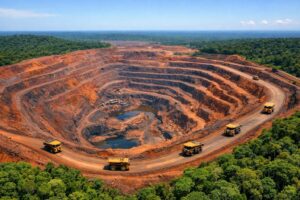
Glencore’s copper portfolio represents the crown jewel Rio Tinto is pursuing. Most notably, Glencore holds a 44% stake in Chile’s Collahuasi mine, one of the world’s premier copper operations. Beyond Collahuasi, Glencore brings projects that extend well beyond 2030 with lower capital intensity than greenfield developments: a crucial consideration given the current tight investment environment facing the sector.
For Rio Tinto, which has historically leaned heavily on iron ore from its Pilbara operations, this merger offers a faster path to copper exposure than organic development could ever provide.
More Read

What Glencore Gains: Scale and Institutional Appeal
The strategic rationale cuts both ways.
For Glencore, the merger creates a diversified mining giant with sufficient scale to attract major institutional investors who increasingly demand exposure to energy transition metals without the volatility of single-commodity plays. The combined entity would rank in the top five globally for iron ore, copper, coal, aluminum, lithium, and nickel production: a portfolio breadth that no current competitor can match.
Glencore’s sprawling operations span over 30 countries, handling or marketing more than 60 commodities. That trading expertise, combined with Rio Tinto’s operational discipline and lower-cost asset base, could theoretically create substantial synergies. Assets currently under discussion include Rio Tinto’s Simandou iron ore project in Guinea and the Oyu Tolgoi copper operation in Mongolia, both of which represent multi-generational resource bases.
The logic, at least on paper, is compelling. Whether execution can match ambition remains the open question.
The Coal Problem Nobody Wants to Discuss
Here’s where things get complicated.
Glencore operates substantial thermal coal assets across New South Wales, Queensland, central Africa, and Latin America. These operations would comprise approximately 8% of the combined group’s EBITDA: not an insignificant slice, and certainly enough to trigger ESG concerns among institutional shareholders who have spent years divesting from thermal coal exposure.

Analysts have floated potential solutions. One scenario involves Glencore executing a pre-deal coal spin-off, cleaning up the portfolio before the merger closes. Another approach would carve out the coal assets into a separately listed Australian vehicle, allowing ESG-sensitive investors to maintain exposure to the combined copper and iron ore operations without the coal baggage.
Neither solution is clean. Spin-offs take time, create tax complications, and require finding buyers or public market appetite for coal assets in an environment where many funds simply cannot touch them. The February 5 deadline doesn’t leave much runway for elegant restructuring.
Rio Tinto, for its part, has spent years positioning itself as a cleaner mining major, having exited coal entirely. Absorbing Glencore’s coal operations would represent a significant strategic reversal, one that management will need to address head-on if the deal advances.
Australian Shareholders Are Skeptical: and They Have Reasons
Market reception has been decidedly mixed, and the skepticism is concentrated precisely where it matters most.
Rio Tinto shares declined 8% following the merger announcement, with Australian investors leading the selling pressure. The concerns are multifaceted. Opposition to inheriting Glencore’s coal holdings ranks high, but deeper questions are circulating about whether Rio Tinto genuinely needs this acquisition at all.
After all, Rio Tinto has recently executed a $5 to $10 billion divestment program and achieved $650 million in annual cost savings. The balance sheet is strong. The dividend is healthy. Why pursue a complex, politically sensitive megamerger when organic growth and selective bolt-on acquisitions could achieve similar copper exposure over time?
Rio Tinto’s dual-listed structure adds another layer of complexity. The company trades separately in London and Sydney, with the London-listed Plc historically trading at a discount to the Australian-listed Ltd. Any all-share merger creates potential implied dilution concerns for Australian shareholders, who may find themselves receiving shares valued differently depending on which exchange they reference.
These aren’t trivial concerns. Australian retail and institutional investors hold substantial Rio Tinto positions, and their approval will be essential for any deal to proceed.
Beijing’s Long Shadow Over the Negotiations
No discussion of a mining merger at this scale can ignore China.
Chinese regulatory scrutiny represents perhaps the most significant hurdle facing the proposed combination. Past large-scale mining mergers, including Glencore’s 2013 acquisition of Xstrata, faced extensive Chinese regulatory examination focused on potential market dominance in critical commodities.
A combined Rio Tinto-Glencore would hold commanding positions in both copper and iron ore: two commodities absolutely essential to Chinese industrial activity. Beijing’s antitrust authorities will scrutinize whether the merged entity could exercise undue pricing power or supply control over materials that China cannot source domestically at scale.

Interestingly, Chinalco: which holds a 14.5% stake in Rio Tinto dating back to a 2008 investment: has reportedly favored the deal according to multiple reports. Whether that support translates into smoother regulatory passage remains uncertain. Chinese approval processes for mining sector consolidation have historically been unpredictable, with outcomes often influenced by factors extending well beyond pure competition law analysis.
The geopolitical dimension cannot be overstated. At a moment when Western governments are actively pursuing critical mineral supply chain diversification away from Chinese processing dominance, a merger that further concentrates copper and iron ore production under a single corporate umbrella will attract scrutiny from multiple directions.
What This Means for Global Supply Chains
If the merger proceeds, the implications for copper and lithium supply chains extend far beyond corporate balance sheets.
A combined Rio Tinto-Glencore would control a significant percentage of global copper production at precisely the moment when supply constraints are tightening. Electric vehicle manufacturers, grid operators, and renewable energy developers would find themselves negotiating with a more concentrated supplier base: a dynamic that could influence pricing, offtake agreements, and strategic inventory decisions across multiple industries.
For lithium, where both companies have exposure through existing and developing projects, consolidation could accelerate development timelines by eliminating duplicative capital expenditures and streamlining permitting processes. Alternatively, it could reduce competitive pressure to bring new supply online quickly.
The February 5 deadline looms. Whether Rio Tinto advances a formal offer or walks away, the mere existence of these negotiations signals that the mining industry’s consolidation wave is far from finished. Copper scarcity, energy transition demand, and geopolitical fragmentation are reshaping the strategic calculus for every major producer.
The $260 billion question remains unanswered: for now.
Stay current with mining industry developments at Skillings Mining Review.