The mining investment landscape has shifted dramatically over the past 18 months, and if you’re still chasing the same plays from 2024, you’re probably leaving money on the table. Critical minerals now dominate boardroom conversations from Toronto to Perth, junior mining companies are suddenly getting serious attention from institutional money, and gold, well, gold just keeps breaking records like it’s got something to prove.

Here’s what’s actually moving the needle right now, and where the smart money is positioning itself heading deeper into 2026.
The Critical Minerals Rush Is Real This Time
We’ve heard the “critical minerals supercycle” story before. But this time, there’s actual infrastructure being built, actual policy getting enacted, and actual supply chain anxiety keeping procurement officers up at night.
The White House’s critical minerals blitz kicked off serious negotiations on strategic supply deals, and the ripple effects are showing up in stock prices and project timelines across North America. When governments start throwing around terms like “national security” and “supply chain resilience,” capital tends to follow.
Rare earths, lithium, and copper aren’t just buzzwords anymore: they’re the backbone of everything from EV batteries to defense systems to the data centers powering AI infrastructure. The companies positioned to extract, process, or refine these materials are sitting on what amounts to 21st-century oil wells.
More Read



1. Ucore Rare Metals: The Downstream Play
Ucore Rare Metals earned the top spot on the 2026 OTCQX Best 50 list, and it’s not hard to see why. While most rare earth companies are still trying to figure out how to get stuff out of the ground, Ucore is focused on the downstream separation and refining infrastructure, basically, the bottleneck everyone else is stuck behind.
Heavy rare earths used in permanent magnets for defense applications, clean energy systems, and advanced manufacturing represent a market that’s growing faster than supply can keep up. Ucore isn’t competing with Chinese miners on extraction; they’re building the processing capacity that Western supply chains desperately need.
More Read
That’s a differentiated thesis in a crowded space, and the market is rewarding it accordingly.
2. Discovery Silver: The Canadian Gold Pivot
Discovery Silver pulled off one of the more interesting strategic moves of early 2025, dropping US$425 million to acquire Newmont’s Porcupine operation in Ontario. That transaction repositioned the company from a silver-focused explorer to a legitimate Canada-based gold producer with real cash flow.
The timing couldn’t be better. Gold prices continue setting records amid geopolitical uncertainty, and Canadian jurisdiction provides the kind of regulatory stability that institutional investors increasingly demand. Discovery’s pivot reflects a broader trend: junior mining companies are maturing faster, making acquisitions that would have been impossible five years ago, and building out diversified portfolios rather than betting everything on a single deposit.
For investors looking at mining investment opportunities with near-term production visibility, Discovery deserves attention.

3. Rio2: Chile’s Newest Gold Producer
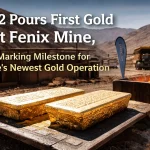
Rio2 just poured first gold at its Fenix project in Chile, and the company closed its US$241 million acquisition of the Condestable mine in Peru back in December. That’s a lot of moving pieces coming together simultaneously, and it positions Rio2 as one of the more compelling mid-tier gold stories heading into 2026.
The Fenix project has been a long time coming: permitting in Chile isn’t exactly fast: but production is now underway and ramping. Combined with the Condestable acquisition, Rio2 now has geographic diversification across two of South America’s most important mining jurisdictions.
Fifth-place ranking on the OTCQX Best 50 suggests the market is starting to recognize what’s being built here.
4. Andean Precious Metals: Financial Flexibility Matters
Andean Precious Metals secured a US$40 million revolving credit facility with National Bank of Canada back in November 2025, and while that might sound like routine corporate finance news, it actually signals something important about where the company sits competitively.
Access to capital at reasonable rates remains a challenge for junior mining companies, particularly those operating in emerging market jurisdictions. When a major Canadian bank extends that kind of facility, it suggests confidence in both the asset quality and the management team’s ability to execute.
Fourth-place ranking on the 2026 list reflects strong operational performance, but the real story is financial positioning. In a market where capital costs can make or break a project, Andean’s balance sheet flexibility gives them options that competitors don’t have.

5. Lundin Gold: High-Grade Excellence
Lundin Gold operates Fruta del Norte in Southeast Ecuador: one of the highest-grade gold operations on the planet: and the numbers speak for themselves: 775% dividend-adjusted share price appreciation over three years.
That’s not a typo. Seven hundred seventy-five percent.
Ecuador isn’t the easiest place to operate, but Lundin has navigated the jurisdictional challenges effectively while maintaining exceptional grade and cost metrics. When you’re mining ore that’s significantly richer than global averages, there’s margin to absorb unexpected challenges.
For investors who want exposure to gold but are tired of watching capital disappear into low-grade bulk mining operations, Lundin represents what best-in-class actually looks like.
The Broader Thesis: Why Critical Minerals and Junior Mining Companies
Beyond these five specific opportunities, there’s a macro setup that’s worth understanding.
Global supply chains continue rewiring around geopolitical realities. The days of optimizing purely for cost are over: resilience, security, and jurisdictional diversification now factor into procurement decisions that were purely economic five years ago. That benefits Western-listed mining companies with assets in stable jurisdictions.
Gold prices remain elevated because nothing fundamental has changed about the uncertainty driving them. Central bank buying continues, inflation expectations remain unstable, and geopolitical tensions show no signs of resolving. The yellow metal isn’t going anywhere.
Meanwhile, junior mining companies that survived the post-2021 funding drought have emerged leaner and more focused. The tourism exploration projects got starved out. What’s left are companies with actual deposits, actual management teams, and actual paths to production.
Some US metals and mining stocks appear undervalued by 16% to 37% based on fair value estimates, according to recent analyst research. That gap doesn’t stay open forever.
Where to Go From Here
Mining investment opportunities in 2026 require a different lens than what worked in previous cycles. Critical minerals exposure isn’t optional anymore: it’s table stakes for any diversified resource portfolio. Gold remains the anchor, but the highest-return plays are increasingly in companies solving bottleneck problems rather than just digging holes.
The five companies highlighted here represent different angles on the same fundamental thesis: Western supply chains need more mining capacity, and the companies building it will be rewarded accordingly.
Do your own due diligence, obviously. Mining stocks can move violently in both directions, and jurisdictional risk never fully disappears. But for investors willing to look beyond the mega-caps, the opportunity set in junior and mid-tier mining companies hasn’t been this compelling in years.
Stay tuned to Skillings Mining Review for ongoing coverage of these stories and more mining news from around the globe.
By Charles Pitts and Mo Shine