Here’s something most people don’t know: the United States imports 100% of its fluorspar. Every single pound. That’s despite the fact that fluorspar is essential for steel production, aluminum smelting, hydrofluoric acid manufacturing, and the refrigerants that keep data centers from melting down.

The Pentagon noticed.
Ares Strategic Mining just restarted the Lost Sheep Mine in Utah’s Spor Mountain region with more than $10 million in Defense Production Act Title III funding. It’s the only permitted fluorspar mine in the United States. Not one of several. The only one.
That’s not a rounding error. That’s a strategic vulnerability the Department of Defense is scrambling to fix.
What Makes Fluorspar Critical (And Why We Don’t Have Any)
Fluorspar, or calcium fluoride (CaF₂), sounds niche until you realize it’s the feedstock for hydrofluoric acid: which is used to refine uranium, etch semiconductors, and produce the fluoropolymers that coat everything from fighter jet fuel lines to lithium-ion battery separators.
More Read



The industrial breakdown looks like this:
- Hydrofluoric acid production: 55-60% of demand
- Steel and aluminum flux: 15-20%
- Fluoropolymers and refrigerants: 20-25%
- Glass, enamels, ceramics: remainder
Steel mills use fluorspar as a flux to remove impurities during smelting. Aluminum refineries need it to reduce the melting point of alumina. Chemical plants convert it into hydrofluoric acid, which then becomes the precursor for Teflon, refrigerants like R-134a, and specialized aerospace alloys.
More Read

Here’s the uncomfortable part: the global fluorspar market is projected to grow from $2.96 billion in 2024 to $3.93 billion by 2033, driven largely by the energy transition. Electric vehicles need more aluminum. Solar panels require hydrofluoric acid for etching. Data centers demand fluoropolymer-insulated wiring and precision cooling systems.
And the U.S. has been importing all of it: primarily from Mexico, Vietnam, South Africa, and Mongolia.
The government designated fluorspar a Critical Mineral in 2018. Eight years later, domestic production is still zero.
Until now.
The Lost Sheep Restart: Infrastructure Complete, Production Imminent
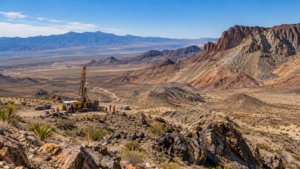
Ares Strategic Mining controls 5,982 acres across 353 mining claims in Utah’s Spor Mountain district. The company holds full permits from the Bureau of Land Management and has already completed the underground mine ramp, tunnel system, ventilation infrastructure, and MSHA-compliant safety systems.
Translation: this isn’t an exploration-stage fantasy. The mine is built. The underground infrastructure is operational. The company is stockpiling high-grade fluorspar and preparing to ship commercial volumes.

CEO James Walker confirmed the completion of the secondary ventilation system: a critical MSHA requirement: which means continuous mining operations can begin immediately. The metallurgical and flotation plants are being finalized to produce two commercial grades:
- Metallurgical grade (metspar): 60-96% CaF₂ for steel and aluminum
- Acid grade (acidspar): +97% CaF₂ for hydrofluoric acid production
The “lump” fluorspar from Lost Sheep is particularly valuable. Unlike finely ground concentrates that require flotation processing, lump ore can be sold directly to steelmakers and foundries as a flux material. It’s higher margin, lower processing cost, and commands a premium in domestic markets where transportation logistics favor local supply.
That competitive edge matters when you’re trying to displace entrenched Mexican and Vietnamese imports that have dominated U.S. supply chains for decades.
The Pentagon’s DPA Title III Calculus
Defense Production Act Title III funding isn’t charity. It’s a national security hedge.
The program provides grants, loans, and purchase commitments to expand domestic production of materials the Pentagon considers strategically critical. Fluorspar qualifies because it’s essential for uranium enrichment, aerospace-grade aluminum alloys, and the fluoroelastomers used in military aircraft and missile systems.

The $11 million in total funding Ares has secured: including Pentagon backing and State of Utah support: reflects a simple strategic calculation: 100% import reliance is unacceptable when your primary suppliers include countries with unstable trade relationships or potential supply disruptions.
Mexico supplies roughly 50% of U.S. fluorspar imports. What happens if cross-border logistics break down or Mexico decides to prioritize domestic processing capacity? Vietnam and Mongolia are even further away, with longer supply chains and more geopolitical risk.
The Pentagon’s bet on Lost Sheep is a recognition that domestic primary production: even at higher cost: is preferable to zero optionality during a crisis.
And it’s not just military demand. The White House’s Critical Minerals Strategy, launched under Commerce Secretary Howard Lutnick’s coordination, has identified fluorspar as a bottleneck for the energy transition. Electric vehicle production requires more aluminum and specialized fluoropolymer coatings. Solar panel manufacturing depends on hydrofluoric acid for silicon wafer etching.
You can’t electrify the economy without securing fluorspar supply. Ares just became the only company in America positioned to deliver it domestically.
What Happens When Supply Chains Tighten
Global fluorspar production is concentrated in a handful of countries. China produces about 3 million metric tons annually: roughly 60% of global supply: but reserves most of it for domestic use. Mexico, Mongolia, South Africa, and Vietnam fill the export gap.
The problem is demand growth. Aluminum production is accelerating to meet EV and packaging requirements. Semiconductor fabs are expanding capacity, which increases hydrofluoric acid consumption. Refrigerant demand for data center cooling is climbing as AI infrastructure scales.

Meanwhile, fluorspar mine development has stalled. Environmental permitting in developed countries is lengthy. China has restricted exports of certain grades to prioritize domestic downstream processing. The average lead time to bring a new fluorspar mine online is 7-10 years.
Lost Sheep bypasses that timeline. The mine is already permitted, built, and ready to produce. Ares estimates it can begin commercial shipments within months: not years.
That speed matters when the alternative is waiting for new projects in jurisdictions with uncertain permitting timelines or betting on continued access to foreign supply chains that could tighten without warning.
The U.S. imported approximately 580,000 metric tons of fluorspar in 2024. Lost Sheep’s initial production capacity won’t replace that entirely, but it establishes a domestic baseline and proves the viability of U.S. fluorspar mining for the first time in decades.
The Broader Critical Minerals Picture
Fluorspar is just one piece of a larger puzzle. The USGS 2026 Mineral Commodities Summary shows the U.S. is now 100% import-reliant for 16 critical minerals and over 50% reliant for 54 commodities. Fluorspar sits alongside graphite, manganese, and rare earths on the list of materials where domestic production is either nonexistent or negligible.
The Lost Sheep restart is significant because it demonstrates that reshoring critical mineral supply chains is possible: but only with explicit government backing, patient capital, and projects that are already permitted.

The mining industry likes to talk about “innovation and disruption,” but the hard reality is that mineral development timelines are measured in decades, not quarters. Ares didn’t discover Lost Sheep last year. The deposit has been known since the 1950s. What changed was the policy environment, the availability of DPA funding, and the Pentagon’s willingness to backstop domestic production.
This isn’t a story about a junior miner striking it rich. It’s a story about the U.S. government finally acknowledging that strategic self-sufficiency requires putting money: and political will: behind unglamorous but essential supply chains.
What Comes Next
Ares expects to begin fluorspar stockpiling in the near term and ship first commercial tonnes shortly after. The company is negotiating offtake agreements with domestic steel mills, aluminum smelters, and chemical producers who are eager to secure U.S.-sourced material.
The strategic calculus is straightforward: diversify away from import dependence, lock in domestic supply, and de-risk operations against future trade disruptions.
For investors, the Lost Sheep restart is a proof point that critical minerals reshoring is moving from policy rhetoric to operational reality. For operators in steel, aluminum, and chemical industries, it’s the first credible alternative to imported fluorspar in more than a generation.
For the Pentagon, it’s one less vulnerability on the critical minerals checklist.
The uncomfortable truth is that the U.S. has been flying blind on fluorspar for decades, relying entirely on foreign supply chains while domestic deposits sat undeveloped. That era is ending: not because of market forces alone, but because the government decided 100% import reliance was no longer acceptable.
Lost Sheep is open. The infrastructure is ready. The only question now is how fast Ares can scale production to meet demand that’s been waiting for a domestic source since the last U.S. fluorspar mine closed.
The clock is already ticking.