VANCOUVER, B.C. : Eldorado Gold Corporation announced on Feb. 1, 2026, it will acquire Foran Mining Corporation in a C$3.8 billion share-and-cash transaction, creating a copper-gold producer positioned to capitalize on tightening copper markets and accelerating production timelines.

The deal, expected to close in the second quarter of 2026, marks one of the largest mining M&A transactions in Canadian history and underscores the industry’s scramble to secure copper assets amid a structural supply deficit projected to exceed 800,000 tonnes by 2027.
Deal Structure and Shareholder Implications
Under the agreement, Foran shareholders will receive 0.1128 Eldorado common shares plus $0.01 in cash for each Foran share. Following completion, existing Eldorado shareholders will own approximately 76% of the combined company, while Foran shareholders will hold the remaining 24%.
The transaction requires approval from two-thirds of Foran securityholders, a majority of Eldorado shareholders, court approval under British Columbia’s corporate statute, and regulatory clearances from the Toronto Stock Exchange, New York Stock Exchange, and Canada’s Competition Bureau.
Meeting materials are expected to be mailed by mid-March 2026. Special shareholder meetings for both companies are scheduled for on or before April 14, 2026. Upon completion, Foran shares will be delisted from the TSX and OTCQX.
More Read

Strategic Rationale: McIlvenna Bay and Dual Production Growth
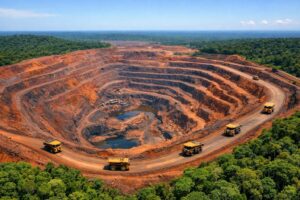
The acquisition centers on Foran’s McIlvenna Bay project in Saskatchewan, a fully financed copper-zinc-gold-silver development asset scheduled to begin commercial production in mid-2026. The timing aligns with Eldorado’s own Skouries copper-gold project in Greece, which is also targeting mid-2026 production startup.


McIlvenna Bay represents a strategic foothold in one of Canada’s most prolific mining districts. The project’s maiden mineral reserve estimate, announced in September 2024, contains proven and probable reserves of 19.8 million tonnes at grades of 1.04% copper equivalent, supporting a 12-year mine life with potential for expansion through ongoing exploration.
More Read
The deposit’s polymetallic nature provides built-in commodity diversification. Initial production plans target 60 million pounds of copper, 48 million pounds of zinc, 37,000 ounces of gold, and 1.5 million ounces of silver annually during the first five years of operation.
Eldorado President and CEO George Burns stated in a release that the transaction “creates a diversified, multi-asset precious and base metals producer with near-term production growth from two fully financed development projects.”
Production and Financial Projections
The combined company is expected to produce approximately 900,000 gold equivalent ounces in 2027, a significant increase from Eldorado’s standalone production guidance. Financial projections for 2027 include approximately $2.1 billion in EBITDA and $1.5 billion in free cash flow, assuming current commodity prices.
Those numbers carry substantial execution risk. Both Skouries and McIlvenna Bay face the challenge of ramping to commercial production simultaneously in a capital-constrained environment. Construction inflation in the mining sector has averaged 12-15% annually since 2023, pressuring project economics and timelines.
Eldorado’s existing operations include the Lamaque gold mine in Quebec, the Kisladag and Efemcukuru gold mines in Turkey, and the Olympias gold mine in Greece. The addition of McIlvenna Bay shifts the company’s revenue mix toward copper, a strategic pivot aligned with the electrification mega-trend driving copper price forecasts above $5.00 per pound for the 2026-2028 period.
Industry Context: The M&A Wave and Copper Deficit
The Eldorado-Foran transaction joins a surge of mining M&A activity in early 2026. Major deals announced in January and February include Newmont’s $4.2 billion acquisition of Osisko Mining, BHP’s hostile approach to Anglo American, and Teck Resources’ pending merger with Anglo American in a $53 billion tie-up.
The common thread: copper. Every major transaction announced in 2026 either directly adds copper production or positions the acquirer to develop copper projects more efficiently through portfolio optimization.

The strategic logic is straightforward. Global copper demand is projected to grow from approximately 29 million tonnes in 2025 to 31.5 million tonnes by 2028, driven by electric vehicle manufacturing, grid infrastructure upgrades, and data center expansion. Supply, however, is growing far more slowly.
Industry analysts forecast a refined copper deficit of approximately 475 kilotons in 2026, widening to 800 kilotons by 2027 if no new projects come online ahead of schedule. That supply-demand imbalance is already reflected in copper prices, which have held above $4.50 per pound since November 2025 despite broader economic uncertainty.
For Eldorado, the Foran acquisition represents a calculated bet that copper prices will remain structurally elevated through the end of the decade. McIlvenna Bay’s copper production profile: concentrated in the first five years of mine life: positions the combined company to capture maximum revenue during the peak of the projected deficit.
Financing and Capital Allocation
Mining finance markets have tightened considerably since 2024, making the structure of the Eldorado-Foran deal noteworthy. The predominantly share-based transaction preserves Eldorado’s balance sheet flexibility while offering Foran shareholders exposure to a larger, more diversified producer.
Eldorado reported $412 million in cash and cash equivalents as of Sept. 30, 2025. The company also maintains a $600 million revolving credit facility, providing adequate liquidity to fund Skouries construction completion while integrating McIlvenna Bay operations.
Both projects are fully financed. Skouries secured a $775 million project financing package in 2024, while Foran arranged a $315 million credit facility in early 2025 to fund McIlvenna Bay construction. Those non-recourse debt structures isolate project-level risk from corporate balance sheets.
The combined company’s projected 2027 free cash flow of $1.5 billion would support aggressive debt reduction, exploration funding, or shareholder returns through dividends or buybacks. Management has not yet disclosed capital allocation priorities post-merger.
Regulatory and Execution Risks
The transaction faces standard regulatory hurdles but no obvious impediments. Canada’s Competition Bureau typically reviews mining transactions involving domestic assets, though horizontal overlap between Eldorado and Foran is minimal. Both companies operate in different provinces with distinct geological settings.
Shareholder approval carries greater uncertainty. Some Eldorado investors may resist dilution from the share-based structure, particularly if copper prices weaken before the April vote. Foran shareholders, conversely, must weigh the certainty of the Eldorado offer against the potential for McIlvenna Bay to achieve higher valuations as an independent producer.
Operational execution represents the most significant long-term risk. Bringing two greenfield projects into production simultaneously stretches management bandwidth and technical resources. Labor shortages in skilled trades: welders, electricians, heavy equipment operators: have plagued Canadian mining projects since 2023, driving wage inflation and extending construction timelines.
Permitting delays pose additional risk, though both Skouries and McIlvenna Bay hold all major environmental approvals. Community engagement and Indigenous consultation remain ongoing for both projects, with potential for work stoppages if stakeholder concerns escalate.
Market Implications
The Eldorado-Foran transaction signals continued consolidation in the mid-tier copper-gold space. Companies with advanced-stage development projects in stable jurisdictions are attracting premium valuations as majors seek to replenish depleting reserves and hedge against copper price volatility.
Foran’s implied valuation in the transaction: approximately C$3.8 billion for a pre-production asset: suggests acquirers are willing to pay significant premiums to avoid greenfield exploration risk and accelerate production timelines.
For Eldorado shareholders, the strategic pivot toward copper exposure aligns with institutional investor preferences. Gold producers with meaningful base metals revenue streams have outperformed pure-play gold miners by an average of 18% since January 2025, according to S&P Global Market Intelligence data.
The deal also highlights Saskatchewan’s emergence as a premier mining jurisdiction. The province’s pro-development regulatory framework, established mining infrastructure, and access to hydroelectric power provide competitive advantages that offset Canada’s higher operating costs relative to jurisdictions like Chile or Peru.
Timeline and Next Steps
Eldorado and Foran expect to mail proxy materials to shareholders by mid-March 2026. The special meetings will occur by April 14, 2026, with closing anticipated shortly thereafter pending regulatory approvals.
Integration planning is already underway. Eldorado has established a transition team to coordinate operational handoffs and align corporate functions. Key priorities include harmonizing exploration strategies across both companies’ land packages, optimizing supply chain logistics, and integrating McIlvenna Bay into Eldorado’s portfolio management framework.
Market participants will watch copper prices closely in the coming months. The transaction’s economic viability depends heavily on sustained copper prices above $4.00 per pound. A material price decline could pressure Eldorado’s stock price and complicate shareholder approval.
The mining industry’s M&A wave shows no signs of abating. With approximately $47 billion in transactions announced in the first six weeks of 2026, the sector is on pace to exceed $300 billion in annual deal volume: surpassing the previous record set in 2021.
For Eldorado and Foran, the immediate focus is execution. Securing shareholder and regulatory approvals by mid-2026 will allow management to shift attention to the more difficult task: delivering two world-class mines into production on schedule and budget in an increasingly complex operating environment.