Nobody wants to admit it, but Western defense supply chains have a China problem. And it’s not the one most politicians are talking about.

While headlines focus on semiconductors and rare earths, antimony has quietly become the critical material keeping procurement officers awake at night. Beijing’s export controls, implemented in September 2024, didn’t just disrupt supply chains. They exposed just how dependent North American defense and high-tech industries had become on a single authoritarian supplier.
Which makes Antimony Resources’ discovery at Bald Hill, New Brunswick, suddenly very interesting to people who rarely think about mineral exploration.
The Antimony Stranglehold
China controls roughly 60% of global antimony production. More importantly, they control the processing capacity that turns raw ore into usable material. When those export restrictions hit last fall, spot prices jumped. But price isn’t the real problem.
The real problem is certainty of supply.
More Read

Antimony isn’t a commodity you can substitute easily. It’s essential for flame retardants in military vehicles and aircraft. It hardens lead in ammunition and batteries. It’s used in infrared sensors, night vision equipment, and precision optics. Defense contractors can’t simply swap it out for something cheaper or more available.


And when your primary supplier decides to use that dependency as geopolitical leverage, suddenly domestic sources stop being a nice-to-have. They become a strategic imperative.
More Read

The Pentagon knows this. Canadian defense planners know this. Which is why a high-grade antimony deposit in politically stable New Brunswick is getting the kind of attention typically reserved for copper or lithium projects.
Bald Hill: The Numbers That Matter
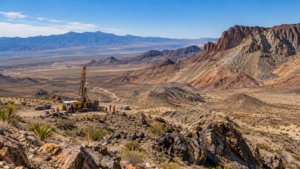
Antimony Resources isn’t chasing a speculative play. They’re advancing a well-documented, high-grade deposit that’s been drilled and outlined over 700 meters of strike length.
The mineralization averages 3 to 4 meters wide. Grades run 3% to 4% antimony. That’s not marginal material. For context, anything above 1% antimony is generally considered economic under normal market conditions. At current strategic imperatives and pricing, these grades are exceptional.
A 2025 technical report identified target potential of approximately 2.7 million tonnes grading between 3% and 4% antimony. Do the math: that’s roughly 80,000 to 108,000 tonnes of contained antimony. Not world-class by historical standards, but significant when you consider the current supply situation and proximity to end users.
And the deposit is still open.
Marcus West: The 2026 Expansion
Early 2026 brought a development that changed the project’s geometry. The Marcus West Zone, discovered through surface trenching, exposed massive stibnite mineralization over 25 meters of continuous bedrock exposure.
Stibnite is the mineral form of antimony sulfide. When you see “massive stibnite,” that means high-grade, concentrated ore. Not disseminated traces requiring complex metallurgy. This is the stuff that makes mining engineers smile.

What makes Marcus West particularly interesting: it appears separate from but parallel to the main mineralization zone. That suggests potential for multiple ore bodies within the same structural corridor. If drilling confirms that geometry, the resource base expands significantly.
Which brings us to the 2026 exploration program.
The 10,000-Meter Program
Antimony Resources is executing a methodical, two-phase approach this year.
Phase one: 10,000 meters of definition drilling on the Main Zone. This isn’t exploration drilling hoping to hit something. This is infill work to upgrade confidence in the existing resource estimate and provide the data needed for economic studies. It’s the unsexy work that precedes development decisions.
Phase two: up to six shallow holes at Marcus West, testing mineralization at 30 to 50 meters depth. These holes serve two purposes. First, they confirm whether surface showings extend to depth with similar grades. Second, they determine whether Marcus West represents a distinct ore body or a splay off the main structure.
The shallow drilling depth is telling. Management isn’t betting the farm on blue-sky targets. They’re testing obvious extensions of known mineralization at depths amenable to low-cost extraction methods. That’s a risk-appropriate strategy for a junior advancing a strategic asset.
Results from this program will likely flow through Q2 and Q3 2026. If Marcus West confirms as a separate, parallel zone with similar grades to the Main Zone, the project’s scale and economics improve materially.
The Strategic Calculus
The context here isn’t subtle. North America needs antimony sources outside Chinese control. Period.
Canada has advantages: political stability, established mining infrastructure, proximity to US defense manufacturers, and regulatory frameworks that, while not always fast, are at least predictable. New Brunswick specifically has a history of base metal mining and existing logistics infrastructure.

The strategic premium on domestic supply chains has already manifested in government policy. The US Department of Defense has used Defense Production Act authorities to support domestic critical mineral projects. Canada has designated antimony as a critical mineral under its 2021 Critical Minerals Strategy.
What that means practically: projects like Bald Hill become eligible for various forms of government support, from exploration grants to offtake agreements to infrastructure assistance. The economics of antimony mining in North America look very different in 2026 than they did in 2020.
And those economics continue evolving in favor of domestic producers as long as geopolitical tensions with China persist. Which they will.
The Uncomfortable Timeline Question
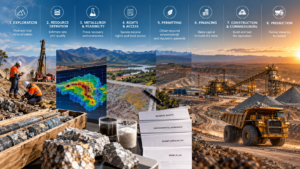
Development timelines in mining are measured in years, not months. Even assuming Bald Hill’s exploration program delivers strong results through 2026, you’re still looking at preliminary economic assessments, feasibility studies, permitting, financing, and construction before a single tonne of ore gets processed.
Optimistically, that’s a five-year timeline to production. More realistically, seven to eight years.
Meanwhile, defense contractors need antimony now. Not in 2033.
That gap creates an awkward strategic problem. The very export controls that make domestic antimony sources strategically valuable also mean potential supply shortages in the interim. You can’t fast-forward geology or permitting processes, no matter how critical the material.
The practical solution probably involves a combination of strategic stockpiling, aggressive pursuit of interim supply agreements with non-Chinese sources like Russia (complicated) or Bolivia, and acceptance of higher prices and supply uncertainty until domestic capacity comes online.
None of those options are satisfying. All of them are necessary.
What Matters Now
For Antimony Resources, the path forward is straightforward: deliver drilling results that confirm and expand the resource base, advance technical studies that demonstrate economic viability, and position the project for development partnerships or government support.
For defense supply chain planners, Bald Hill represents one data point in a broader portfolio approach to antimony security. The project’s success matters, but it’s not sufficient on its own to solve North America’s antimony dependency.

For investors evaluating the antimony space, the question isn’t whether demand exists. It clearly does. The question is whether specific projects can navigate the technical, regulatory, and financial challenges to actually deliver production within a timeframe that captures the strategic premium currently being priced into the market.
Bald Hill has genuine technical merit: high grades, favorable geology, strategic location. The 2026 drilling program will determine whether that merit extends to the scale needed for standalone development or partnership with a larger producer.
The broader narrative, though, extends beyond any single project. China’s export controls revealed a dependency Western nations can no longer ignore. That creates multi-year tailwinds for domestic antimony development.
But tailwinds don’t drill holes or build mines. Execution does.
The next nine months of drilling at Bald Hill will provide critical data points on whether this specific deposit can deliver the scale, grade, and metallurgy needed to attract development capital in a crowded critical minerals landscape. The strategic case is already made. Now comes the technical validation.
And in an industry where most exploration projects fail, technical validation is never guaranteed. Even when the strategic imperative is obvious.