Most analysts are looking at the $13,000 copper ticker and waiting for the bubble to pop. They’re waiting for a “correction” that fits their 20th-century models.

They’re going to be waiting a long time.
The reality of the 2026 copper market isn’t about a temporary price spike or a speculative frenzy. It’s about a structural divorce between what the world needs and what the earth is currently willing to give up. We aren’t just looking at a price rally; we are witnessing the birth of a new era of resource scarcity that will redefine the winners and losers of the energy transition.
If you’re waiting for copper to become “cheap” again, you aren’t paying attention to the math.
The $14,000 Target: Why the Consensus is Still Too Low
As of early March 2026, copper is trading in the $13,000 to $13,100 per metric ton range. To the uninitiated, that looks like a peak. But when you look at the copper forecast 2026 prices, the ceiling is much higher than the floor.
More Read

J.P. Morgan is currently calling for an average of $12,075/mt, while Citigroup is more aggressive, suggesting we could easily blow past $13,000 toward $15,000 if supply disruptions continue at their current pace. Even the “bearish” outlook from Goldman Sachs: which recently moved its surplus forecast to 300,000 tons: feels like a mathematical hedge against a reality they can’t quite swallow: demand is decoupling from traditional GDP growth.

The strategic calculus here isn’t subtle: we are in a deficit that can’t be solved by simply “turning up the volume” at existing mines. The International Copper Study Group projects a 150,000-ton deficit for 2026. J.P. Morgan puts that number closer to 330,000 tons.
That’s not a rounding error. That’s a crisis.
More Read

The Inventory Illusion: Why a “Surplus” Doesn’t Save You
There’s a lot of chatter about “weak demand in China” and a potential 300k ton surplus. It sounds comforting if you’re a buyer. It’s also largely irrelevant.
Here’s the kicker: physical inventory in LME warehouses is at historic lows relative to consumption. Even if a small surplus materializes on paper, it’s being swallowed by the “invisible” demand of AI data centers and national security stockpiling. When central bank gold reserves hit record highs in early 2026, it signaled a broader trend: nations are hording hard assets. Copper is now a strategic asset, not just an industrial one.
The “surplus” narrative ignores the timing. You can’t use a surplus predicted for Q4 to wire a data center in Q1. The volatility we’re seeing is a direct result of this “just-in-time” supply chain hitting a “not-in-time” geological reality.
Geology Doesn’t Care About Your Spreadsheet
We have reached the end of the “easy copper” era. This is the uncomfortable truth that mining executives are grappling with daily.
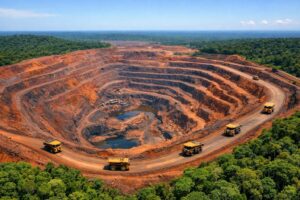
Take Peru, for example. The average ore grade has plummeted from 1.02% to a dismal 0.66%. To maintain the same level of output, miners have to move nearly double the rock, use double the energy, and manage double the waste.
Major Tier-1 assets like Escondida, El Teniente, and Grasberg are aging. They are fighting a losing battle against the laws of physics. New supply isn’t just “slow” to come online: it’s becoming prohibitively expensive. This is exactly why we are seeing M&A mania in 2026; it is cheaper and faster to buy a competitor’s proven reserves than it is to find and build a new mine from scratch.
The AI Stranglehold: A New Pillar of Demand
For years, we talked about “electrification” as the primary driver for copper. That was the old story. The new story is the shiny AI revolution.
Every single GPU-dense data center being built to power the next generation of LLMs is a copper sponge. We’re talking about massive increases in power density that require heavy-duty copper busbars, cooling systems, and grid reinforcements.
The digital world is built on a physical foundation of red metal.
By 2040, global copper demand is forecast to jump from 18 million metric tons to 23 million metric tons. A significant portion of that delta is coming from the tech sector: a sector that, ironically, has much higher margins than traditional manufacturing and can afford to pay a premium for copper. This effectively “crowds out” other industries like consumer electronics and construction. If Apple or Google needs copper for a server farm, they will pay whatever it takes. Your local homebuilder won’t.

Strategy Over Hype: How the Big Players are Moving
While retail investors chase the daily price action, the majors are playing a different game.
Look at BHP. They’ve been famously disciplined, shunning M&A mania in favor of their own sector-leading pipeline. They know that having the assets is more important than winning a bidding war in a hot market.
On the flip side, we see strategic acquisitions like Eldorado’s $2.8B buy of Foran. This wasn’t just a expansion; it was a survival move. They are securing high-grade, ESG-compliant supply in Tier-1 jurisdictions because they know that in 2026, “clean” copper is the only copper that will trade at a premium.
And it’s not just the giants. Small-cap and mid-tier players are scrambling to secure positions. We saw Core Critical Metals acquire an 80% stake in the Lucky Mike property recently. Why? Because it’s a polymetallic play with significant copper and tungsten exposure. Diversification is the new hedge.
The ESG Factor: The Gatekeeper of Capital
In 2026, you can’t talk about copper prices without talking about ESG. It’s no longer a “nice to have” or a section in the annual report that everyone ignores. It is the literal gatekeeper of capital.
Why mining ESG reporting will change the way you access capital in 2026 is simple: institutional investors have stopped funding projects that don’t have a clear path to net-zero or strong social licenses. This creates a “supply throttle.” Even if a massive copper deposit is found tomorrow, if it’s in a sensitive ecosystem or lacks community support, it will never reach the market.
This effectively shrinks the pool of “available” copper, pushing prices even higher for the projects that actually manage to cross the finish line.

The June 2026 Wildcard: Tariffs and Volatility
If you’re looking for a catalyst that could send prices into the stratosphere, mark your calendar for June 2026. The U.S. refined copper tariff decision is expected to drop then.
The uncertainty leading up to this is already causing jitters. If the U.S. decides to implement aggressive tariffs to protect domestic smelting or to pivot away from specific “unfriendly” jurisdictions, we could see a bifurcated market. A “Western-compliant” copper price could trade at a significant premium over the rest of the world.
This isn’t just about trade wars; it’s about the “weaponization” of the supply chain. If you’re an operator or an investor, you need to be prepared for the volatility that follows. Uncertainty is the enemy of the spreadsheet, but it’s the friend of the opportunist.
Summary of 2026 Copper Market Drivers
| Factor | Impact on Price | Narrative Shift |
|---|---|---|
| Ore Grades | Bullish | Declining grades in Chile/Peru are permanent. |
| AI Demand | Bullish | Data centers are the new “EV” for copper demand. |
| Inventory | High Volatility | LME stocks are too low to buffer supply shocks. |
| ESG | Bullish | Regulation is acting as a “supply throttle.” |
| M&A | Neutral/Bullish | Companies are buying growth rather than discovering it. |
The Bottom Line
The 2026 copper price forecast isn’t a guess; it’s a reflection of geological and geopolitical exhaustion.
The world is demanding more copper for the energy transition, more copper for the AI revolution, and more copper for grid modernization. Meanwhile, the mining industry is struggling with declining grades, escalating costs, and a capital market that demands ESG perfection before writing a check.
Those two clocks do not sync.
For the investor, the opportunity isn’t just in the price of the metal itself. It’s in identifying the companies that have already secured their “strategic moat”: those with existing production in safe jurisdictions and those with the foresight to have invested in exploration when everyone else was cutting budgets. Hecla’s $55M exploration blitz is a perfect example of this “reserve-first” mentality.
Welcome to the new reality. Copper isn’t just a commodity anymore. It’s the bottleneck of the modern world. And in a bottleneck, the person who owns the supply holds all the cards.
There’s simply not enough to go around.