By Salini Krishnan & Sonny Jimerson

Conventional wisdom in the mining sector suggests that the winners are the ones with the biggest shovels or the deepest pockets. That is wrong. In the current market, the winners are the ones who control the supply chain and the financing that puts those shovels in the ground.
Tokyo-based ITOCHU Corp. is betting billions that this thesis is correct. On Feb. 19, 2026, the Japanese trading giant announced it would increase its stake in Hitachi Construction Machinery (HCM) from 20.4% to 33.4%. It is a massive move. It officially positions ITOCHU as the largest single shareholder in one of the world’s most critical equipment manufacturers.
But this isn’t just a simple capital injection. This is a declaration of war on the established duopoly of Caterpillar and Komatsu.
For decades, the “Big Two” have dominated the heavy machinery landscape, particularly in the Americas. Hitachi has always been the formidable third player, but it often lacked the sprawling, integrated logistics and financing network required to unseat the incumbents. By doubling down, ITOCHU is providing the “connective tissue” that Hitachi needs to turn into a global powerhouse.
More Read
The 33.4% threshold: Why the math matters
In the world of Japanese corporate governance, 33.4% isn’t a random number. It is a “blocking minority.” By hitting this threshold, ITOCHU gains the power to veto major board decisions, including mergers, acquisitions, and changes to the articles of incorporation.

The strategic calculus here isn’t subtle: ITOCHU is now effectively the architect of Hitachi’s future.
The trading house stated it has no immediate plans for further acquisitions, but they don’t need them. At 33.4%, they have enough skin in the game to dictate terms but enough distance to keep Hitachi’s operational management agile.
More Read
ITOCHU is bringing its expertise in logistics, ESG, and: most importantly: finance to the table. In a high-interest-rate environment where miners are desperate to preserve cash, the ability to offer attractive rental and leasing terms is a lethal competitive advantage.

From Hitachi to LANDCROS: The 2027 pivot
Perhaps the most jarring piece of this expansion is the looming identity shift. In April 2027, HCM will rebrand globally as LANDCROS Corp.
For an industry that relies heavily on legacy and brand loyalty, ditching the “Hitachi” name in the construction and mining space is a massive gamble. However, the move is designed to shed the “conglomerate” image and establish a pure-play identity that resonates better in Western markets.
The rebranding is the centerpiece of the “BUILDING THE FUTURE 2025” management plan. The goal is simple: transition from being a Japanese equipment exporter to a global solutions provider. ITOCHU’s increased stake is the fuel for this fire.
The LANDCROS era will focus on three pillars:
- Value Chain Expansion: Moving beyond the initial sale to dominate the “afterlife” of the machine (parts, service, and data).
- Autonomous Systems: Integrating AI-driven haulage systems to compete with the autonomous haulage lessons learned by industry leaders.
- The Americas: Breaking the stranglehold held by Peoria and Minato.
The North American battleground
North America is the most profitable mining and construction market on the planet. It is also the hardest to crack.
Caterpillar has the dealer network. Komatsu has the historical footprint. For Hitachi to win here, it can’t just build a better excavator; it has to out-service and out-finance the competition.
This is where the ITOCHU-Hitachi synergy becomes visible. The two companies have already established ZAXIS Financial Services Americas to handle sales financing. By leveraging ITOCHU’s massive balance sheet, Hitachi can offer the kind of flexible financing terms that smaller operators: and even mid-tier miners: need to upgrade their fleets.
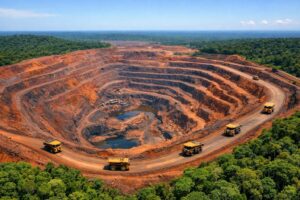
The timing is critical. As the world faces a looming copper deficit in 2026, demand for high-capacity mining equipment is skyrocketing. Miners cannot afford downtime. They need machines, and they need them yesterday. If LANDCROS can provide faster delivery and better financing than a backlogged Caterpillar, the market share will shift.

Logistics: The hidden moat
Everyone talks about the “iron,” but nobody talks about the “ships.”
ITOCHU is a trading house at its core. It owns or controls vast networks of land and sea logistics. In an era of volatile shipping costs and regionalized supply chains, having a shareholder that specializes in moving heavy goods across oceans is a superpower.
While other manufacturers struggle with “port congestion” or “container shortages,” Hitachi (and soon LANDCROS) can tap into ITOCHU’s global logistics network. This ensures that a replacement part for a mining truck in Arizona doesn’t get stuck in a warehouse in Tokyo for six weeks.
In mining, downtime is measured in millions of dollars per hour. This logistics integration isn’t a “nice-to-have”: it’s a fundamental part of the value proposition.
The Commodities tailwind: Why now?
The decision to double down in February 2026 isn’t a coincidence. The mining industry is currently at an inflection point.
We are seeing a massive push toward electrification and digitization. At the same time, the “green transition” is demanding more metal than the current global fleet can extract. According to recent copper forecast 2026 data, the industry is looking at a supply gap of roughly 800,000 tonnes.
Solving that gap requires massive new projects, and new projects require new equipment. ITOCHU knows that the “M&A mania” we’ve seen in the copper sector won’t solve the supply crisis alone. As we’ve noted before, innovation and technology-first mining are the real solutions.
Hitachi is at the forefront of that innovation. Their Ultra-Large Hydraulic Excavators and electric-drive dump trucks are exactly what the ESG-conscious mining board is looking for. By securing its stake now, ITOCHU is positioning itself to capture the “re-fleeting” cycle that will define the late 2020s.
The competitive landscape: Cat vs. Komatsu vs. LANDCROS
The “Equipment Wars” are getting nasty.
Caterpillar is leaning heavily into its “Services” revenue model, aiming to double its earnings from parts and subscriptions by 2026. Komatsu is doubling down on its “Smart Construction” suite, using drones and 3D modeling to automate the job site.
Hitachi: under ITOCHU’s guidance: is taking a different path. They are focusing on the “Total Cost of Ownership.” By integrating finance, logistics, and highly efficient machines, they are positioning themselves as the “rational choice” for miners who are tired of the premiums charged by the Big Two.
The strategy is working. The joint ventures in Thailand and Indonesia have already proven that the ITOCHU-Hitachi model can dominate emerging markets. Now, they are bringing that same playbook to the United States and Canada.

What happens next?
The market should expect a flurry of activity from HCM as it prepares for the LANDCROS rebrand.
- More M&A: Expect ITOCHU to use its influence to push for strategic acquisitions in the software and sensor space. Hitachi needs better “brains” for its machines to compete with Komatsu’s automation.
- Rental Expansion: The rental market is the next frontier. ITOCHU’s expertise in asset management makes a “Rental-as-a-Service” model for mining equipment highly likely.
- The 2027 Rebrand: This will be a massive marketing blitz. If the industry accepts LANDCROS as a premium global brand, the ITOCHU investment will look like a masterstroke. If it fails to gain traction, it will be a multi-billion dollar lesson in the power of legacy naming.
There is no room for error. The global mining equipment market is brutal, and the incumbents do not give up territory easily. But ITOCHU isn’t playing a short-term game. They have spent the last two years setting the board, and this 33.4% stake is the move that puts the competition in check.
The equipment wars have entered a new phase. It’s no longer just about who can build the toughest machine. It’s about who can manage the capital, the carbon, and the cargo. Right now, ITOCHU is making a very loud statement that they intend to be the ones holding the keys.
2026 marks the inflection point. By the time 2027 rolls around and the LANDCROS nameplate starts appearing on mine sites from Antofagasta to the Pilbara, the “Big Two” might find that the market has already moved beneath their feet.
For more in-depth analysis on mining finance and equipment trends, visit our Markets and Commodities section.