By Penny Laneford

**BRASÍLIA : ** The global race to secure low-carbon industrial capacity just cleared a major regulatory checkpoint in South America. Brazil’s antitrust watchdog, the Administrative Council for Economic Defense (CADE), granted unconditional approval for the joint acquisition of Companhia Brasileira de Alumínio (CBA) by Rio Tinto and Chinalco.
The decision, handed down this week, removes the final legal obstacle for the $910 million (R$4.69 billion) transaction. For the broader mining industry, this isn’t just a corporate handover. It is a strategic consolidation of one of the world’s most vertically integrated, hydropowered aluminum footprints.
Here is the reality of the deal: While most of the market was watching fluctuations in the LME, Rio Tinto and Chinalco were quietly carving out a dominant position in the “green” aluminum sector. This wasn’t a hostile takeover or a speculative play. It was a surgical move to acquire a 68.6% controlling stake from the Brazilian conglomerate Grupo Votorantim.
The strategic calculus here isn’t subtle: In a world where carbon borders and ESG mandates are no longer optional, owning the energy source is as important as owning the ore.
More Read
The Joint Venture: A Marriage of Resource Security and ESG
The transaction will be managed through a specialized joint venture. The ownership structure is lopsided by design: a Chinalco subsidiary holds a 67% controlling interest, while Rio Tinto maintains a 33% stake.

On the surface, it looks like Rio Tinto is playing second fiddle. It isn’t. This partnership reflects a maturing of the “frenemy” relationship between the Anglo-Australian major and the Chinese state-owned giant. By partnering, Rio Tinto gains expanded exposure to the Brazilian market without the full capital intensity of a solo buyout, while Chinalco secures a Western partner to help navigate the complexities of Brazilian labor and environmental regulations.
For Chinalco, this is a cornerstone of Beijing’s broader strategy to secure upstream resources outside of its domestic borders. As global supply chains tighten, Chinalco is moving aggressively to lock down primary aluminum assets that aren’t reliant on coal-fired grids.
More Read

Rio Tinto, meanwhile, is checking a massive box in its decarbonization roadmap. The company has been vocal about its shift toward “materials of the future.” By folding CBA into its orbit, Rio adds a low-carbon crown jewel to its portfolio.

Why CBA? The 1.6 GW Hydropower Advantage
To understand why two of the world’s largest mining firms fought for a mid-sized Brazilian producer, you have to look at the power bill.
CBA isn’t just a smelter; it is a power utility that happens to produce metal. The company operates a 1.6 GW renewable power generation portfolio. This includes 21 hydroelectric plants and various wind complexes across Brazil.
In the aluminum business, power accounts for roughly 30% to 40% of the total cost of production. But there is a secondary cost that is becoming even more punitive: carbon. Smelting aluminum via coal-fired electricity is an environmental liability that European and North American regulators are increasingly looking to tax through mechanisms like the Carbon Border Adjustment Mechanism (CBAM).
By acquiring CBA, the Rio-Chinalco JV inherits a production line that is essentially “pre-decarbonized.” CBA produced approximately 0.36 million tonnes of primary aluminum in 2024, all of it backed by its massive renewable portfolio.
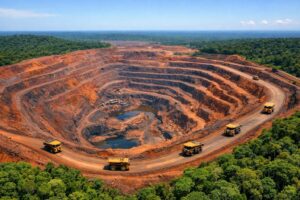
The vertical integration goes deeper. The deal includes three bauxite mines with an annual production capacity of roughly 2 million tonnes. This ensures a closed-loop supply chain from the mine site to the refining of alumina, through to the final smelting and secondary recycling. That level of control is rare in today’s fragmented market.
The CADE Ruling: No Strings Attached
Antitrust regulators are rarely this accommodating. CADE’s decision to approve the deal without restrictions suggests that the Brazilian government views the entry of Chinalco and Rio Tinto as a stabilizing force for the domestic industry rather than a threat to competition.
The approval follows a multi-jurisdictional gauntlet. Because of the global scale of the two parent companies, the deal required sign-offs in China, Germany, South Korea, and Uruguay. Brazil was the final: and most critical: domino to fall.
With the CADE hurdle cleared, the joint venture is now legally obligated to launch a mandatory tender offer for the remaining shares of CBA held by minority investors on the B3 exchange. Under Brazilian corporate law, this ensures that minority shareholders are offered the same terms as the controlling block, a move that will likely lead to CBA being delisted and folded entirely into the private JV structure.
Contextualizing the $910M Price Tag
Is $910 million a fair price? In the context of 2026 valuations, it looks like a bargain.
Consider the replacement cost of a 1.6 GW renewable energy grid. Building that from scratch in today’s regulatory environment would cost significantly more than the total deal value, and that’s before you even break ground on a smelter or a bauxite mine.
The R$4.69 billion price tag reflects a calculated exit by Grupo Votorantim, which has been pivoting its capital toward other industrial sectors. For the buyers, the deal is a hedge against the volatility seen in other sectors. While lithium forecasts for 2026 show a market still trying to find its floor, the demand for low-carbon aluminum remains structurally undersupplied.

Geopolitical Implications: The South American Shift
This deal signals a significant shift in CBA’s ownership from domestic industrial control to a hybrid of Chinese state capital and global institutional mining.
It is part of a larger trend where Africa and South America are emerging as the strategic anchors for the 2026 critical minerals supply chain. As Western nations scramble to secure “friendly” supply chains, China is doubling down on established jurisdictions like Brazil, where the infrastructure is already built and the regulatory path: though rigorous: is predictable.
The Rio-Chinalco JV also complicates the narrative of a “decoupling” between Chinese and Western mining interests. While politicians in Washington and Brussels talk about de-risking, the world’s largest miners are finding that they still need each other to execute billion-dollar infrastructure plays.
What Happens Next?
The focus now shifts to the tender offer and the operational integration of CBA into the JV’s global sales desk. Investors should expect a period of “quiet optimization.” Rio Tinto and Chinalco are unlikely to make massive changes to CBA’s workforce or local management in the short term, but they will almost certainly look to scale the bauxite production and potentially upgrade the smelting technology to squeeze more efficiency out of the existing hydro capacity.
There is also the question of recycling. CBA already has a secondary recycling footprint. In the current market, “circularity” is the only way to meet the aggressive ESG targets set by automotive OEMs. Expect the JV to lean heavily into CBA’s recycling capabilities to augment its primary production.
The global aluminum market is entering a phase where the “green premium” is no longer a theory: it’s a prerequisite for tier-one contracts. By clearing CADE, Rio Tinto and Chinalco have just secured one of the best seats at the table.
Summary of Key Data Points
| Metric | Detail |
|---|---|
| Total Deal Value | $910 Million (R$4.69 Billion) |
| JV Structure | 67% Chinalco / 33% Rio Tinto |
| CBA Aluminum Production (2024) | 0.36 Million Tonnes |
| Renewable Energy Capacity | 1.6 GW (21 Hydro Plants + Wind) |
| Bauxite Capacity | ~2 Million Tonnes per Annum |
| Regulatory Status | Approved by CADE (Brazil) – Final |
For decision-makers, the message is clear: the era of “easy” mining assets is over. Future value lies in integrated, energy-independent clusters. Those who don’t own their power supply will eventually find themselves priced out of the market. Rio Tinto and Chinalco just made sure they won’t be among them.