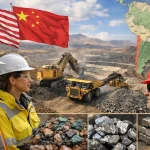
Canada is no longer just talking about supply chain security: it’s financing it.

OTTAWA : Canada’s critical minerals strategy just hit a massive gear shift. On March 12, 2026, Federal officials confirmed the Critical Minerals Production Alliance has secured 30 new partnerships, unlocking $12.1 billion in fresh capital aimed squarely at the midstream and upstream mining sectors.
This isn’t a rounding error. It’s a $12.1 billion declaration of independence from volatile Eastern supply chains. When combined with the figures from late 2025, the Alliance has now mobilized a staggering $18.5 billion in total commitments. The target? Ensuring that the “nervous system” of the energy transition: copper, gold, and uranium: stays firmly within allied hands.
The timing is anything but accidental. As global trade tensions tighten, Ottawa is positioning itself as the “First and Last Mile” solution for the West. This latest wave of investment isn’t just about digging holes in the ground; it’s about the infrastructure, processing, and refining capabilities that have long been the industry’s Achilles’ heel.
The $12.1 Billion Breakdown: Where the Money is Flowing
The capital injection is divided across 12 allied partners, signaling a shift toward a “friend-shoring” model that goes beyond simple bilateral trade. We aren’t just selling ore anymore. We’re building the machines that process it.
More Read
| Fund/Initiative | Allocated Amount | Primary Focus |
|---|---|---|
| Critical Minerals Sovereign Fund | $2.0 Billion | Equity investments and loan guarantees |
| First and Last Mile Fund | $1.5 Billion | Infrastructure (roads, power, rail) |
| Direct Project Grants | $165.2 Million | Planning and development for 22 projects |
| Private/Allied Investment | $8.4 Billion | Strategic partnerships and JVs |
The Sovereign Fund, set to launch in full this spring, is the “kicker” for many junior miners. It provides the kind of equity and supply agreements that traditional banks: often allergic to the long timelines of mining: won’t touch.


Copper, Gold, and Uranium: The Strategic Trinity
While the “sexy” minerals like lithium and cobalt get the headlines, the 2026 investment wave focuses heavily on the old-school heavyweights.
More Read

Copper: With the copper processing demand reaching a fever pitch, Canada is doubling down on its domestic capacity. The Alliance is funneling significant capital into Tier-1 assets in British Columbia and Ontario to ensure cathode production stays domestic.
Gold: No longer just a store of value, gold is being treated as a strategic asset for financing the broader transition. Increased exploration permits in the Abitibi region are part of a broader plan to use gold’s liquidity to de-risk more volatile mineral plays.
Uranium: As SMR (Small Modular Reactor) technology moves from concept to construction, Canada’s uranium reserves are becoming the ultimate geopolitical leverage. The partnerships announced today include specific provisions for North American nuclear fuel security.
International Moats: EU, India, and Greenland
The diplomatic side of this announcement is just as vital as the dollar signs. Canada isn’t acting alone.
- The India MoU: Canada and India signed a Memorandum of Understanding on Critical Minerals Collaboration. This is a massive hedge against regional monopolies, focusing on trade and investment policy coordination.
- The EU Joint Declaration: Brussels and Ottawa are now officially “joined at the hip” regarding supply chains. This declaration aims to streamline bilateral investment, making it easier for European automakers to source Canadian-processed materials.
- The Greenland Intent: A Joint Declaration of Intent with Greenland expands Canada’s footprint in the Arctic, focusing on shared natural resource development.
The European Investment Bank (EIB) also signed a Letter of Intent to negotiate cooperation agreements. Translation: The world’s biggest lenders are starting to see Canadian dirt as the safest bet on the planet.

Table: Comparison of Strategic Mineral Reserves and Allied Investment Commitments for 2026.
Project Spotlights: Red Rock and First Phosphate
Two projects stand out as the poster children for this new era of “Capital Wave” investment.
In Ontario, Rock Tech Lithium’s Red Rock Converter Project has secured a strategic partnership with Siemens Canada. This isn’t just about mining lithium; it’s about building the domestic conversion infrastructure needed to turn raw ore into battery-grade chemicals. Without converters, the mining is useless. With them, Canada becomes a price maker, not a price taker.
In Quebec, First Phosphate’s Bégin-Lamarche project is taking a different route. Backed by a $16.7 million investment, the focus is on lithium iron phosphate (LFP) cathode material phosphorous. As LFP batteries become the standard for mass-market EVs, First Phosphate is sitting on the “missing ingredient” that everyone from Tesla to Volkswagen is scrambling to secure.
The Reality Check: Can the Infrastructure Keep Up?
Here is where it gets uncomfortable. You can’t just throw $12 billion at a problem and expect it to disappear. Mining projects in Canada are notoriously slow, bogged down by permitting delays and a lack of basic infrastructure in the “ring of fire” and other remote regions.
The government’s $1.5 billion First and Last Mile Fund is supposed to address this. It’s a tacit admission that we’ve ignored the roads and power lines needed to actually get the rocks out of the ground. It’s a good start, but in the context of a $12 billion capital wave, it feels like a down payment on a much larger debt.
Ironically, while we are focused on China’s export controls, the real “squeeze” in 2026 might be internal. If the Sovereign Fund doesn’t cut through the red tape, that $12.1 billion will sit in escrow while the rest of the world moves on.

The 2026 Outlook: An Inflection Point
We’ve reached the inflection point. The transition from “exploration” to “execution” is happening now. The 30 new partnerships are more than just PR: they are the legal and financial frameworks that will dictate who controls the energy markets of the 2030s.
Minister Tim Hodgson’s announcement also included $165.2 million for 22 specific Canadian projects to accelerate development capacity. This is “grease for the wheels” aimed at getting projects through the feasibility stage faster than the traditional 10-year mining cycle allows.
For investors, the message is clear: the government is now the ultimate de-risker. Whether it’s through equity stakes from the $2 billion Sovereign Fund or infrastructure grants, the Canadian state is now a majority partner in the nation’s mineral future.

What Happens Next?
Expect the spring launch of the Critical Minerals Sovereign Fund to trigger a feeding frenzy among junior miners. Those with “shovel-ready” projects or strategic midstream processing plans will be the first in line.
However, the “brutal numbers” still loom. Even with $18.5 billion mobilized, the gap between what we have and what we need for a full energy transition is measured in the trillions. Canada is moving fast, sure. But in the global race for mineral dominance, the clock is already ticking.
There’s not enough to go around. And for the first time in a decade, Canada is acting like it knows it.