By Charles Pitts

The global nuclear energy landscape is undergoing its most significant shift since the mid-20th century. As we approach mid-2026, the primary driver of uranium demand is no longer just the massive, decade-long builds of traditional GW-scale reactors. Instead, the focus has pivoted toward Small Modular Reactors (SMRs). With the first commercial SMR deployments slated for the latter half of this decade, the scramble for high-grade, ethically sourced uranium has moved from the boardrooms of utilities to the drill pads of junior explorers.
For investors, the “SMR boom” represents a fundamental change in the supply-demand equation. SMRs, designed for modularity and factory-scale production, require a consistent and often higher-assay fuel source, including High-Assay Low-Enriched Uranium (HALEU). This shift has placed a premium on explorers with assets in Tier-1 jurisdictions: specifically the Athabasca Basin in Saskatchewan and the prolific ISR (In-Situ Recovery) districts of Wyoming.
As the industry prepares for the mining workforce 2026 outlook, which predicts a tightening labor market for specialized geological roles, these five small-cap explorers have positioned themselves as the primary M&A targets for majors looking to replenish depleted pipelines.
1. Skyharbour Resources (SYH.V)
Focus: Athabasca Basin, Saskatchewan
The Hook: Partner-Funded Exploration Model
More Read

Skyharbour Resources has mastered the “prospect generator” model in the uranium space. By holding a massive portfolio of over 25 projects in the Athabasca Basin, Skyharbour minimizes shareholder dilution by bringing in partners like Orano and Azincourt to fund exploration.

Their flagship Moore Lake project, which hosts the high-grade Maverick Zone, remains a centerpiece. However, the market is currently watching their Russell Lake project: a joint venture with Denison Mines. Positioned strategically between the McArthur River and Key Lake mines, Russell Lake benefits from industry-standard infrastructure proximity that many juniors lack.
Management Track Record: CEO Jordan Trimble has been vocal about the “structural deficit” in the uranium market. His ability to attract majors as joint-venture partners validates the geological merit of Skyharbour’s land package. As SMR demand ramps up, Skyharbour’s diverse portfolio offers multiple “shots on goal” for a major discovery.
More Read


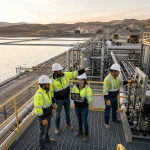
Geologists inspect high-grade uranium core samples from the Athabasca Basin, where grade remains king for SMR fuel specifications.
2. Fission 3.0 (FUU.V)
Focus: Patterson Lake North (PLN), Saskatchewan
The Hook: High-Grade Discovery Potential
Fission 3.0 is the tactical exploration arm of the Fission group, led by the same team that discovered the Triple R deposit (Fission Uranium) and the Waterbury Lake deposit. Their primary focus is the Patterson Lake North (PLN) project, located just north of the massive Triple R and Arrow deposits.
In late 2024 and throughout 2025, Fission 3.0 reported significant high-grade intercepts at the A1 zone within PLN. For an SMR-driven market, high-grade deposits are essential because they offer better economics for the specialized enrichment processes required for modern reactor designs.
Why They Are an M&A Target: Fission 3.0’s proximity to Fission Uranium’s Triple R deposit makes them a natural consolidation target. If a major producer acquires Fission Uranium, Fission 3.0’s PLN project becomes the logical next step for regional expansion.
3. CanAlaska Uranium (CVV.V)
Focus: West McArthur Project, Saskatchewan
The Hook: Proximity to the World’s Richest Uranium Mine
CanAlaska Uranium is currently exploring the West McArthur project, a joint venture with Cameco. The project is situated immediately adjacent to the McArthur River mine: the highest-grade uranium mine in the world. Recent drilling at the “Pike Zone” has yielded massive grades, with some intercepts exceeding 10% U3O8.
Infrastructure Advantage: Exploration is expensive, but exploration near existing mills is a game-changer. CanAlaska’s projects are within trucking distance of the Key Lake mill. For SMR operators looking for supply security by 2026, projects that can be fast-tracked into production via existing infrastructure are priced at a premium.

4. Basin Uranium (NCLR.CN)
Focus: Wyoming and Athabasca
The Hook: US Domestic Supply Security
While the Athabasca Basin holds the grade, Wyoming holds the permits. Basin Uranium has strategically diversified its portfolio to include the Wray Mesa project in Utah/Colorado and the Chord project in South Dakota, alongside its Athabasca holdings.
The U.S. government’s push for domestic uranium production to fuel its burgeoning SMR fleet: highlighted by the ban on Russian uranium imports: has made Wyoming assets incredibly valuable. Basin Uranium’s focus on ISR-amenable projects in the U.S. aligns perfectly with the “Made in America” energy policy that is expected to peak in 2026.
Grounding the Speculation: Unlike the deep, expensive shafts required in Canada, Wyoming’s ISR projects offer a lower CAPEX route to production, making them attractive for mid-cap miners looking to scale quickly to meet SMR utility contracts.
5. Stallion Uranium (STUD.V)
Focus: Southwestern Athabasca Basin
The Hook: Massive Land Position in a New Frontier
Stallion Uranium holds the largest exploration land package in the Southwestern Athabasca Basin, bordering the projects of NexGen Energy and Fission Uranium. This “Land of the Giants” is where the most significant uranium discoveries of the last decade have occurred.
Stallion is currently utilizing advanced geophysical surveys to identify basement-hosted targets similar to NexGen’s Arrow deposit. For an investor, Stallion represents a “pure-play” exploration bet. If they hit a discovery similar to their neighbors, the valuation re-rate would be exponential.
Comparison of Top 5 Uranium Explorers
| Company | Primary Project | Jurisdiction | Strategic Advantage |
|---|---|---|---|
| Skyharbour | Russell Lake | Athabasca, SK | Partner-funded; Low dilution |
| Fission 3.0 | PLN | Athabasca, SK | High-grade discovery; Top-tier team |
| CanAlaska | West McArthur | Athabasca, SK | Adjacent to McArthur River; Cameco JV |
| Basin Uranium | Wray Mesa / Chord | US (UT/SD/WY) | US domestic supply; ISR potential |
| Stallion | Southwestern Basin | Athabasca, SK | Largest land package in “Giant” district |
Why 2026 is the Critical Year for M&A
The mining industry is currently facing a copper deficit in 2026, but the uranium deficit is arguably more acute due to the lack of secondary supply. Major producers like Cameco and Orano have spent the last two years strengthening their balance sheets. By 2026, with SMR units from GE-Hitachi and NuScale moving into late-stage construction or early operation, the need to secure 20-year fuel contracts will reach a fever pitch.
We expect the majors to follow the lead of companies like Rio Tinto, which recently expanded lithium production through major acquisitions. In the uranium sector, this means acquiring juniors that have already done the heavy lifting of discovery and initial resource definition.
The Management Factor
In the junior space, the management team is as important as the rocks. The “Lundin-style” approach: finding a resource, de-risking it through aggressive drilling, and selling it to a major: is the blueprint for the companies listed above. Investors should closely monitor the insider buying and capital allocation strategies of these firms as we move through 2026.

Conclusion: A Speculative but Grounded Opportunity
The 2026 SMR boom is no longer a theoretical “maybe.” It is backed by government policy, utility demand, and a desperate need for carbon-free baseload power. While exploration is inherently risky, the small-cap explorers focusing on the Athabasca Basin and Wyoming represent the most direct way to play this thematic shift.
For more insights on the global energy transition and its impact on mining, explore our analysis of the world’s largest rare earth mines or our deep dive into the global battery revolution.