In the rugged sub-Arctic landscape of northern Quebec, the Labrador Trough has long been the backbone of North American iron ore production. However, as the global steel industry pivots toward decarbonization, the scale and quality requirements for new projects have undergone a fundamental shift. At the center of this transition is MetalQuest Mining and its Lac Otelnuk project: a deposit of such staggering proportions that it requires not just capital, but a strategic alliance with a global Tier-1 operator to move toward production.

MetalQuest is currently intensifying its search for a joint venture partner to unlock what is arguably one of the largest undeveloped high-purity iron deposits in the world. With over $150 million already invested in the ground and a refreshed feasibility outlook, the company is positioning Lac Otelnuk as a vital source of “green steel” feedstock. This push comes at a time when the Quebec and Canadian federal governments have officially designated high-purity iron ore as a critical mineral, recognizing its essential role in the per-geijer-rare-earths-green-transition.
The Scale of the Ambition: 20 Billion Tonnes
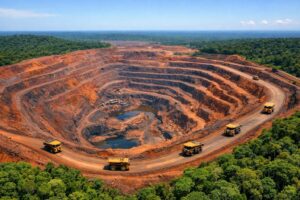
The sheer numbers associated with Lac Otelnuk often require a second look. The project hosts a historical measured and indicated resource of 20.64 billion tonnes grading 29.8% total iron. To put that into perspective, the 2015 feasibility study envisioned a 50-million-tonne-per-annum (Mtpa) operation with a mine life exceeding 30 years: and that only accounted for a fraction of the total resource.
For MetalQuest, the objective is no longer just about volume; it is about purity. The deposit is capable of producing a concentrate grading above 68.5% Fe with exceptionally low impurities. This is the “holy grail” for modern steelmakers utilizing Electric Arc Furnaces (EAF) and Direct Reduced Iron (DRI) technology. As traditional blast furnaces are phased out to meet carbon targets, the demand for this high-grade material is expected to outpace supply significantly by the end of the decade.

More Read
Bridging the Gap: Updating the 2015 Feasibility Study
A decade is a lifetime in the mining industry. The 2015 feasibility study, while comprehensive, was drafted in a different economic and technological era. That study outlined an open-pit design with a post-tax Net Present Value (NPV) of US$5.24 billion and a capital expenditure (Capex) requirement of approximately US$14.2 billion.

In early 2026, MetalQuest engaged AtkinsRéalis to conduct a rigorous gap analysis. This work is intended to modernize the project’s technical parameters, focusing on:
- Modular Construction: Reducing on-site labor costs by utilizing prefabricated units.
- Renewable Energy Integration: Exploring the use of Quebec’s vast hydroelectric grid to power operations.
- Automated Logistics: Implementing autonomous haulage and rail systems to mitigate the challenges of the sub-Arctic environment.
The updated scoping studies are also expected to address the mine-electrification-2026-5-operations-hacks-to-slash-diesel-costs that have become industry standards for reducing Scope 1 emissions.
More Read
Infrastructure: The Sub-Arctic Challenge
Located 165 km northwest of Schefferville, Lac Otelnuk faces the classic dilemma of “stranded” assets: the mineral wealth is proven, but the path to market requires significant infrastructure. A 50 Mtpa operation cannot rely on existing patchwork solutions. It requires a dedicated heavy-haul rail line and expanded port facilities on the St. Lawrence Seaway or the Labrador coast.
The infrastructure bill alone accounts for a significant portion of the $14.2 billion Capex. However, the project sits in a globally recognized iron district. To the south, major players like Rio Tinto (IOC), ArcelorMittal, Champion Iron, and Tata Steel have already blazed the trail. MetalQuest’s strategy involves potential cost-sharing or third-party infrastructure models that could lower the barrier to entry for a new partner.

The “Green Steel” Catalyst
The most significant tailwind for the Lac Otelnuk project is the shift in global policy. In 2024, the Canadian federal government and the province of Quebec officially added high-purity iron to their critical minerals lists. This wasn’t just a symbolic gesture; it opened doors to streamlined permitting and potential government financial support under various “green transition” initiatives.
Steel production accounts for roughly 7% to 9% of global CO2 emissions. To hit 2050 net-zero targets, the industry must transition to DRI-EAF pathways which require iron ore with a grade of 67% or higher. Lac Otelnuk’s ability to hit 68.5% places it in an elite tier of global projects. This quality premium is likely to be a major talking point in current JV negotiations, as steelmakers look to secure long-term “green” supply chains.
The recent aluminum-independence-the-first-new-us-smelter-in-50-years-breaks-ground serves as a parallel example of how strategic industrial metals are being resourced within North America to ensure supply chain security.
Strategic Partnerships: Why Now?
MetalQuest Mining’s CEO, Charles Pitts, has been vocal about the company’s pivot toward a partnership model. In January 2026, the company amended its royalty structure, a move designed to provide maximum flexibility for incoming investors. The goal is to find a partner with the balance sheet and technical expertise to handle a project of this magnitude: think a major diversified miner or a consortium of international steel producers.
The timing is influenced by a broader skillings-mining-intelligence-the-44b-ma-surge-the-perseus-strong-buy-signal-april-11th-2026 in the sector. As Tier-1 deposits become increasingly rare and geopolitical tensions make jurisdictions like West Africa or Central Asia more volatile, the stability of Quebec’s Labrador Trough looks more attractive than ever.

Risk Factors and Mitigations
No project of this scale is without its hurdles. The primary risks for Lac Otelnuk remain:
- Capital Intensity: The multi-billion dollar price tag is a high bar, even for majors.
- Permitting Timelines: Large-scale mining in the sub-Arctic requires extensive environmental and social impact assessments, particularly involving First Nations communities.
- Logistics Complexity: Constructing hundreds of kilometers of rail through permafrost-prone terrain is a significant engineering feat.
To mitigate these, MetalQuest is focusing on a phased development approach. Instead of jumping straight to 50 Mtpa, a smaller “starter” operation could prove the process and generate cash flow to fund subsequent expansions. This would align with the trend seen in other critical mineral sectors, such as century-lithiums-angel-island-npv-surges-to-4-billion-in-study-update, where iterative development helps de-risk the total investment.
Conclusion: A Decisive Year for MetalQuest
As 2026 progresses, the results of the gap analysis and the progress of partnership talks will define the future of Lac Otelnuk. The project represents a rare opportunity to secure a multi-generational supply of the highest-quality iron ore in a top-tier jurisdiction.
For the Quebec mining industry, Lac Otelnuk is more than just a mine; it is a test of whether the province can leverage its “green” energy and mineral wealth to become a global leader in the decarbonized steel supply chain. MetalQuest’s hunt for a partner is the first major hurdle in realizing that vision.
| Key Project Metric | Value |
|---|---|
| Total Resource | 20.64 Billion Tonnes |
| Average Iron Grade | 29.8% Fe |
| Target Concentrate Grade | > 68.5% Fe |
| Est. Capital Cost (2015) | US$14.2 Billion |
| Location | Labrador Trough, Quebec |
| Strategic Status | Designated Critical Mineral (2024) |
For more in-depth analysis on the future of North American mining and the critical minerals transition, visit skillings.net.