By Penny Langford

The relationship between Silicon Valley and the global mining industry has historically been one of customer and supplier: separated by several layers of mid-stream processing and manufacturing. But as we move deeper into 2026, that distance is collapsing. Amazon, Google, and Microsoft, the “hyperscalers” of the cloud era, are no longer content waiting at the end of the supply chain. They are moving upstream, becoming direct financiers, equity partners, and off-take guarantors for the minerals that power the AI revolution.
This shift isn’t driven by a sudden interest in geology. It is driven by a desperate, existential need for power and the materials required to transmit it. As generative AI models grow in complexity, the electricity required to train and run them has hit a wall: the physical limit of the electrical grid. To bypass this bottleneck, Big Tech is rewriting the rules of project finance in the mining sector.
The AI-Energy Nexus and the Grid Bottleneck
The scale of the energy demand is difficult to overstate. According to research from the Electric Power Research Institute (EPRI), data center electricity consumption in the United States alone reached roughly 192 terawatt-hours in 2024. By 2030, that figure is projected to explode to 790 terawatt-hours. To put that in perspective, data centers could soon account for nearly 17% of all U.S. electricity generation.
The problem isn’t just generating the power; it’s getting it to the data center. The “time-to-power” gap has become the primary hurdle for AI expansion. In many jurisdictions, the wait time for a new grid interconnection for a large-scale data center has stretched to seven years. For a tech giant like Microsoft or Google, seven years is an eternity.
More Read

This infrastructure lag is forcing hyperscalers to look for “behind-the-meter” solutions and direct-wire connections to power sources. This is where the mining industry enters the chat. Whether it is copper for the massive expansion of electrical infrastructure or uranium for the carbon-free baseload power of Small Modular Reactors (SMRs), hyperscalers are realizing that if they don’t fund the mine, they won’t get the metal, and if they don’t get the metal, they won’t have the power.

Why Hyperscalers are Bypassing Traditional Banks
Traditionally, a junior mining company would seek funding through equity raises on the TSX or ASX, followed by debt from commercial banks once a bankable feasibility study was complete. However, banks have become increasingly cautious, hampered by ESG mandates and the inherent volatility of commodity prices.
Hyperscalers are stepping into this vacuum with a different set of priorities. They aren’t looking for a 15% IRR on a copper play; they are looking to de-risk a $100 billion AI investment. This has led to the rise of the “Hyperscaler Backstop.”
More Read

We are seeing tech giants provide off-take guarantees that are effectively “bankable” in a way traditional commodity contracts aren’t. When a company like Google guarantees to buy power or minerals at a set price for 20 years, it transforms a risky mining project into a creditworthy infrastructure asset. This allows miners to access project financing with loan-to-cost ratios as high as 85%.
For an example of how this is playing out in the energy sector, look no further than the uranium market. Big Tech is increasingly weighing direct backing for uranium developers to ensure their future data centers have dedicated carbon-free power. You can read more about how Big Tech is fueling the next uranium bull market as firms like NexGen Energy explore these unconventional partnerships.
The Bitcoin Mining Pivot: A Shortcut to Power
One of the most fascinating developments in this new financing era is the role of former Bitcoin miners. For years, Bitcoin mining companies built out massive grid interconnections and industrial-scale power infrastructure in remote areas. With the 2024 halving and rising global competition, many of these firms found themselves with “stranded” power assets that were more valuable for AI than for crypto.
Hyperscalers have moved in quickly, retrofitting these sites for High-Performance Computing (HPC). In these deals, the tech giants often provide the capital for the retrofit in exchange for long-term leases. Google, for instance, has backed approximately $5 billion worth of these conversion deals over the past year. By partnering with miners who already have the “permits and power,” hyperscalers can bring new AI capacity online in months rather than years.
This pivot is part of a broader trend where the “Mine of the Future” is no longer just about extraction; it’s about being a node in a global energy and data network. The U.S. Department of Energy’s Mine of the Future initiative is already highlighting how integrated technology and energy systems will define the next decade of American mining.
Copper and Uranium: The Primary Targets
While the “Silicon-Lithium Nexus” is often discussed in the context of batteries, the “AI-Energy Nexus” is primarily focused on copper and uranium.
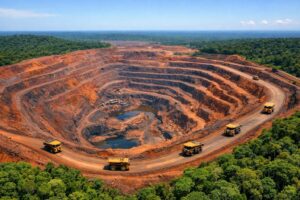
Copper is the nervous system of the AI era. A single large-scale AI data center requires significantly more copper than a traditional facility due to the density of the server racks and the complexity of the cooling systems. With traditional copper mines facing declining grades and lengthy permitting processes, hyperscalers are looking at everything from direct equity in junior explorers to funding innovative extraction methods in dormant volcanoes.
Uranium is the second pillar. Hyperscalers have made it clear that their AI growth must be carbon-neutral. Solar and wind are insufficient for the 24/7 “always-on” requirements of a massive LLM (Large Language Model). This has led to a renaissance in nuclear interest, specifically SMRs.
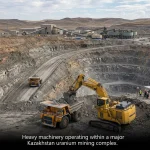
We are seeing direct lines of communication between tech firms and uranium producers like UEC, which recently commenced production at Burke Hollow, the first new U.S. ISR uranium mine in a decade. For the hyperscalers, securing domestic supply isn’t just about price: it’s about national security and supply chain certainty.
Direct Equity and the 2026 Outlook
As we look toward the remainder of 2026, the trend of direct equity investment by hyperscalers is expected to accelerate. We are moving away from simple off-take agreements toward “Full Lifecycle Financing.” In this model, a tech giant might provide the seed capital for exploration, the bridge financing for permitting, and the final construction debt.
The impact on the mining industry is profound. It creates a “two-tier” market:
- The Tech-Backed Tier: Projects that align with the AI-Energy Nexus (copper, uranium, high-grade silicon) will have access to nearly unlimited, low-cost capital.
- The Traditional Tier: Projects focused on traditional industrial metals or consumer goods will continue to struggle with the whims of the commercial banking sector and equity markets.
Even the lithium sector is feeling the ripples of this AI-first strategy. Companies are now tailoring their 2026 outlooks to align with AI-driven battery demand, recognizing that “AI-adjacent” is the most attractive label a mining project can carry in the current investment climate.
Conclusion: A New Era of Industrial Convergence
The entry of hyperscalers as the “new financiers” of the mining world marks the end of the era where tech was “clean” and mining was “dirty.” Today, they are two sides of the same coin. Without the massive scale of mineral extraction, the promise of artificial intelligence remains a theoretical exercise.
For mining executives, the message is clear: your next partner might not be a major mining house like Rio Tinto or BHP. It might be Amazon Web Services. For investors, the opportunity lies in identifying the projects that are “AI-ready”: those with the right geography, the right mineral mix, and, most importantly, the right grid access to solve the hyperscalers’ power problem.
The grid bottleneck is real, the demand is surging, and the checkbooks of Silicon Valley are open. The AI era won’t be built on code alone: it will be built on copper, uranium, and a new breed of financier.