By Charles Pitts
BUENOS AIRES : Argentina’s mining sector is undergoing its most significant transformation in decades as the administration of President Javier Milei moves to dismantle regulatory barriers and provide unprecedented financial incentives for global investors. Since the passage of the Regime for Incentive of Large Investments (RIGI) and recent controversial reforms to environmental laws, the country has secured a projected investment pipeline exceeding $40 billion, focused primarily on the copper and lithium required for the global energy transition.
The shift marks a pivot from the protectionist policies of previous decades toward an aggressive, export-oriented strategy. With ten major projects already moving through the approval pipeline: representing a combined value of approximately $25.5 billion: Argentina is positioning itself to challenge neighboring Chile as a primary supplier of battery metals and industrial copper.
The $40 Billion Pipeline: A Copper and Lithium Surge
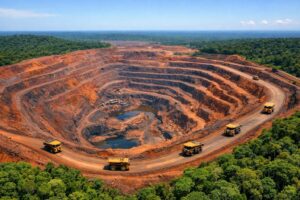
The scale of capital entering Argentina’s mining sector is headlined by the Vicuña project in San Juan province. A joint venture between BHP and Lundin Mining, the project is estimated at $18 billion, representing the largest single foreign investment in Argentine history. The development is part of a broader “copper renaissance” that includes Glencore’s El Pachón and First Quantum Minerals’ Taca-Taca in Salta province, the latter valued at $4.2 billion.
More Read
For years, Argentina’s copper potential remained largely untapped due to fiscal instability and legal uncertainty. However, the current administration views these deposits as essential to the country’s economic recovery. Government projections suggest that if the current pipeline reaches full production, Argentina could generate $165 billion in mining exports by 2035.

In the lithium sector, Argentina continues to solidify its role within the “Lithium Triangle.” While established players like Livent (now Arcadium Lithium) have operated in the region for decades, a new wave of capital from firms such as Posco, Eramet, and Ganfeng is pushing production capacity to new heights.

More Read

Key Mining Projects in Argentina (2026 Outlook)
The following table outlines the most significant projects currently driving the Argentine mining revival:
| Project | Principal Operator | Commodity | Province | Estimated Investment | Status |
|---|---|---|---|---|---|
| Vicuña | BHP / Lundin Mining | Copper/Gold | San Juan | $18.0 Billion | RIGI Application / Pre-Construction |
| Taca-Taca | First Quantum | Copper | Salta | $4.2 Billion | Final Permitting |
| El Pachón | Glencore | Copper | San Juan | $3.5 Billion | Feasibility Update |
| Kachi | Lake Resources | Lithium | Catamarca | $1.38 Billion | Development / Pilot Phase |
| Sal de Oro | Posco | Lithium | Salta/Catamarca | $1.1 Billion | Construction (Phase 2) |
| Puna Ops | SSR Mining | Silver/Zinc | Jujuy | Ongoing | Active Production (Chinchillas) |
RIGI: The Engine of Investment Stability
Central to this influx of capital is the Regime for Incentive of Large Investments (RIGI). This legislative framework offers a 30-to-40-year period of legal and fiscal stability, including significant tax breaks and eased customs duties for projects exceeding $200 million.
For major miners, the stability guarantees are as important as the tax incentives. “The primary hurdle in Argentina hasn’t been the geology; it’s been the rules of the game,” says an analyst familiar with the San Juan projects. “RIGI attempts to fix that by shielding investors from the country’s history of sudden policy shifts.”
Companies like Capstone Copper, which have seen record production growth in other South American jurisdictions, are closely watching the Argentine landscape as the risk profile shifts. The integration of Argentine assets into global portfolios is accelerating as the RIGI framework provides a clearer path to project financing.

Glacier Law Reform and Environmental Friction
The push for rapid expansion has not come without significant domestic resistance. In April 2026, the Argentine Chamber of Deputies passed a reform to the 2010 Glacier Protection Law with a 137–111 vote. This reform is a cornerstone of President Milei’s plan to unlock high-altitude mining, but it has sparked a national debate over water security and constitutional law.
The reform fundamentally changes how glaciers and periglacial environments are protected:
- Decentralization: The authority to classify and protect glaciers has shifted from federal agencies to provincial governments.
- Narrowed Scope: The legal definition of “protected environments” has been narrowed, effectively opening thousands of hectares of Andean territory to mining infrastructure.
- Economic Priority: The administration argues that provincial control allows for more “tailored” environmental management that balances conservation with economic development.
Environmental groups, led by Greenpeace, have launched a constitutional challenge against the reform. Critics argue that the move threatens the freshwater reserves for over 7 million people, particularly in the arid northwest where glacial meltwater is the primary source for agriculture and domestic use.

Regional Focus: Salta, Jujuy, and Catamarca
While the massive copper projects are centered in San Juan, the lithium boom is concentrated in the provinces of Salta, Jujuy, and Catamarca. In January 2026 alone, mining exports from these three provinces totaled $172 million, a 52.9% year-over-year increase.
In Catamarca, the mining sector now accounts for 95.6% of the province’s total exports. However, the rapid pace of development has hit legal roadblocks. In March 2026, the Supreme Court of Catamarca ordered a halt on new lithium authorizations in the Salar del Hombre Muerto region. The court ruled that mining activities must pause until a “cumulative and integral environmental impact study” is completed, specifically addressing water extraction from the Los Patos River basin.
This ruling highlights a growing tension: while the federal government is providing the fiscal “carrot” through RIGI, local judiciaries are increasingly applying the environmental “stick.” Investors must now navigate a landscape where federal stability is guaranteed, but local social license and water rights remain contested.
The Road Ahead: 2026–2030 Outlook
Despite the legal and social hurdles, the momentum behind Argentina’s mining revival appears robust. The global demand for copper and lithium: essential for everything from EV batteries to the US nuclear fuel supply: is driving a long-term investment horizon that outlasts current political cycles.
For operators, the next 24 months will be a period of intense construction and permitting. As projects like Centenario Ratones and Mariana move into full production, Argentina’s share of the global lithium market is expected to double. In copper, the focus will remain on the San Juan province as BHP and Lundin Mining advance the Vicuña project through the RIGI application process.
The success of the Milei reforms will ultimately be measured by whether these projects can move from the “pipeline” to “production” without being derailed by the constitutional challenges currently winding through the courts. For now, the $40 billion in committed capital suggests that the global mining industry is willing to bet on Argentina’s new direction.