By Charles Pitts
The mining sector enters May 2026 facing a paradox of record-high precious metal valuations and persistent inflationary pressures on capital projects. While gold continues to test new highs, the delta between “paper value” and operational reality is widening, forcing investors to re-examine traditional valuation metrics. Today’s report analyzes a landmark $4.3 billion streaming deal, a massive NPV upgrade in Guyana, and the cautionary tale of a $1.1 billion cost blowout in the United States.
Market Snapshot: May 1, 2026
| Commodity / Index | Price (USD) | 24h Change | YTD Change |
|---|---|---|---|
| Gold (oz) | $2,585.40 | +0.45% | +12.2% |
| Silver (oz) | $31.15 | -0.12% | +8.4% |
| Copper (lb) | $4.65 | +0.80% | +5.1% |
| Lithium Carbonate (t) | $18,400 | -0.30% | -4.2% |
| GDX (Gold Miners ETF) | $42.15 | +1.10% | +15.6% |
| S&P/TSX Global Mining | 114.80 | +0.55% | +9.3% |
Valuation Insight: The P/NAV Trap in Gold Stocks
Price-to-Net Asset Value (P/NAV) remains the “holy grail” of mining valuation, yet it is arguably the most misapplied metric in the current market. As gold miners trade at significant premiums to their historical averages, investors often overlook the structural flaws in static NAV models.
The primary mistake is treating Net Asset Value as a fixed destination rather than a moving target. In an environment of 4-6% sustained industrial inflation, a feasibility study conducted two years ago is effectively obsolete. To avoid overpaying for “growth,” investors must apply a “Capital Intensity Buffer.” If a project’s NAV is calculated using 2024 capex estimates, we suggest a 20% haircut to the NAV before calculating the P/NAV multiple.
More Read

Furthermore, many models fail to account for the “discount rate drift.” While 5% has been the industry standard for decades, the rising cost of capital and geopolitical risk in Tier 2 jurisdictions like Guyana or Brazil necessitates a move toward 8% or even 10%. A company trading at 0.8x P/NAV at a 5% discount rate might actually be trading at 1.2x P/NAV when adjusted for modern risk profiles.


M&A Intelligence: G Mining Ventures Sets a New Bar with $2.2B Oko West NPV
G Mining Ventures (TSX: GMIN) has once again demonstrated why it is considered one of the most efficient builders in the junior-to-mid-tier space. The company recently released a definitive feasibility study for its Oko West project in Guyana, revealing a staggering $2.2 billion after-tax NPV (at a $2,500/oz gold base case).
More Read
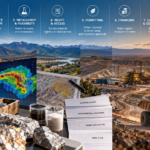
This study follows the successful commercial production launch at their Tocantinzinho mine in Brazil, which was delivered on time and on budget: a rare feat in the current cycle. The Oko West economics are supported by an Internal Rate of Return (IRR) of 27% and a projected payback period of just 2.9 years. At a spot price of $3,000/oz, the project’s NPV scales to $3.2 billion.
For investors, G Mining represents the “developer premium.” By maintaining an in-house construction and engineering team, they bypass the contractor margin-stacking that has plagued competitors. The market is now watching to see if G Mining will become a target for a senior producer looking to replenish a depleting Tier 1 pipeline.
Royalty & Streaming: Wheaton’s $4.3B BHP Deal Signals a High-Stakes Capital Shift
Wheaton Precious Metals (WPM) has executed the largest silver streaming transaction in history, betting $4.3 billion on BHP’s Antamina mine in Peru. This move doubles Wheaton’s silver entitlement from the asset to 67.5%, effectively making Antamina the cornerstone of their global portfolio.
This transaction is a clear indicator of the “New Paradigm” in project finance. As traditional bank lending for large-scale mining remains tight due to ESG hurdles and Basel IV capital requirements, streaming companies have evolved from niche financiers into primary capital providers.
Wheaton is essentially providing BHP with the liquidity to fund their transition toward “green” commodities (copper and potash) while Wheaton secures a multi-decade, low-cost silver stream. With Antamina expected to contribute 18% of Wheaton’s total gold equivalent production by 2030, the company is positioning itself as a proxy for industrial and precious metal upside without the direct exposure to rising underground operating costs.

Commodity Forecast: Lithium 2026 Price Trajectory and Margin Gravity
The lithium market in 2026 is characterized by “Margin Gravity.” After the supply-side shocks of 2023-2024, the market has settled into a period of rationalized growth. While the “Silicon-Lithium Nexus” is driving battery efficiency, the oversupply of spodumene concentrate from Australia and Africa has kept a lid on spot prices.
Skillings Mining Intelligence forecasts a base-case lithium carbonate price of $18,500/t for the remainder of 2026. While this is significantly lower than the 2022 peaks, it is above the marginal cost of production for most brine operations in the Lithium Triangle.
The focus for 2026 has shifted from “geology” to “refining corridors.” Investors are increasingly rewarding companies that have secured domestic refining capacity in North America or the EU, rather than those with just high-grade resources in isolated jurisdictions. The 2026 outlook suggests that while volume is increasing, the era of triple-digit margins for unrefined concentrates is over.

Risk Watch: South32’s Hermosa Blowout and the Inflationary Capex Cycle
The most significant warning sign for mining investors this quarter came from South32’s Hermosa project in Arizona. The company announced a US$1.1 billion capex increase, bringing the total project cost to US$3.3 billion: a 50% jump from the 2024 estimates.
The “Hermosa Blowout” is a textbook example of the risks inherent in the current US mining renaissance. South32 cited contractor underperformance, higher-than-expected shaft construction costs, and US tariffs on steel and specialized machinery as the primary drivers.
Key Takeaways from the Hermosa Update:
- Operating Costs: Forecast at $100/t, up from $86/t.
- Timeline: First production delayed to H2 FY2028.
- Sustaining Capital: Increased by 39% to $50M per annum.
This development serves as a critical reminder: in a jurisdiction with high labor costs and complex regulatory frameworks, “permitting” is only half the battle. The real risk lies in the execution phase, where the shortage of skilled underground mining contractors is creating a bottleneck that directly eats into shareholder returns.

Conclusion: Navigating the 2026 Mining Cycle
As we progress through 2026, the strategy for mining investors must pivot from “discovery” to “delivery.” Companies like G Mining Ventures prove that value can be created through disciplined execution, while the South32 situation highlights the fragility of large-scale development in a high-inflation environment.
The Wheaton-Antamina deal suggests that the market’s biggest players are willing to pay a premium for “known quantities” in Tier 1 assets. For the retail and institutional investor, the message is clear: prioritize balance sheet strength and operational track records over blue-sky exploration potential.