By Penny Langford
The global mining industry has long focused its forecasting efforts on geological depletion, falling ore grades, and labor disruptions. However, as we move through mid-2026, a secondary market: often dismissed as a mere byproduct: has emerged as the primary bottleneck for copper supply. The availability and price of sulphuric acid are now fundamentally reshaping the copper price forecast for 2026, forcing analysts to move beyond simple demand-side modeling to account for a complex chemical supply chain crisis.
Sulphuric acid is the silent engine of the copper industry. Approximately 21% to 25% of the world’s copper is produced through solvent extraction-electrowinning (SX-EW), a process that relies heavily on leaching ore with acid. As of May 2026, structural shifts in acid supply: driven by geopolitical bans and shifting smelting capacities: have created a "chemical ceiling" on copper output that the market is only beginning to price in.
The 2026 Sulphuric Acid Supply Shock
The current volatility in the copper market stems from a convergence of three major factors in the sulphuric acid sector. First, China’s decision to implement a strict export ban on the chemical effective May 1, 2026, has removed a significant portion of the merchant market’s liquidity. Historically, China used its massive smelting capacity to export surplus acid to regions like Chile and the Democratic Republic of Congo (DRC). That tap has now run dry.
More Read

Second, ongoing instability in the Middle East has interrupted the flow of elemental sulfur, the primary feedstock for acid production. Finally, the shift toward green energy is paradoxically tightening the market. As coal-fired power plants (a source of sulfur-rich flue gas) are decommissioned, the incidental production of "smelter acid" is failing to keep pace with the exponential growth in copper demand.


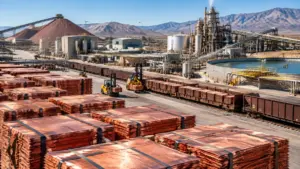
Infrastructure at a modern copper mining facility, where processing plants now face rising input costs for essential chemicals.
Copper Price Forecast 2026: Market Snapshot
Despite a projected global surplus of roughly 96,000 tonnes according to the International Copper Study Group (ICSG), prices have remained remarkably resilient, hovering near $5.90/lb ($13,000/mt). This price paradox exists because the surplus is largely on paper, reflecting inventories that are logistically trapped or of a grade not easily utilized by the most supply-strained regions.
More Read

| Institution | 2026 Average Forecast (USD/mt) | Scenario/Outlook |
|---|---|---|
| Goldman Sachs | $10,710 | Base case; focus on Chinese recovery |
| Citibank | $12,000 | Bullish; supply-side bottlenecks |
| JP Morgan | $11,000 | Conservative; macroeconomic headwinds |
| S&P Global | $12,100 | Supply tightness from input constraints |
| Skillings Analysis | $11,850 – $12,400 | Acid-driven supply contraction in SX-EW |
Regional Vulnerabilities: Chile and the Copper Belt
The impact of the acid shortage is not distributed evenly. It is most acute in regions that rely on leaching rather than concentrate smelting.
Chile: The World’s Largest Producer Under Pressure
In Chile, the world's leading copper producer, Q1 2026 production already registered a 6% year-over-year decline. While domestic supply from state-owned Codelco and integrated majors like Anglo American has provided a temporary buffer, the visibility for the second half of 2026 is deteriorating. Small and mid-tier miners, who procure acid on the spot market, are facing prices that have more than doubled in the last six months. For these operators, the "copper price forecast 2026" is less about the LME price and more about the margin compression caused by chemical procurement costs.
The DRC and Zambia: The SX-EW Nexus
The African Copper Belt is perhaps the most structurally exposed region. Over 80% of copper production in the DRC and Zambia is derived via SX-EW. The logistical challenge of importing acid into landlocked Central Africa was already significant; with the Chinese export ban, these miners are competing for limited supplies from South Africa and the Middle East at exorbitant premiums. We expect at least 150,000 to 200,000 tonnes of African supply to be "at risk" of curtailment by late 2026 if current acid price trajectories continue.

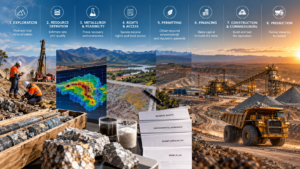
Active extraction of ore that requires extensive chemical processing to reach refined metal status.
Why Traditional Forecasting Models are Failing
Traditional copper forecasting models often treat the cost of reagents as a fixed variable or a minor inflationary adjustment. This approach is no longer valid in 2026. The current acid crisis is a structural shift, not a cyclical fluctuation.
Forecasters must now account for:
- Smelter-to-Leach Ratios: As companies move toward lower-grade oxide ores that require leaching, their acid demand increases just as smelting capacity (and thus byproduct acid) becomes more geographically concentrated in China.
- Transportation Logistics: Sulphuric acid is hazardous and expensive to ship. A shortage in Chile cannot be easily solved by a surplus in Europe.
- The Nickel-Copper Competition: High-pressure acid leach (HPAL) facilities for nickel production (essential for EV batteries) are competing for the same sulphuric acid volumes as copper miners, further driving up the price.
For decision-makers at firms like Lundin Gold or major diversified miners, securing long-term chemical supply contracts has become as critical as securing mineral rights.
The Investor’s Perspective: Winners and Losers
In this environment, "Copper price forecast 2026" should be viewed through the lens of producer integration.
- The Winners: Large-scale integrated producers that operate their own smelters. These companies produce sulphuric acid as a byproduct of processing sulphide concentrates. They are not only insulated from price spikes but are actually profiting by selling surplus acid to their competitors.
- The Losers: "Pure play" leaching operations and junior miners with projects focused on oxide ores. These projects, which were attractive due to their lower initial capital expenditure (Capex), are now seeing their operating expenditures (Opex) spiral out of control.

Modern control rooms are increasingly focusing on supply chain logistics and input costs to maintain operational efficiency.
Looking Ahead to 2027 and Beyond
While the immediate focus is on the 2026 outlook, the sulphuric acid crisis will likely act as a catalyst for technological innovation. We are already seeing increased investment in acid recovery systems and alternative leaching technologies that use bio-leaching or glycine-based reagents. However, these technologies are years away from large-scale commercial viability.
The copper price forecast for 2026 remains bullish, not necessarily because demand is "exploding" beyond expectations: though AI and grid modernization remain strong drivers: but because the "floor" of production costs has moved significantly higher.
At Skillings Mining Intelligence, we anticipate that copper will remain range-bound between $11,500 and $12,500 per tonne for the remainder of the year. Any further escalation in geopolitical trade restrictions regarding chemical reagents could easily push the market toward the $14,000 "bull case" scenario frequently cited by Citibank.
Conclusion
The sulphuric acid crisis of 2026 is a reminder that the energy transition is not just a mining challenge, but a chemical one. As investors and operators evaluate their portfolios, the ability to secure chemical inputs will be the ultimate differentiator between profitable production and stalled operations. The narrative for 2026 has shifted: it’s no longer about whether there is enough copper in the ground, but whether we have the chemical means to bring it to the surface.
For more in-depth analysis of commodity market shifts and daily mining news, visit our mining review section or subscribe to the Skillings digital magazine.
Social Media Snippet (LinkedIn/X):
Is your copper forecast missing the chemical link? In 2026, sulphuric acid availability has replaced ore grade as the primary bottleneck for 25% of global supply. With China’s export ban now in effect, Chile and the DRC face a "chemical ceiling" that could push copper prices toward $13,000/mt. Read our deep dive on the 2026 outlook at Skillings.net. #Copper #MiningNews #Commodities #SulphuricAcid #EnergyTransition