The biggest gems ever discovered are worth hundreds of millions of dollars and remain among the rarest natural treasures on Earth. From the gigantic Bahia Emerald to the legendary Cullinan Diamond, these record-breaking gemstones transformed mining history, triggered international legal battles, and reshaped the global luxury market.
The market for ultra-rare gemstones has accelerated sharply in recent years as wealthy collectors increasingly diversify into hard assets, rare minerals, and museum-grade jewelry. Auction houses continue reporting record-breaking gemstone sales, particularly for large untreated emeralds, sapphires, and diamonds.
The biggest gems ever found continue attracting global fascination because of their size, rarity, and extraordinary value. Some of the world’s biggest gems now sit inside royal collections, museum vaults, and high-security facilities because their value is almost impossible to calculate.
Global demand for rare minerals and gemstones continues rising alongside broader mining investment trends. For a deeper look at the sector, read our Top 50 Biggest Mining Companies in the World 2026 ranking.
#1 Bahia Emerald — One of the Biggest Gems Ever Found
More Read

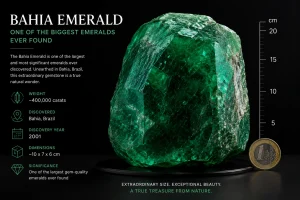

The Bahia Emerald remains one of the most mysterious and controversial discoveries among the biggest gems in history. Discovered in Brazil’s Bahia region, the giant emerald cluster weighs approximately 1.7 million carats — or around 752 pounds. That makes it the largest emerald specimen ever discovered.
Valuation estimates vary dramatically. Some experts place its value near $400 million, while others claim it could exceed $900 million depending on gemstone quality and ownership rights.
More Read

Brazil and Colombia remain among the world’s most important gemstone-producing regions. Our latest analysis on South America’s mining expansion explains why mineral-rich regions continue attracting billions in exploration capital.
The stone survived floods during Hurricane Katrina, disappeared after thefts and ownership disputes, and eventually ended up locked inside a Los Angeles evidence vault during ongoing legal battles.
#2 Cullinan Diamond — The Biggest Diamond Gem in History
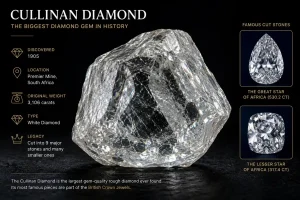
The Cullinan Diamond remains the largest gem-quality rough diamond ever found and one of the biggest gems in mining history. Discovered in South Africa in 1905, the enormous stone weighed 3,106 carats before cutting.
Rather than selling the stone intact, cutters divided it into multiple polished gems. The largest sections became part of the British Crown Jewels, including the famous Great Star of Africa and Lesser Star of Africa diamonds.
Diamond exploration remains a key part of global mining investment. You can also read our report on the biggest gold mines in the world to see how large-scale mineral discoveries reshape economies.
More than a century later, no gem-quality diamond larger than the Cullinan has ever been discovered.
#3 Star of Adam — One of the World’s Biggest Sapphire Gems
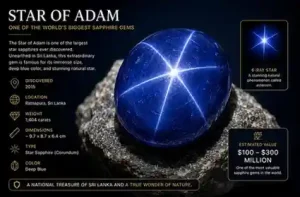
Discovered in Sri Lanka in 2015, the Star of Adam shocked the gemstone industry due to both its size and rarity. The massive blue sapphire weighs 1,404 carats, making it one of the biggest gems ever discovered in sapphire mining.
Star sapphires display a glowing six-pointed star when exposed to light — an optical effect called asterism. Achieving that effect at such enormous scale is exceptionally rare.
Experts have estimated the stone’s value anywhere between $100 million and $300 million.
#4 Guinness Emerald — One of Colombia’s Biggest Gems
The Guinness Emerald became world famous after entering the Guinness Book of Records as one of the biggest gems ever recovered from Colombia. The rough stone weighs 1,759 carats and originated from the legendary Coscuez emerald mine.
Colombia consistently produces some of the highest-quality emeralds in the world, and the Coscuez region is known for exceptionally vivid green coloration.
Some estimates suggest the emerald could eventually command hundreds of millions of dollars if fully cut into premium gemstones.
#5 Chaiyo Ruby — The Biggest Ruby Gem Mystery
The Chaiyo Ruby remains one of the most mysterious gemstones ever discussed publicly. Reportedly weighing an astonishing 109,000 carats, the stone would rank among the biggest gems in ruby history if authenticated.
However, controversy surrounds nearly every aspect of the gem. Competing claims suggest it originated either in Myanmar or Thailand. Other experts question whether the stone is natural at all.
Its current location remains unknown, adding even more mystery to one of the world’s biggest gems.
#6 Letseng Diamond — One of the Biggest White Diamond Gems
Lesotho’s Letseng mine has repeatedly produced some of the world’s most valuable diamonds per carat. One of its most extraordinary discoveries came in the form of a 910-carat near-colorless diamond.
The stone attracted enormous attention because of its exceptional purity. Diamonds with extremely low nitrogen content appear brighter and clearer after polishing, making them highly desirable among luxury jewelers.
The discovery reinforced Letseng’s reputation as one of the world’s premier sources of ultra-high-value diamonds and one of the leading producers behind the biggest gems market.
#7 Sergio Carbonado — The Biggest Black Diamond Gem Ever Found
Sergio remains the largest black diamond ever discovered. Found in Brazil in 1895, the rough stone weighed approximately 3,167 carats before cutting, making it one of the biggest gems ever unearthed.
Carbonado diamonds are exceptionally rare and differ structurally from traditional gem diamonds. Scientists still debate exactly how they formed.
Some theories suggest carbonado diamonds may have extraterrestrial origins connected to ancient meteorite impacts billions of years ago.
Why the Biggest Gems Matter to the Mining Industry
The biggest gems are not just luxury collectibles. They also demonstrate the economic importance of mining regions capable of producing rare mineral deposits. Countries like Brazil, Colombia, South Africa, Sri Lanka, and Lesotho have all benefited from gemstone demand.
Collectors now compete aggressively for the world’s biggest gems as investment demand for hard assets continues rising globally.
Mining companies continue searching for the next record-breaking discovery as global demand for rare minerals grows. Our coverage of the critical minerals boom in 2026 explains why exploration spending continues rising worldwide.
Frequently Asked Questions About the Biggest Gems
What is the biggest gem ever found?
The Bahia Emerald is widely considered the largest emerald ever discovered at approximately 1.7 million carats. However, the Cullinan Diamond remains the largest gem-quality rough diamond ever found.
What is the largest diamond ever discovered?
The Cullinan Diamond is the largest gem-quality rough diamond in history. It weighed 3,106 carats before being cut into multiple polished stones for the British Crown Jewels.
Which country produces the most famous gemstones?
Several countries dominate specific gemstone categories. Colombia is famous for emeralds, Sri Lanka for sapphires, South Africa for diamonds, and Myanmar for rubies.
How much are the biggest gems worth?
Valuations vary dramatically depending on rarity, clarity, origin, and market demand. Some of the biggest gems on Earth carry estimated values ranging from tens of millions to nearly $1 billion.
Can giant gemstones still be discovered today?
Yes. Mining companies continue discovering major gemstones in Africa, South America, and Asia. Improved exploration technology increases the chances of future record-breaking discoveries.
Sources and Industry References
Additional industry data and gemstone references are available through the United States Geological Survey (USGS), the Smithsonian National Museum of Natural History, and the Gemological Institute of America (GIA).
Source: Analysis compiled from historical gemstone records, mining industry publications, auction archives, geological reports, and publicly available industry data. Original inspiration article referenced from Mining.com and Oilprice reporting. :contentReference[oaicite:0]{index=0} :contentReference[oaicite:1]{index=1}