By Charles Pitts

The 2026 gold market has undergone a fundamental shift in how investors value “tier-2” discoveries. As the Federal Reserve’s “higher-for-longer” interest rate regime continues to pressure capital-intensive projects, the traditional premium once reserved for massive, multi-decade open pits has eroded. Today, the market’s darling is the “fast-payback” model: a strategic pivot that has brought the debate between high-grade underground starters and optimized open pits to the forefront of mining finance.
For developers like Barton Gold and those following the Minera Alamos operational playbook, the choice between open pit and underground is no longer just a geological one; it is a financial maneuver designed to capture the highest possible P/NAV (Price to Net Asset Value) in a capital-constrained environment.
The Investor Mandate: Cash Now, Scale Later
In the current gold price forecast 2026 outlook, bullion is comfortably testing the $2,500–$2,700/oz range, driven by persistent central bank accumulation and geopolitical hedging. However, project valuations haven’t seen a proportional lift across the board. Instead, a valuation “bifurcation” has emerged.
Projects with long lead times and billion-dollar capex requirements are trading at a significant discount, often struggling to break 0.4x P/NAV. In contrast, “lean” projects: those with high-grade starters that can return capital in under 18 months: are commanding premiums of 0.7x to 0.9x P/NAV.
More Read

This environment has revived interest in the “Copperstone Model”: a reference to the Arizona-based underground gold mine that exemplifies the lean, high-grade, infrastructure-light approach.

The Underground Advantage: The “Copperstone” Lean-Start Model
The appeal of high-grade underground restarts, such as Sabre Gold’s Copperstone or similar brownfield plays, lies in their capital efficiency. By leveraging existing declines and processing infrastructure, these projects bypass the multi-year permitting and “big-bang” capex of large open pits.
Underground mining in 2026 is no longer the labor-intensive venture of a decade ago. With the mass adoption of autonomous jumbo drills and battery-electric fleets, the “high-cost” stigma of underground mining has been partially mitigated by lower ventilation costs and higher productivity.
More Read

Key Economic Drivers for Underground Hits:
- Grade is King: Average head grades of 5–8 g/t gold allow for a massive margin buffer against inflationary opex.
- Lower Surface Footprint: Faster permitting cycles and reduced environmental rehabilitation liabilities.
- Staged Development: The ability to ramp up production organically from cash flow, minimizing equity dilution.
The Open Pit Counter-Attack: Barton Gold’s Area 51 Strategy
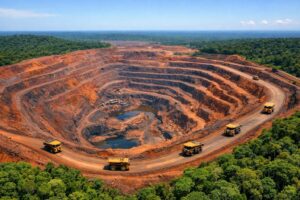
Barton Gold is proving that “open pit” doesn’t have to mean “slow payback.” Their Tunkillia project, specifically the Area 51 and Area 223 zones in South Australia, represents a modern evolution of the open-pit model.
Barton’s May 2025 Optimised Scoping Study (OSS) changed the narrative for large-scale assets. By focusing on high-grade “starter pits” (S1 and S2), the project aims to produce roughly 365,000oz of gold and 923,000oz of silver in just the first 27 months. The result? A staggering sub-1-year payback period at current gold prices.

By treating a large resource as a series of high-margin satellite cells rather than one massive low-grade haul, Barton is effectively mimicking the economics of a high-grade underground mine within an open-pit framework.
Comparative Economics: 2026 Project Benchmarks
To understand why the market is shifting, we must look at the sensitivity of these models to the current discount rates.
| Metric | High-Grade Underground (e.g., Copperstone) | Optimized Open Pit (e.g., Area 51) | Traditional Bulk Open Pit |
|---|---|---|---|
| Typical Head Grade | 6.5 g/t Au | 1.8 g/t Au (Starter) | 0.8 g/t Au |
| Initial Capex | $60M – $90M | $120M – $180M | $450M+ |
| Payback Period | 1.2 Years | 0.9 Years | 4.5 Years |
| P/NAV Multiplier | 0.82x | 0.75x | 0.38x |
| AISC (All-In Sustaining Cost) | $1,150/oz | $1,250/oz | $1,400/oz |
Why P/NAV Mining Valuations are Diverging
The P/NAV metric is particularly sensitive to the “time value of money.” In 2026, with a weighted average cost of capital (WACC) for juniors often exceeding 12-15%, the “tail” of a 15-year mine life is worth very little in today’s dollars.
Investors are rewarding “front-loaded” cash flows. This is the hallmark of the Minera Alamos philosophy: acquire near-production assets, keep the flowsheet simple (heap leach or basic CIL), and prioritize rapid transition to producer status.
For Barton Gold, the “Area 51” discovery is a catalyst because it adds high-grade inventory that can be pulled forward in the mine plan. The discovery of the Tolmer silver-gold zone nearby further supports this “blending” strategy, where high-grade “sweeteners” are used to keep the mill head-grade high and the payback periods low.

2026 Gold Price Forecast: A Tailwinds for Tier-2 M&A
The underlying gold price forecast 2026 outlook remains the primary tailwind. With gold holding steady above $2,500/oz, the “margin of safety” for these tier-2 projects has never been wider. Major producers, currently sitting on record cash piles but facing depleting reserves, are looking at Barton Gold and Minera Alamos-style assets with fresh eyes.
However, majors are no longer buying “potential ounces in the ground.” They are buying “de-risked cash flow.” A project that can prove a sub-2-year payback is an immediate accretive acquisition. A project that requires a five-year build and a billion-dollar check is a liability.
The Technical Edge: Hybrid Mining Models
We are also seeing the rise of “Hybrid” models. Projects that start as high-grade underground mines to pay off the mill and then transition into large-scale open pits once the capital is sunk. This “Underground-First” approach is becoming the preferred pathway for junior developers looking to reach mid-tier status without massive dilution.

Conclusion: The Winner of the 2026 Cycle
In the battle of Underground vs. Open Pit, the real winner is Capital Velocity.
Whether it is Barton Gold’s Area 51 optimizing its pit shells for immediate returns or the Copperstone-style underground restarts focusing on grade over volume, the successful mining CEOs of 2026 are those who think like hedge fund managers. They are optimizing for IRR and payback, not just “Total Ounces.”
For the savvy investor, the opportunity lies in identifying the developers who have moved past the “bigger is better” fallacy. In 2026, the high-grade underground starter and the optimized, fast-payback open pit are two sides of the same coin: the only coin that currently spends in the equity markets.