By Charles Pitts

The gold sector is witnessing a fundamental shift in capital allocation, characterized by a retreat from high-risk geopolitical frontiers toward the stability of Tier-1 jurisdictions. Nowhere is this more evident than in Ontario, where Agnico Eagle Mines and the provincial government have signaled a staggering C$14 billion commitment to expand and modernize the Abitibi mining camp through 2030.
As we enter the mid-point of 2026, this capital concentration is not merely a regional expansion; it is a strategic roadmap for the next wave of mining M&A deals. By anchoring production at multi-decade assets like Detour Lake and Upper Beaver, majors are setting the stage for a “hub-and-spoke” consolidation model that prioritizes long-term operational security over short-term grade spikes in volatile regions.
The C$14 Billion Anchor: A Multi-Decade Commitment
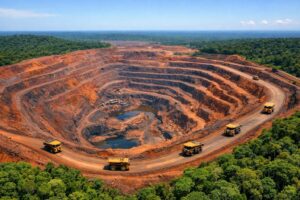
The centerpiece of Agnico Eagle’s Ontario strategy is the extension of the Detour Lake mine life to approximately 2054. This extension, coupled with the development of the Upper Beaver gold-copper project, represents one of the largest sustained capital deployments in Canadian mining history.
From an operator’s perspective, the C$14 billion figure covers more than just pit expansions. It includes a massive push toward autonomous haul trucks and cost-saving technologies, which are essential for maintaining margins at lower-grade, large-scale deposits. For investors, the scale of this investment serves as an implicit valuation floor for the Abitibi region. When a major producer sinks $14 billion into a specific corridor, every junior explorer and mid-tier operator within a 100-kilometer radius becomes part of a potential consolidation narrative.
More Read



Why Majors Prioritize Stability Over Grade
In the 2010s, the “gold rush” was often defined by a search for high-grade “bonanza” veins, often in jurisdictions with challenging regulatory frameworks or fluctuating tax regimes. However, the 2026 mining landscape is different. The “Jurisdiction Premium” has surpassed the “Grade Premium” in the eyes of institutional investors and boardrooms alike.
The Abitibi belt offers a rare combination:
More Read

- Regulatory Predictability: Transparent permitting processes and government partnerships, such as those seen in Ontario’s recent mining reforms, reduce the risk of multi-year delays.
- Sunk Infrastructure: With C$14 billion flowing into processing plants, roads, and power grids, the cost of bringing an adjacent discovery into production drops significantly.
- ESG Integration: Operating in a Tier-1 jurisdiction allows for easier compliance with strict ESG reporting standards, which is increasingly tied to capital access.
This shift means that a 1.5 g/t deposit in Ontario is often viewed as more valuable than a 5.0 g/t deposit in a jurisdiction prone to resource nationalism. The Agnico-Eagle spend is a clear bet that operational continuity and political safety are the most reliable drivers of shareholder value in a volatile global economy.
Gold Price Forecast 2026 Outlook: The M&A Engine
The current gold price environment is the primary catalyst for this aggressive M&A activity. As we analyze the gold price forecast 2026 outlook, three scenarios emerge that will dictate the pace of acquisitions:
- The Base Case ($2,200 – $2,400/oz): This “higher-for-longer” environment allows majors to fund expansions out of free cash flow. In this scenario, we expect Agnico and its peers to target mid-tier players with existing production to immediately boost their Tier-1 ounce profile.
- The Bull Case (>$2,500/oz): A sharp move higher: driven by continued central bank buying and geopolitical de-risking: would likely spark a “land grab” in the Abitibi. Majors would move down the food chain to acquire advanced-stage exploration juniors to lock in long-term supply.
- The Bear Case (<$2,000/oz): Even in a price retreat, the C$14 billion Ontario spend acts as a defensive moat. Consolidation would still occur, but it would shift toward distressed M&A, where majors pick up high-quality assets from overleveraged mid-tiers at a discount.

Predictive Look: The Next Abitibi Targets
The “hub-and-spoke” model suggests that any asset within hauling distance of Agnico’s processing hubs: Detour Lake, Kirkland Lake, and the Malartic complex: is a candidate for integration. Industry analysts are closely watching several profiles that fit the 2026 acquisition criteria:
1. The High-Grade Satellite
Mid-tier operators like Alamos Gold or Wesdome Gold Mines have historically been seen as consolidators themselves, but in the current environment, their high-grade assets in Ontario and Quebec make them attractive “bolt-on” targets for super-majors. Their ability to deliver immediate high-margin ounces complements the lower-grade bulk tonnage of the larger pits.
2. The Resource-Rich Junior
Juniors with defined resources exceeding 2 million ounces in the Abitibi are the most likely targets for early-stage buyouts. The goal for a major like Agnico is to prevent competitors from establishing a foothold near their core infrastructure. Companies focused on deep continuity and resource expansion are particularly valuable as they offer a “brownfield” expansion opportunity without the risks of a “greenfield” startup.
3. The Gold-Copper Pivot
With projects like Upper Beaver incorporating copper, there is a clear trend toward diversifying the mineral mix within traditional gold camps. Any mid-tier with a gold-copper porphyry or VMS deposit in the region will command a premium as majors look to satisfy investor demand for “energy transition” metals alongside their gold production.
Market Dynamics: The Role of Valuations
The valuation gap between majors and juniors remains a hurdle, but the current valuation and royalty pivots are bridging the divide. We are seeing an increase in all-share deals and structured earn-ins, which allow majors to preserve cash while providing juniors with the technical expertise and capital needed to navigate the final stages of permitting and construction.
| Metric | 2024 Average | 2026 Forecast | Impact on M&A |
|---|---|---|---|
| Gold Price (Avg) | $2,050/oz | $2,350/oz | Increases cash-on-hand for deals |
| Abitibi AISC | $1,150/oz | $1,280/oz | Modernization spend offset by inflation |
| Jurisdiction Risk Discount | 15-20% | 25-30% | Favors stable regions like Ontario |
| Average M&A Premium | 22% | 31% | Reflects scarcity of Tier-1 assets |
Strategic Implications for Investors
The takeaway from the Agnico-Eagle Ontario spend is that the “easy ounces” have been found, and the “safe ounces” are being hoarded. For decision-makers, the strategy is clear: focus on companies with a footprint in proven, stable camps that have the infrastructure to withstand inflationary pressures and labor shortages.
As we look toward the remainder of 2026, the Abitibi region will remain the epicenter of mining M&A deals 2026. The $14 billion commitment is not just a capital expenditure; it is a declaration that the future of gold mining is domestic, digitized, and deeply integrated into the economic fabric of Tier-1 jurisdictions.