By Penny Langford

Mining industry trends in 2026 are defined by a singular, high-stakes collision: the relentless expansion of artificial intelligence (AI) and the structural inability of global power grids to keep pace. As global AI spending eclipses $2 trillion this year, the “silicon cycle” has officially merged with the “mining cycle.” The result is a 2026 commodities super-cycle where silicon’s hunger for electricity is dictating the valuation of copper, uranium, and the logistics corridors that move them.
For operators, investors, and policymakers, the core challenge of 11 June 2026 is no longer just finding the ore: it is powering the extraction and ensuring the infrastructure exists to deliver it to a power-hungry world.
The 2026 Super-Cycle: Why Commodities Are the New Compute
The narrative that dominated 2024 and 2025: that AI is a software revolution: has been replaced by the reality that AI is a hardware and energy revolution. In 2026, data centers are projected to consume nearly 1,000 TWh globally, roughly double their 2023 levels. This massive electricity requirement has transformed mining companies from simple material suppliers into critical nodes of the global energy infrastructure.
The current super-cycle is fundamentally different from the China-led boom of the early 2000s. While that era was driven by urbanization, the 2026 surge is driven by compute intensity. Every new H200-equivalent chip deployed requires a corresponding investment in copper-intensive cooling, silver-heavy circuitry, and, most crucially, reliable baseload power.
More Read
We are seeing a decoupling of mining valuations from general industrial production. Instead, miners are increasingly being valued as “power plays.” Projects with secured, low-carbon energy sources: whether through small modular reactors or high-capacity renewables: are commanding significant premiums in the current M&A environment.

AI-Uranium: SMR Funding and the Nuclear Pivot
The most significant shift in 2026 energy policy is the formal integration of Small Modular Reactors (SMRs) into mining and data center development. With data centers facing a projected 49 GW power access shortfall in the U.S. alone, the mining sector has emerged as a primary partner for nuclear deployment.

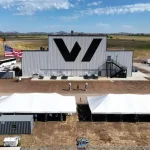
A conceptual SMR installation at a remote mining facility, providing stable, carbon-neutral baseload power for high-intensity operations.
More Read
SMR Deployment: The New Baseline
In 2026, SMR funding has transitioned from government-backed R&D to private-sector capital. Major mining houses are no longer waiting for grid extensions; they are co-developing SMRs to power both their remote operations and the adjacent data centers they are increasingly hosting.
- Reliability: SMRs provide the 24/7 baseload power that wind and solar cannot yet guarantee for heavy industrial milling.
- Decarbonization: With ESG mandates tightening, nuclear is the only scalable path for miners to achieve “Scope 1” neutrality while maintaining 90%+ capacity factors.
- Funding: Institutional investors have earmarked over $150 billion for SMR-linked infrastructure in 2026, viewing these as “de-risked” long-term assets compared to traditional greenfield mining.
Recent consolidation, such as the Cameco and Orano deal at Cigar Lake, highlights the strategic necessity of controlling the primary fuel source for this nuclear pivot.
Copper: The $12,000 Floor and the Silicon-Mining Sync
Copper remains the “indispensable metal” of 2026. While the traditional “mining cycle” (supply-driven) often moves in 10-year waves, it has now synced with the “silicon cycle” (demand-driven by electronics), which moves much faster.
Copper Price Forecast 2026: Drivers and Risks
As of June 2026, copper prices have established a firm $12,000/t floor. The market is currently in a structural deficit of approximately 450,000 tonnes, driven by two primary factors:
- AI Infrastructure: Data centers require 3x more copper per megawatt than traditional commercial buildings for high-density power distribution and liquid cooling systems.
- Grid Hardening: Global utilities are in a race to reinforce aging grids to handle the dual surge of EV charging and AI workloads.
| Case | Copper Price ($/t) | Primary Driver |
|---|---|---|
| Bull | $15,500 | Accelerated SMR rollout + continued DRC logistics bottlenecks |
| Base | $12,400 | Steady data center expansion + successful Lobito Corridor ramp-up |
| Bear | $9,800 | Macro-economic slowdown in China + faster-than-expected recycling tech |
The volatility in copper is no longer just about housing starts; it’s about the speed of “rack density” in North Carolinian and Irish data centers.

Lobito Corridor: The Kamoa-Kakula Milestone
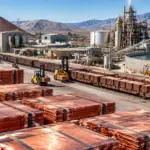
Logistics have become the primary bottleneck for the 2026 energy transition. The Lobito Corridor: linking the Central African Copperbelt to the Atlantic port of Lobito in Angola: has reached a critical operational milestone this quarter.
The corridor is now facilitating record exports from the Kamoa-Kakula complex, which has officially become the world’s third-largest copper mine. By bypassing the traditional, congested routes through South Africa and East Africa, the Lobito Corridor has reduced transit times for copper concentrates from 30 days to less than 10.
Why the Lobito Corridor Matters in 2026:
- Strategic Autonomy: It provides a Western-backed logistics alternative to traditional routes, reducing geopolitical risk for investors in the DRC and Zambia.
- Cost Efficiency: Lower freight costs have significantly reduced the All-In Sustaining Costs (AISC) for Copperbelt operators, making their 2026 margins among the healthiest in the industry.
- Mineral Diversification: While copper is the lead, the corridor is also beginning to move significant volumes of high-grade cobalt and manganese, essential for the evolving battery landscape.
The Boardroom: Buy vs. Build in a High-Scarcity Market
In the boardroom, the central debate of 2026 is “Buy vs. Build.” As permitting timelines for new greenfield mines stretch beyond 15 years in Tier-1 jurisdictions, the scarcity value of existing assets has reached an all-time high.

The Consolidation Super-Cycle
The “Build” option is increasingly viewed as a 2040 solution for a 2026 problem. Consequently, we are witnessing a major M&A supercycle where majors are aggressively acquiring late-stage juniors and mid-tier producers.
- The Valuation Gap: Junior miners with proven, high-grade resources are seeing P/NAV (Price to Net Asset Value) multiples not seen since 2011. Smart investors are looking for P/NAV anomalies to identify takeover targets.
- Asset Quality: The focus has shifted from “volume at any cost” to “quality with power.” An asset with a lower grade but secured hydropower or an SMR permit is now more valuable than a high-grade deposit in a power-starved region.
- Technology Integration: AI is not just a demand driver; it is an operational tool. In 2026, boardrooms are prioritizing the scaling of autonomous fleets and AI-driven orebody modeling to offset rising labor and energy costs. Reports suggest that digital-first mines are seeing AISC reductions of 15%–22%.
Conclusion: The New Mining Reality
The convergence of compute and commodities has fundamentally rewired the mining industry. In 2026, the successful mining company looks less like a traditional extractor and more like a high-tech infrastructure firm. As we navigate this energy-constrained, AI-accelerated decade, the winners will be those who control the nexus of power, logistics, and critical metals.
Stay tuned for our upcoming deep-dive into the Gold Price Forecast for 2026 and the impact of these macro trends on precious metals.