By Charles Pitts

Rio Tinto just achieved a major breakthrough on the Simandou iron ore project in Guinea by completing the 70-kilometer SimFer rail spur. This milestone signals a shift as the project moves quickly toward full commissioning of the new Trans-Guinean logistics corridor.
Key Takeaways
- Rio Tinto completed the 70-kilometer SimFer rail spur integral to the $600 km Trans-Guinean Railway.
- The project expects to finish commissioning common rail-to-port infrastructure by Q1 2026.
- Combined Simandou exports could reach 120 million tonnes per annum, challenging Australia’s top producers.
- The Morebaya port is 66% complete and set for early 2027 operational status.
What Rio Tinto’s Rail Milestone Means for Simandou Iron Ore
Mechanical completion of the 70-kilometer SimFer rail spur marks a pivotal step for Rio Tinto’s Simandou project in Guinea. This rail spur connects the high-grade SimFer mine sites to the main Trans-Guinean Railway, enabling the first full logistical link from mine to port. Simandou’s infrastructure is one of the largest undertakings in the mining sector, requiring a new industrial backbone unlike Australia’s established Pilbara rail systems.
The Trans-Guinean Railway is managed by a joint venture involving Rio Tinto, the Government of Guinea, and other partners. This complex alliance now transitions from construction to operational testing. Early rail movements of ore in late 2025 and early 2026 demonstrate the network’s functional readiness ahead of full commissioning scheduled for the first quarter of 2026.
For exploration and technology followers, this rail completion highlights not just engineering success but the start of integrating multi-user logistics essential for Simandou’s long-term operation. Rio Tinto’s progress is well documented in company news, emphasizing the scale of this breakthrough.
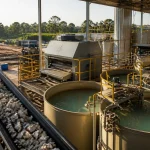
How Simandou’s Integrated Logistics Unlock New Iron Ore Supply Chains
The Trans-Guinean logistics corridor combines a 600-kilometer main line and a dedicated deep-water port at Morebaya. This corridor will tackle longstanding logistical challenges that stranded Guinea’s massive, high-grade iron ore deposits. The SimFer rail spur directly links the mine to this corridor, shifting the project from earthworks to operational ramp-up.

Operational milestones include commissioning permanent crushing facilities at the mine site later in 2026, replacing temporary crushers currently in use. Until the Morebaya port reaches full capacity in early 2027, Rio Tinto will use shared ports with the Winning Consortium Simandou (WCS). This arrangement creates intricate coordination between rail arrivals and maritime logistics, paralleling models seen in other critical mineral corridors like the Lobito Corridor.
Why Simandou’s High-Grade Ore Supports Green Steel Production
Simandou’s ore averages over 65% iron content with low impurities, making it highly suitable for low-carbon steel production. Demand for this grade is rising with steelmakers shifting toward Direct Reduced Iron (DRI) processes that reduce carbon emissions by using hydrogen or natural gas instead of coal. Rio Tinto’s investment aligns with evolving ESG goals and strengthens its position amid tightening environmental regulations.
This strategic resource will support producers aiming to cut Scope 3 emissions by providing premium quality iron ore tailored for the emerging green steel market. For detailed industry and sustainability insights, readers can refer to ESG mining reports.
Industry Impact: What This Means for Iron Ore Mining in Africa and Australia
Rio Tinto’s milestone on the Simandou project reshapes the global iron ore landscape by introducing Africa as a formidable competitor to traditional Australian suppliers. The project’s 120 million tonnes per annum capacity rivals major producers in Australia’s Pilbara region, creating new supply options amid rising global demand aligned with sustainable steelmaking.
This development diversifies Rio Tinto’s portfolio beyond its heavy base in Australian iron ore, offering geographic and regulatory hedges. Moreover, Guinea’s infrastructure upgrades promise long-term regional economic transformation beyond mining, fueling transport and freight growth with the Trans-Guinean Railway’s multipurpose design.
Competitors should watch how Rio Tinto coordinates with local and international partners as this project advances through its 30-month ramp-up period.
Market Analysis: Iron Ore Prices and Investment Prospects for Rio Tinto
Introducing Simandou’s high-quality ore could temper long-term global price premiums for low-impurity fines. However, Rio Tinto gains critical leverage by adding a high-grade asset outside Australia, providing price diversification and security against supply chain disruptions.
Investors should consider the supply-demand balance as Simandou moves toward production in 2026, with ramp-up extending through 2028. The project’s annual export potential of 120 million tonnes represents a significant market influx, likely impacting iron ore trade dynamics globally.
For financial details and market context, visit mining finance analysis or consult official Rio Tinto releases.
Future Outlook: What Investors Can Expect From Rio Tinto’s Simandou Project
Investors should anticipate full commissioning of the rail-to-port infrastructure by Q1 2026. This milestone precedes a crucial 30-month operational ramp-up that targets steady export flows from the combined Simandou operations.
Simandou is set to significantly influence global iron ore supply by 2028, potentially establishing Guinea as a key iron ore exporter. Observers should track the resolution of logistical risks and joint venture coordination to assess project stability during this ramp-up phase.
Final Thoughts on Rio Tinto Iron Ore Australia and the Simandou Expansion
Rio Tinto’s achievement at Simandou represents a transformative advance for iron ore mining both in Guinea and for its broader portfolio including Australia. The rail milestone and forthcoming infrastructure commissioning open new avenues for diversifying supply and penetrating the green steel market. Investors focusing on Rio Tinto iron ore Australia assets should watch for Q1 2026 milestones that could redefine global production dynamics.