By Charles Pitts

The latest milestone in autonomous mining technology 2026 is not a laboratory demonstration. It is a production number: Komatsu has commissioned its 1,000th ultra-class autonomous haul truck, extending a commercial deployment that has already moved more than 11.5 billion metric tonnes of material.
The milestone, announced in April, involved a Komatsu 930E-5AT electric-drive truck with a 290-metric-tonne payload. The machine was deployed at Barrick’s Nevada Gold Mines operation in the United States, showing how autonomous haulage is moving beyond a small group of large iron ore mines and into gold and copper-producing regions.
The more important development is what is happening around the truck. At Freeport-McMoRan’s Bagdad mine in Arizona, a 33-truck fleet has been converted to autonomous haulage. In Australia’s Pilbara, Rio Tinto operates more than 130 autonomous trucks and 40 autonomous drills. In China, the Huaneng Yimin open-pit coal mine is running 100 cabless, battery-electric autonomous trucks.
Taken together, these deployments point to the next phase of mine automation: not simply driverless haulage, but the integration of autonomy, electrification, communications networks and mine planning into one operating system.
More Read

Komatsu’s 1,000-truck milestone moves autonomy into the mainstream
Komatsu’s FrontRunner Autonomous Haulage System was introduced commercially in 2008. Its 1,000th ultra-class commissioning marks a shift in how mining companies assess the technology.

The central question is no longer whether an autonomous haul truck can operate on a defined route. The question is whether an entire mine can redesign its operating model around predictable, software-managed movement of material.
Komatsu says FrontRunner customers have collectively moved more than 11.5 billion tonnes. The company also reports more than 900 trucks commissioned as of October 2025, making the subsequent move to 1,000 units a rapid expansion in the global installed base.
More Read

The 930E platform is significant because it is already an electric-drive haul truck, rather than a conventional mechanical-drive platform adapted solely for automation. That gives operators a path to combine autonomy with trolley-assist systems, battery-electric technology or other energy-management approaches as those technologies mature.
Komatsu has also demonstrated an autonomous electric-drive truck connected to a dynamic trolley line. The test matters because haulage emissions and energy consumption remain among the largest operational challenges in open-pit mining. Autonomy can stabilize speed, reduce unnecessary stops and improve dispatching, but electrification determines how much diesel consumption can ultimately be removed.
The result is a more integrated technology roadmap. Equipment manufacturers are increasingly treating the truck, autonomy stack, fleet-management system and mine network as one platform rather than separate products.
Linkable insight: The value of autonomous haulage is shifting from “driverless equipment” to production control: the ability to make every truck cycle more predictable, measurable and compatible with the mine plan.

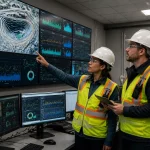
Remote operators monitor mine maps, equipment status and production performance.
Bagdad shows that conversion is an operating-model project
Freeport’s Bagdad mine provides one of the clearest examples of the organizational work required to scale autonomy.
The Arizona operation began its conversion in 2023. By August 2025, all 33 autonomous haul trucks were operating, while seven staffed trucks remained in a separate area during the transition. Freeport said the final staffed trucks were scheduled to be removed from service at the end of that year, making Bagdad the first major U.S. mine to move to fully autonomous haulage.
The equipment retrofit was only one part of the project. Bagdad built a new command center, upgraded communications and data-transmission networks, widened roads and established an isolated autonomous operating zone to reduce interactions between driverless and manually operated equipment.
That checklist is important for mining executives evaluating capital requirements. Autonomy cannot be installed as a software layer without changing the physical and operational environment around the fleet. Road geometry, traffic control, loading patterns, dispatch logic, maintenance practices and emergency procedures all become part of the deployment.
The workforce transition is equally material. Freeport said more than 200 haul truck drivers were retained through redeployment, retraining and new roles. Some moved into shovel operation, while others transitioned into information technology, autonomous-system support and other mine departments.
This approach reflects a broader reality: autonomy removes people from the cab, but it does not remove people from the production system. It changes where their expertise is applied.
Rio Tinto links autonomous haulage with drilling and mine control
Rio Tinto’s Pilbara operations illustrate what a more mature automation ecosystem looks like.
According to the company’s published automation profile, Rio Tinto operates more than 130 autonomous trucks across its iron ore operations. It also operates 40 autonomous drills on five drill platforms across seven mine sites. A controller based at the Perth Operations Centre can plan activity for as many as eight drills from one console.
The productivity case is built on consistency. Rio Tinto has previously estimated that autonomous trucks operated approximately 700 hours more per year than conventional haul trucks in 2018 and delivered costs about 15% lower. These figures are historical company estimates rather than a universal benchmark, but they show why autonomy is attractive in high-volume, repetitive haulage environments.
The operating benefit is not limited to removing drivers from hazardous areas. Autonomous trucks can maintain spacing, follow defined routes and respond to dispatch instructions without the variability associated with shift changes, fatigue or uneven traffic patterns.
Autonomous drilling adds another layer. Drill accuracy affects blast fragmentation, loading performance, downstream crushing and energy use. When drilling data is connected to the mine plan, operators can manage the chain from bench design to blasting and haulage with greater precision.
For copper producers, this systems approach is especially relevant. As ore grades decline and haul distances increase, productivity improvements must come from better coordination as well as larger equipment. Skillings’ analysis of the copper market outlook highlights the pressure on producers to expand supply while managing costs, energy requirements and project execution risk.
Yimin demonstrates the convergence of autonomy and electrification
The Yimin open-pit coal mine in Inner Mongolia represents a different model from the ultra-class diesel-electric fleets common in Australia and North America.
XCMG says it has delivered 100 autonomous, all-electric haul trucks to the mine. Huawei, which worked with China Huaneng and other partners on the project, describes the trucks as cabless and coordinated through a vehicle-cloud-network architecture using 5G-Advanced connectivity.
The Huaneng Ruichi trucks carry up to 90 metric tonnes, operate at speeds of up to 50 km/h and are designed to work in temperatures as low as minus 40 degrees Celsius. Official project materials identify lithium iron phosphate batteries and automated battery swapping in less than six minutes.
Huawei says the mine’s 5G-Advanced network supports high-definition video transmission and cloud-based dispatching. XCMG and its partners estimate that the 100-truck fleet can replace more than 15,000 tonnes of diesel consumption and avoid approximately 48,000 tonnes of carbon dioxide emissions annually, although those figures are company and project estimates.
Yimin’s significance lies in the architecture. The trucks are not simply electric vehicles operating without drivers. They are part of a coordinated system involving charging and battery swapping, fleet dispatch, high-precision positioning, obstacle detection, route planning and solar-generated electricity.
The cabless design also changes the economics of the vehicle. Removing the driver’s cab creates more flexibility in the vehicle layout and removes personnel from an extremely cold, dusty and high-altitude operating environment. It also places greater demands on sensors, communications reliability and remote intervention procedures.

Automated drilling is extending mine control beyond surface haulage.
Sandvik extends automation into drilling and underground operations
Surface haulage has attracted most of the attention, but automation is also spreading across drilling and underground equipment.
Sandvik’s AutoMine Autonomous package enables fully autonomous surface drilling fleet operation from a remote control room. The AutoCycle function can automate hole-to-hole tramming and drilling across multiple rigs, allowing one operator to supervise as many as three rigs from a remote station.
Sandvik also offers AutoMine solutions for underground equipment, including tele-remote and automated control of underground drills. These systems are designed to let operators supervise machines away from the active work area and, in some configurations, manage multiple machines through a common control environment.
The distinction between autonomous and tele-remote operation remains important. A tele-remote machine still depends on human control for key movements, while an autonomous system executes a defined task with limited intervention. However, both approaches contribute to the same operational objective: moving people away from high-risk areas while increasing equipment utilization.
Underground mines face more complicated conditions than surface haul roads. Tunnels change, visibility is limited and equipment must share constrained working areas. That makes traffic management, access control, perception systems and interoperability central to deployment.
Autonomous mining technology deployment tracker
| Deployment | Equipment or system | Scale | Primary significance | Status |
|---|---|---|---|---|
| Komatsu FrontRunner | Ultra-class autonomous haul trucks | 1,000 commissioned | Production-proven autonomous haulage across multiple regions and commodities | Commercial scale |
| Freeport Bagdad, Arizona | Caterpillar 793 haul trucks | 33 autonomous trucks | Full-fleet conversion at a major U.S. mine, including site and workforce redesign | Fully implemented transition |
| Rio Tinto Pilbara | Autonomous haul trucks | 130+ trucks | Long-running high-volume haulage integrated with centralized operations | Operating fleet |
| Rio Tinto Pilbara | Autonomous drills | 40 drills across seven sites | Remote drilling and centralized shift planning | Operating fleet |
| Huaneng Yimin, Inner Mongolia | XCMG cabless electric haul trucks | 100 trucks | Battery-electric autonomy, 5G-Advanced and battery swapping at fleet scale | Operating fleet |
| Sandvik AutoMine | Autonomous and tele-remote drilling | Multiple rigs per control station | Extends automation into surface and underground drilling | Commercial platform |
Sources: Komatsu, Freeport-McMoRan, Rio Tinto, XCMG, Huawei and Sandvik company materials. Deployment figures are reported by the respective companies.
The next phase is integrated mine planning
The industry’s next challenge is not simply adding more autonomous trucks. It is ensuring that autonomous equipment improves the performance of the entire mine.
That requires integration between geological models, short-interval control, dispatch systems, drill-and-blast plans, maintenance scheduling, energy management and processing capacity. A truck fleet that moves more tonnes is not necessarily creating value if the crusher is constrained, the shovel is waiting or the mine is producing the wrong material at the wrong time.
Electrification raises a similar systems question. Battery-electric trucks require charging or swapping infrastructure, grid capacity, route planning and power-management software. Trolley systems require suitable haul-road geometry and electrical infrastructure. Autonomy must coordinate these energy constraints with production targets.
The strongest deployments therefore share three characteristics:
- Fleet scale: enough equipment to generate meaningful operational data and justify infrastructure.
- Network reliability: communications and positioning systems capable of supporting continuous operation.
- Mine-plan integration: software that connects equipment decisions to grade control, blasting, processing and maintenance.
Komatsu’s 1,000-truck milestone, Bagdad’s fleet conversion, Rio Tinto’s combined truck-and-drill model and Yimin’s cabless electric fleet all point in the same direction. Mining automation is becoming less about isolated machines and more about the design of the mine as a connected production system.
For operators and investors, the key measure in 2026 is not whether a company has announced an autonomous pilot. It is whether the technology has moved into sustained production, delivered measurable utilization or safety gains, and been integrated with the energy and planning systems required to scale.