Mining engineers review real-time operational and environmental data in a control room.

By Charles Pitts
For mining companies, environmental, social and governance reporting is moving closer to the financial control room.
Carbon emissions, water withdrawals, tailings risks, community relations and biodiversity impacts are no longer managed solely through annual sustainability reports. They are increasingly connected to enterprise risk, project approvals, financing terms, insurance, audit procedures and the assumptions used in mine plans.
That shift is defining mining ESG compliance 2026. The central challenge is not simply producing more disclosure. It is building data systems that can withstand scrutiny from regulators, auditors, lenders, investors, communities and operating teams.
More Read

Two reporting structures are particularly important. The International Sustainability Standards Board’s IFRS S1 and S2 establish an investor-focused baseline for sustainability-related financial information. The European Union’s Corporate Sustainability Reporting Directive, through the European Sustainability Reporting Standards, requires companies within its scope to apply a broader double materiality assessment.

The standards overlap, but they do not ask the same question.
IFRS S1 and S2 move ESG into enterprise-value analysis
IFRS S1 covers general requirements for sustainability-related financial disclosures, while IFRS S2 focuses specifically on climate-related risks and opportunities. The standards are designed around information that could reasonably affect a company’s cash flows, access to finance or cost of capital.
More Read

For miners, that can bring issues such as water stress, extreme weather, energy costs, carbon pricing, biodiversity constraints and community opposition into the same risk architecture used for production, currency and commodity-price assumptions.
IFRS S2 also increases the pressure to improve greenhouse-gas accounting. Scope 1 emissions from controlled operations and Scope 2 emissions from purchased electricity are usually accessible through site-level systems. Scope 3 is more difficult. It can include contractors, purchased explosives and steel, logistics, downstream processing, customer use of products and capital goods.
For a diversified producer, the largest emissions may sit outside the mine gate. That makes Scope 3 both a measurement problem and a commercial relationship problem. Companies need data from smelters, refiners, transport providers, equipment suppliers and customers: many of which use different boundaries, estimation methods and reporting periods.
The IFRS Foundation’s Sustainability Standards Navigator lists IFRS S1 and IFRS S2 as the core issued standards. Jurisdictional adoption and implementation schedules remain important, so mining groups must assess the rules that apply in each market where they are listed, financed or operating.
CSRD adds the impact side of the equation
The CSRD and ESRS use double materiality. A sustainability issue can be material because it affects the company financially, because the company has a significant impact on people or the environment, or for both reasons.
That distinction is important in mining.
A tailings facility may create a direct environmental and social risk even before the risk is reflected in a financial model. Water withdrawals may affect communities and ecosystems in ways that are significant from an impact perspective, while water scarcity can also threaten production continuity and increase treatment costs. Biodiversity loss may delay permitting, increase rehabilitation obligations or restrict future expansion.
EFRAG, the European Commission’s technical adviser on sustainability reporting standards, says CSRD reporting uses a double materiality perspective under the ESRS. Its work also includes interoperability with the ISSB and GRI, with the aim of reducing unnecessary duplication.
For mining executives, the practical implication is that a single materiality workshop is not enough. Companies need a documented process showing:
- Which sites, projects and value-chain activities were assessed.
- How affected communities and other stakeholders were identified.
- What thresholds were used for impact and financial materiality.
- Why a topic was included or excluded.
- How the conclusions connect to risk management, strategy and capital allocation.
The assessment itself becomes an auditable control.
The data burden is concentrated at site level
The most difficult part of compliance is often not the reporting software. It is the quality of information entering the system.
A corporate sustainability team may be able to consolidate emissions and water data, but it cannot repair inconsistent measurement at the mine, processing plant, tailings facility or contractor level. Gaps often arise from different equipment inventories, changing production boundaries, manual spreadsheets, missing supplier information and inconsistent definitions of “consumption,” “withdrawal,” “discharge” or “recycled water.”
The priority data areas for 2026 include:
- Scope 1–3 emissions: fuel consumption, purchased electricity, contractor activity, logistics and downstream processing.
- Water stewardship: withdrawals, consumption, recycling, discharge quality, water-stressed catchments and community dependence.
- Tailings safety: facility classification, governance roles, monitoring, emergency preparedness, independent reviews and closure planning.
- Community relations: grievances, resettlement, Indigenous rights, local procurement, employment and benefit-sharing.
- Biodiversity: land disturbance, habitat condition, protected areas, restoration and closure outcomes.
This is why ESG reporting is becoming a finance-and-operations issue. Data owners must be assigned, definitions must be controlled and changes must leave an evidence trail.
Key reporting frameworks for mining companies
| Framework or standard | Primary question | Main mining relevance | Practical compliance challenge |
|---|---|---|---|
| IFRS S1 | How could sustainability risks and opportunities affect enterprise value? | Links water, social, nature and governance risks to financial performance | Establishing financial materiality and forward-looking assumptions |
| IFRS S2 | How could climate risks and opportunities affect the company? | Emissions, transition plans, physical climate risks and resilience | Scope 3 boundaries, scenario analysis and emissions controls |
| CSRD/ESRS | What are the company’s financial risks and impacts on people and nature? | Double materiality across climate, water, biodiversity and social topics | Value-chain mapping, stakeholder evidence and assurance-ready records |
| GRI 14: Mining Sector | What are the sector’s significant impacts? | Site-level issues including communities, land, waste and closure | Collecting granular operational and impact data |
| GISTM | How can catastrophic tailings failures be prevented and managed? | Governance, engineering, monitoring, emergency response and public accountability | Maintaining lifecycle controls and clear responsibility |
| GRI 101: Biodiversity 2024 | Where and how does the organization affect biodiversity? | Habitat disturbance, ecosystem impacts and restoration | Establishing credible baselines and tracking change over time |
The Global Industry Standard on Tailings Management is not an IFRS or ESRS regulation. It is an industry standard built around six topic areas, 15 principles and 77 auditable requirements. Its provisions cover project-affected people, site knowledge, facility design and operation, governance, emergency response and public disclosure.
That structure makes GISTM useful when building a broader ESG control framework. Tailings information should not sit in a specialist engineering file that is disconnected from the board risk register. It should flow into operational reviews, capital planning, insurance discussions and external reporting.

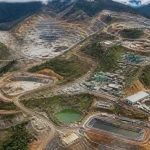
An engineered tailings storage facility with monitoring infrastructure and surrounding mine terrain.
Water and biodiversity require location-specific evidence
Generic group-wide indicators are often inadequate for mining.
A water-recycling percentage may look strong at corporate level while a single operation remains exposed to a stressed catchment. Similarly, a rehabilitation target may not explain whether restored land is returning to a functioning ecosystem or simply meeting an area-based metric.
Water reporting should therefore connect volumes with location and consequence. Useful information includes catchment conditions, seasonal availability, competing users, discharge performance, process changes and the operational effect of restrictions.
Biodiversity reporting faces a similar challenge. The Global Reporting Initiative’s GRI 101: Biodiversity 2024 emphasizes understanding where impacts occur across the value chain and how business decisions contribute to biodiversity loss. For miners, this makes baseline surveys, habitat mapping, restoration monitoring and closure design central to disclosure quality.

Water monitoring connects site conditions with operational and community risk.
The cost of compliance versus the cost of weak data
Compliance costs are visible. They include software, consultants, assurance, training, sensors, laboratory testing, stakeholder engagement and additional staff time.
The cost of weak data is less predictable but potentially larger. It can appear as:
- Delayed reporting and repeated data collection.
- Qualified or heavily challenged assurance conclusions.
- Higher financing or insurance friction.
- Delayed permits and project approvals.
- Disputes over emissions, water or community impacts.
- Inaccurate closure and rehabilitation provisions.
- Reputational damage after an incident.
- Management decisions based on unreliable operational information.
Not every company needs to install a fully integrated digital twin in 2026. But every company needs clear ownership of material metrics, consistent definitions and a defensible audit trail.
The most efficient approach is to treat reporting controls like financial controls. Start with the risks most likely to affect production, capital access or legal obligations. Then prioritize the sites and metrics where data uncertainty is highest.
Mining ESG compliance 2026: base, bull and bear cases
Base case: controlled convergence
In the base case, miners gradually align IFRS S1/S2, ESRS, GRI and GISTM data without eliminating every duplication. Companies improve controls for Scope 1 and 2 emissions first, while Scope 3, biodiversity and community data remain partly estimated. Assurance expands, but implementation remains uneven across jurisdictions.
The winners are not necessarily the companies with the largest sustainability departments. They are the companies that connect finance, operations, engineering, legal and community teams around a common data model.
Bull case: ESG data becomes an operating advantage
In the bull case, better data improves more than compliance. Real-time energy monitoring reduces fuel and power waste. Water data supports process optimization. Tailings monitoring improves maintenance decisions. More reliable community and biodiversity information reduces permitting uncertainty.
Under this scenario, ESG systems become part of productivity and risk management rather than a parallel reporting function.
Bear case: fragmented rules and unreliable evidence
In the bear case, jurisdictional differences create several reporting systems, while site-level data remains inconsistent. Scope 3 estimates are challenged, materiality decisions are poorly documented and assurance identifies gaps close to filing deadlines.
The result is higher cost, management distraction and greater exposure to disputes over whether reported sustainability information is complete and comparable.

Rehabilitation monitoring links closure commitments with measurable biodiversity outcomes.
What mining leaders should do now
A practical 2026 compliance program should begin with five steps:
- Map obligations by jurisdiction, entity and reporting period.
- Run one documented materiality process that distinguishes financial and impact materiality.
- Create a controlled data dictionary for emissions, water, tailings, social and biodiversity metrics.
- Assign executive and site-level owners for every material disclosure.
- Test a sample of reported figures back to operational records before assurance begins.
The strategic question is no longer whether ESG information belongs in the financial control room. For many mining companies, it is already there.
The question is whether the data arriving on those screens is sufficiently consistent, traceable and decision-useful to support the next mine plan, financing discussion, permit application and public commitment.
For further reading, see Skillings’ coverage of mining regulation, mining operations and mining technology.