ABIDJAN, Côte d’Ivoire : Turaco Gold Limited (ASX: TCG) has achieved a definitive milestone in the West African gold sector, announcing a maiden JORC-compliant Probable Ore Reserve of 1.91 million ounces for its flagship Afema Gold Project. The declaration, part of a comprehensive Pre-Feasibility Study (PFS), positions Afema as a top-tier development asset in one of the world’s most prolific mining jurisdictions.

The project, located in the southeast corner of Côte d’Ivoire, is slated to produce an average of 196,000 ounces of gold per year over an initial 10.3-year mine life. During the first seven years of operation, production is expected to peak at an average of 215,000 ounces per annum, highlighting the high-grade nature of the early-stage pits.
For the international mining community and investors monitoring West African assets, the Afema reserve declaration is more than a company milestone; it is a clear signal of the intensifying industrialization of the Birimian Greenstone Belt.
The 1.91 Million Ounce Milestone
The maiden reserve is based on a total of 55.1 million tonnes (Mt) of ore grading 1.1 grams per tonne (g/t) of gold. This reserve is derived from a Mineral Resource Estimate (MRE) that remains open at depth and along strike, suggesting significant upside potential as Turaco continues its exploration programs.
The transition from resource to reserve is a critical de-risking event for any junior miner. By defining nearly 2 million ounces of gold that can be economically extracted under current market conditions, Turaco has moved the Afema Project from a discovery story into the category of a “shovel-ready” industrial operation.
More Read
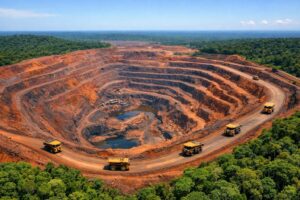
The PFS indicates that the project will utilize conventional open-pit mining methods. The low strip ratio and the proximity of the ore to the surface are expected to contribute to a competitive cost profile, though specific All-In Sustaining Costs (AISC) will be further refined in the upcoming Definitive Feasibility Study (DFS).


Production Dynamics and Scaling
Turaco’s production schedule for Afema is front-loaded to maximize early-year cash flows. The first year of production is forecast to yield approximately 230,000 ounces, following a six-month ramp-up period. This high initial output is driven by the extraction of higher-grade near-surface deposits within the “Woulo Woulo” and “Anuaze” discovery areas.
More Read
Over the life of the mine (LOM), total recovered production is estimated at approximately 2.0 million ounces, factoring in a metallurgical recovery rate of 87% to 88%. These recovery rates are considered excellent for the types of mineralization identified at Afema, which include both oxide and fresh rock (sulfide) components.
The scale of the project puts Turaco in a peer group of major West African producers. At 196,000 ounces per year, Afema would rival established operations in the region, providing a significant boost to the company’s valuation and the country’s national gold output.
Côte d’Ivoire’s Emerging Mining Dominance
The development of Afema occurs against a backdrop of rapid growth in the Côte d’Ivoire mining sector. Historically known as a cocoa powerhouse, the nation has aggressively diversified into minerals over the last decade. With a stable regulatory environment and a modern mining code, Côte d’Ivoire is increasingly viewed as a safer alternative to neighboring jurisdictions that have faced recent geopolitical volatility.
The Ivorian government has been a proactive partner in the development of the mining industry, recognizing that gold and critical minerals are essential for national infrastructure funding. The Afema Project, located near the border with Ghana, benefits from existing infrastructure, including access to the national power grid and proximity to the port of Abidjan.
This regional stability and infrastructure availability are key factors that investors and analysts consider when forecasting the 2026 mining outlook, particularly as global demand for gold remains a hedge against inflation and currency fluctuations.

Technical Specifications and Processing
The processing route selected for Afema is a standard Carbon-in-Leach (CIL) circuit. This is a tried-and-tested technology across West Africa, preferred for its reliability and efficiency in treating the diverse ore types found in the Birimian Greenstone Belt.
The PFS outlines a processing plant capacity designed to handle the 55.1 Mt reserve over a decade. The circuit will include primary crushing, semi-autogenous grinding (SAG), and ball milling, followed by gravity recovery and the CIL tanks.
Afema Project: Key Maiden Reserve and Production Metrics
| Metric | Value |
|---|---|
| Maiden Probable Ore Reserve | 1.91 Million Ounces |
| Total Ore Tonnage | 55.1 Million Tonnes |
| Average Gold Grade | 1.1 g/t Au |
| Initial Mine Life | 10.3 Years |
| Average Annual Production | ~196,000 Ounces |
| Peak Annual Production (Year 1) | ~230,000 Ounces |
| Estimated Metallurgical Recovery | 87% – 88% |
The technical robustness of the project is underscored by the shallow nature of the pits. Most of the defined reserve sits within 150 meters of the surface, allowing for a phased mining approach that reduces initial capital expenditure and operational complexity.
Operational and Financial Outlook
With the PFS complete and a substantial maiden reserve declared, Turaco Gold is now transitioning toward the Definitive Feasibility Study (DFS) and environmental permitting. The financial model suggests a project with high margins and a rapid payback period, which is essential for securing project financing in the current high-interest-rate environment.
The ability of the project to generate significant free cash flow early in its life is a primary driver for Turaco’s strategic planning. This cash flow will likely be reinvested into further exploration, as the company holds a massive land package surrounding the current reserve area that has yet to be fully drill-tested.
The mining industry’s shift toward autonomous and high-efficiency hardware will also likely play a role in Afema’s development. As noted in recent analysis on the scale of modern industrial machinery, the integration of advanced fleet management and energy-efficient processing can significantly impact the bottom line of large-scale operations like those planned in Côte d’Ivoire.

Geopolitical Context and Regional Growth
West Africa remains a focal point for global gold production, accounting for nearly 10% of the world’s annual supply. Within this region, Côte d’Ivoire is the fastest-growing producer. The “Afema Gold Project” sits in an area with a long history of artisanal mining, but Turaco’s move toward large-scale industrial mining represents a fundamental shift for the local economy.
The project is expected to create hundreds of direct jobs and thousands of indirect roles during the construction and operational phases. For policymakers, the project serves as a blueprint for how international investment can be leveraged to build sustainable industrial hubs.
As Turaco moves toward its final investment decision (FID), the focus will remain on maintaining ESG (Environmental, Social, and Governance) standards that align with international lending requirements. This includes community engagement programs and water management systems designed to minimize the environmental footprint in the tropical ecosystem of southeastern Côte d’Ivoire.

Conclusion
The declaration of a 1.91 million ounce maiden reserve at Afema is a transformative event for Turaco Gold and a significant addition to the West African gold landscape. With an average production profile of nearly 200,000 ounces per year and a clear path toward construction, the project is well-positioned to become one of the next major gold mines in the region.
As the global mining industry continues to grapple with supply constraints and increasing operational costs, high-quality, long-life assets like Afema represent the future of sustainable production. For Turaco, the journey from a junior explorer to a significant gold producer is now firmly on track.