By Penny Langford

The rapid expansion of artificial intelligence is fundamentally a story of physical infrastructure. While the software layer captures the headlines, the backend reality: massive data centers, upgraded electrical grids, and high-performance hardware: requires an unprecedented volume of metals and energy. As we move through June 2026, the "AI trade" has shifted from chipmakers to the primary producers who supply the essential inputs: copper for connectivity, uranium for baseload power, and lithium for grid-scale storage.
Current projections for 2026 indicate that the energy hunger of generative AI models is driving a structural shift in commodity demand. Data centers now account for a significant and growing percentage of global electricity consumption, forcing a pivot toward reliable, low-carbon power sources. This week’s Power List examines the mining and royalty companies best positioned to benefit from this industrial transformation.
1. Cameco Corporation (CCJ)
As the world’s largest publicly traded uranium producer, Cameco sits at the nexus of the AI power crisis. Data center operators are increasingly seeking "firm" power: electricity that stays on 24/7 regardless of weather conditions. This has led to a renaissance in nuclear energy. With its tier-one assets like McArthur River and Cigar Lake, Cameco is the primary beneficiary of a uranium spot market that has stabilized near $89/lb in early 2026. The company’s vertical integration through its stake in Westinghouse further solidifies its role in the nuclear supply chain.
2. Freeport-McMoRan (FCX)
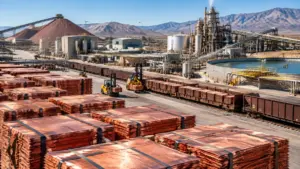
Copper is the "DNA" of the AI revolution. Every server rack, transformer, and high-voltage transmission line requires massive amounts of the red metal. Freeport-McMoRan, with its significant operations in the Americas and Indonesia, remains the benchmark for copper exposure. With a copper deficit projected to persist through 2026, Freeport’s ability to maintain high production levels makes it a cornerstone for any AI-themed resource portfolio.
More Read



3. BHP Group (BHP)
The world’s largest miner has made no secret of its desire to grow its copper business. BHP’s massive Olympic Dam and Escondida operations provide the scale necessary to meet global demand. Furthermore, the company’s focus on potash and iron ore provides a diversified cushion, though its 2026 strategy remains heavily weighted toward the "future-facing" metals that enable high-tech industrialization. BHP represents the institutional-grade "blue chip" play for AI infrastructure.
4. Rio Tinto (RIO)
Rio Tinto is aggressively pivoting toward the energy transition. Beyond its massive iron ore business, its Oyu Tolgoi project in Mongolia is set to become one of the world's largest copper mines. Additionally, Rio’s investments in lithium and its focus on "green aluminum" (essential for lightweighting high-tech enclosures) position it as a critical supplier for the physical hardware that houses AI processors.
More Read
5. Wheaton Precious Metals (WPM)
As a streaming company, Wheaton offers a unique way to play the sector with high margins and lower operational risk. While primarily focused on silver and gold, Wheaton receives a significant portion of its production as a byproduct from major copper mines. Given that silver is highly conductive and essential for high-end electronics and solar panels: which power many "green" data centers: Wheaton provides a low-overhead entry into the tech-metal space.

6. NexGen Energy (NXE)
For investors looking for growth in the uranium sector, NexGen Energy is the standout developer. Its Arrow project in Saskatchewan’s Athabasca Basin is slated to be one of the largest and lowest-cost uranium mines in the world. As AI-driven power demand grows, the market is looking toward the next generation of supply to come online by the late 2020s, placing NexGen in a strategic position.
7. Southern Copper Corporation (SCCO)
Southern Copper holds the largest copper reserves of any publicly traded company. Operating primarily in Peru and Mexico, SCCO is a pure-play copper producer with exceptionally low cash costs. While jurisdictional risks in Latin America are always a factor, the sheer volume of metal under its control makes it an essential name for tracking the long-term supply needs of the global power grid.
8. Arcadium Lithium (ALTM)
Following the major consolidation in the lithium sector, Arcadium Lithium (formed from the merger of Livent and Allkem) has emerged as a diversified leader. While lithium prices faced an "L-shaped" recovery in recent years, the 2026 outlook for lithium has brightened due to the massive demand for Battery Energy Storage Systems (BESS). These systems are critical for buffering the intermittent renewable energy used to power data centers.

9. Lundin Mining (LUN.TO)
Lundin Mining has carved out a niche as a high-growth copper producer with assets in stable jurisdictions like Chile and Brazil. Their recent focus on the Vicuña district in Argentina and Chile highlights their aggressive expansion strategy. For operators and investors seeking a mid-cap company with higher leverage to copper price movements than the diversified majors, Lundin is a primary candidate.
10. Franco-Nevada (FNV)
Franco-Nevada is the gold standard of the royalty model. The company does not operate mines; instead, it provides upfront capital to miners in exchange for a percentage of future production. This protects the company from inflationary cost pressures (CAPEX/OPEX) that plague traditional miners. Its diversified portfolio includes significant exposure to copper and energy, making it a defensive yet high-reward way to play the AI mining boom.
Market Snapshot: AI Metals Performance
The following table provides a snapshot of the primary commodities powering the AI build-out and their current market positioning as of June 22, 2026.
| Commodity | Primary AI Use Case | 2026 Market Status | Top Stock Pick |
|---|---|---|---|
| Uranium | Baseload Data Center Power | Deficit / High Demand | Cameco (CCJ) |
| Copper | Grid Infrastructure / Wiring | Structural Undersupply | Freeport-McMoRan (FCX) |
| Lithium | Grid-Scale Energy Storage | Recovering / Stable | Arcadium Lithium (ALTM) |
| Silver | High-Conductivity Electronics | Industrial Tightness | Wheaton Precious Metals (WPM) |
| Iron Ore | Data Center Construction | Stable / High Volume | Rio Tinto (RIO) |
The Road Ahead: 2026 Outlook
The intersection of heavy industry and high technology is no longer a theoretical concept. As data center capacity is expected to triple in some regions by 2030, the mining sector has become the ultimate "bottleneck" for AI progress. The companies listed above are not just resource extractors; they are the fundamental utility providers for the digital age.
Investors and operators should monitor geopolitical developments in key mining jurisdictions, as the strategic importance of these metals has led to increased government intervention and "resource nationalism" in several territories. However, for those focused on the long-term structural drivers of the global economy, the AI mining trade remains one of the most compelling narratives of the decade.
LinkedIn / Social Snippet
Is your portfolio ready for the AI physical layer? ?
As AI models scale, the demand for physical infrastructure is hitting the mining sector hard. From uranium for 24/7 baseload power to copper for the massive grid upgrades required by data centers, the "AI trade" is moving back to the source.
In this week's Power List, Penny Langford breaks down the top 10 mining and royalty stocks positioned to lead the AI revolution.
Read the full analysis here: [Link]
#Mining #AI #Uranium #Copper #EnergyTransition #SkillingsMining #CriticalMinerals #Investing