By Charles Pitts

The traditional logistics of the Central African Copperbelt are undergoing a fundamental transformation. For decades, the movement of copper and cobalt from the Democratic Republic of the Congo (DRC) and Zambia has been a slow, arduous journey eastward to Dar es Salaam or southward to Durban. However, as of July 2026, the US and EU-backed Lobito Corridor has emerged as a primary geoeconomic lever, effectively redrawing the map for critical mineral exports and challenging long-standing logistical bottlenecks.
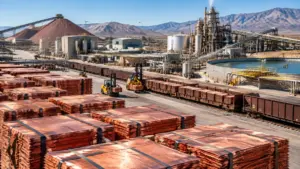
This trans-continental rail link, stretching from the Port of Lobito in Angola to the heart of the Copperbelt, is no longer just a developmental concept; it is an operational reality reshaping how Western markets secure the materials essential for the energy transition and data center infrastructure.
The 7-Day Sprint: Breaking the 30-Day Logistical Barrier
The most immediate impact of the Lobito Corridor is the drastic reduction in transit times. Historically, mining operators in the DRC and Zambia faced transit windows of 35 to 45 days to move concentrates from the mine site to a deep-water port. Congestion at the Port of Durban and the logistical complexities of the TAZARA railway to Dar es Salaam often extended these timelines, tying up significant working capital in “inventory on wheels.”
Data from 2026 operations indicates that the Lobito route has successfully compressed this window to between 7 and 9 days. For major producers like Ivanhoe Mines, which operates the Kamoa-Kakula copper complex, this efficiency shift is transformative.
More Read

| Export Route | Destination Port | Average Transit Time (Mine to Port) |
|---|---|---|
| Lobito Corridor | Lobito, Angola | 7 – 9 Days |
| Durban Corridor | Durban, South Africa | 35 – 45 Days |
| Dar es Salaam Corridor | Dar es Salaam, Tanzania | 30 – 40 Days |
| Walvis Bay Corridor | Walvis Bay, Namibia | 15 – 20 Days |
This 75% reduction in transit time allows mining companies to respond more fluidly to market volatility and significantly lowers the carbon footprint of the supply chain by shifting bulk freight from thousands of trucks to high-capacity rail.

Geopolitical Realignments: The US and EU Counter-Move
The revival of the Lobito Corridor is a centerpiece of the G7’s Partnership for Global Infrastructure and Investment (PGI). With over $1 billion in US financing via the International Development Finance Corporation (DFC) and an additional €2 billion mobilized by the EU’s Global Gateway initiative, the project represents a rare, direct Western intervention in African heavy infrastructure: a sector largely dominated by Chinese investment over the last two decades.

More Read

By securing a 30-year concession through the Lobito Atlantic Railway: a consortium including Trafigura and Mota-Engil: Western powers have established a “green corridor” that bypasses ports where Chinese state-owned enterprises hold significant influence. This strategic autonomy is critical as the race for battery metals intensifies. As noted in our 2026 critical minerals outlook, supply chain resilience is now prioritized alongside raw extraction volumes.
Infrastructure Expansion: Beyond the Angolan Border
While the Angolan portion of the rail line is the most mature, 2026 has seen a surge in “last-mile” connectivity projects deeper into the DRC and Zambia. The US DFC has issued letters of interest for the rehabilitation of the Dilolo-Sakania rail link, which connects DRC’s Katanga mining hub directly into the Angolan system.
In Zambia, the focus has shifted to the Jimbe greenfield railway extension. This expansion is designed to bring Zambian copper: traditionally reliant on southern routes: into the Atlantic sphere. The EU has recently funded feasibility studies for this “Zambia-Lobito” link, aiming to turn the corridor into a multi-modal regional backbone rather than a single-track export pipe.

Operational Realities: Tariffs vs. Time
Despite the impressive time savings, the transition to the Lobito Corridor is not without friction. In mid-2026, many heavy mining loads continue to utilize the Durban route. The primary reason is a matter of mature logistics: backhaul.
Durban remains a highly competitive port because of the massive volume of imports flowing back into the African interior. Trucks and trains heading back to the Copperbelt are rarely empty, which subsidizes the cost of the export leg. For the Lobito Corridor to achieve cost parity with southern routes, it must develop its “import” economy: bringing fuel, reagents, and consumer goods into the interior to balance the costs of exporting ore.
The Lobito Atlantic Railway consortium is addressing this by investing $450 million in Angolan infrastructure and $100 million in the DRC, focusing on automated signaling and modern rolling stock to increase reliability and lower unit costs.
A New Hub for Mineral Value Addition
The strategy behind the corridor extends beyond simple logistics. The Angolan government, supported by EU technical assistance, is leveraging the rail link to establish “Logistics Platforms” like the one in Caála. The goal is to encourage on-site mineral processing and value addition within the corridor’s footprint.
If the corridor can facilitate the export of high-value copper cathodes and refined cobalt rather than just concentrates, the economic profile of the region shifts from an extraction-only zone to an industrial hub. This aligns with the broader policy trends in 2026 emphasizing local content and ESG-compliant supply chains.

The 2026 Outlook: A Diversified Future
As we move into the second half of 2026, the Lobito Corridor has successfully challenged the monopoly of eastern and southern export routes. For operators, it offers a high-speed alternative that mitigates the risks of port congestion in South Africa and political instability elsewhere. For investors, it represents the most tangible evidence of a Western “Critical Minerals Strategy” in action.
The map has been redrawn. The Copperbelt now has a direct, high-speed artery to the Atlantic, and the Port of Lobito is positioned to become one of the most important mineral terminals in the Southern Hemisphere.