By Charles Pitts

The landscape for critical minerals investment underwent a fundamental transformation in early 2026 as the U.S. government shifted its weight from purely climate-focused subsidies to a rigorous, security-first industrial strategy. This shift, often characterized as the “$1B White House Pivot,” refers to the Department of Energy’s (DOE) nearly $1 billion suite of funding opportunities designed to shore up domestic supply chains for lithium, graphite, cobalt, and rare earth elements.
For investors, the stakes have never been higher. While the transition to a low-carbon economy remains a long-term tailwind, the “easy money” era of speculative lithium exploration has closed. In its place is a complex, policy-driven market where government co-investment, midstream processing capacity, and geopolitical resilience dictate winners and losers.
As of July 2026, many market participants are still operating on 2022-era assumptions, leading to significant capital misallocation. Below are the most common investment mistakes currently seen in the sector and how the White House pivot is redefining the roadmap for success.
1. Ignoring the Midstream Processing Bottleneck
One of the most persistent errors in critical minerals investment is the disproportionate focus on “upstream” extraction: the mines themselves: while ignoring the “midstream” refining and processing facilities.
More Read

The White House pivot explicitly addresses this by allocating roughly $500 million of the new funding package specifically to battery material processing and recycling. Historically, 60% to 85% of critical mineral processing has been dominated by China. A mine without a domestic or “friendly” refining partner is essentially an asset with a single, potentially hostile customer.

Investors who prioritize integrated “mine-to-metal” strategies or independent processing hubs are finding more stability. Projects like the West Virginia rare earth hub, which focuses on recovering minerals from coal tailings, represent the “unconventional” processing plays that the DOE is now aggressively backing.


2. The “Unlimited Demand” Delusion in Lithium
In the 2021-2023 cycle, the prevailing narrative was that lithium demand would outstrip supply indefinitely. However, the market in 2026 has reached a stage of “maturation and rebalancing.”
The mistake many investors make is treating lithium as a monolithic commodity. In reality, the market is bifurcating between high-cost, speculative explorers and low-cost, integrated brine producers. As noted in the lithium price forecast for 2026, the “supply wall” is no longer a theoretical concept: it is an operational reality.
Overpaying for marginal, high-cost deposits on the assumption that prices will return to $80,000/tonne is a strategy rooted in the past. Today’s successful investors are looking at Albemarle’s capex adjustments and focusing on assets that remain profitable even in a $15,000 to $20,000/tonne environment.

3. Overestimating the Government Safety Net
With headlines frequently touting “$1 billion in grants” or “$100 billion in lending authority,” it is easy to assume that the U.S. government will backstop every domestic project. This is a dangerous assumption.
The new policy framework, including initiatives like Project Vault and the Forum on Resource Geostrategic Engagement (FORGE), is designed to be selective. Price floors and government stockpiling are:
- Time-limited: They are intended to bridge the gap during periods of market manipulation, not to permanently subsidize uncompetitive operations.
- Conditional: Funding is tied to strict ESG standards, domestic content requirements, and geostrategic priority.
Buying a marginal project because “the government won’t let it fail” ignores the reality that Washington is prioritizing security over individual equity returns.
4. Underestimating Geopolitical Price Wars
China’s response to Western critical mineral self-sufficiency has been a series of tactical “price suppression” events. By flooding the market with cheaper material, adversarial producers have successfully delayed or canceled several high-profile Western projects.
Investors making the mistake of ignoring global supply response: particularly from Indonesia’s nickel sector or China’s graphite producers: risk being caught in a capital-intensive project that becomes unbankable overnight. The White House pivot is a direct response to this “weaponized overproduction,” but the protection it offers (such as the proposed price floor backstops) is still in the early rollout phase.
Effective positioning requires analyzing a company’s ability to withstand a two-to-three-year “pricing winter” without total dilution or bankruptcy.

5. The “Discovery-to-Production” Time Lag
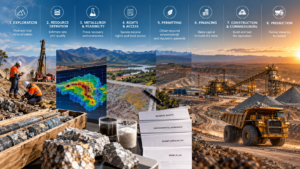
The average time from discovery to first production for a new mine is still roughly 16.5 years. Investors often buy into the “2026-2030 demand surge” without realizing that a project currently in the PEA (Preliminary Economic Assessment) stage is unlikely to contribute to that surge.
The 2026 market rewards “Safe-Haven Ore”: assets that are already in production or have cleared all major permitting hurdles. In jurisdictions like Canada or Australia, the permitting premium is real. For instance, while copper faces a structural deficit, the companies that will actually profit are those that can bring supply online within the current decade, not those still wrestling with social license issues.

6. Strategic Framework: Stabilizers vs. Policy Plays
To avoid these common pitfalls, professional mining investors are adopting a bifurcated portfolio strategy for 2026:
The Stabilizers (60–70% of Exposure)
These are producing, multi-asset miners with strong balance sheets and established cash flow. They provide exposure to the commodity price without the “binary risk” of a single-project failure. This includes low-cost lithium brine producers and established copper majors.
The Policy Plays (30–40% of Exposure)
These are mid-tier companies that have secured: or are front-runners for: government grants, DOE loans, or strategic offtakes with Western OEMs (Original Equipment Manufacturers). These companies are the direct beneficiaries of the $1B White House pivot. They are often focused on the midstream: refining, recycling, and unconventional recovery.
The 2026 Outlook
The “security-over-climate” pivot represents a maturation of the Western mining industry. It signals that critical minerals are no longer just a “green story”; they are the bedrock of 21st-century national power.
However, government support is not a substitute for project economics. As we move deeper into 2026, the market will continue to punish those who confuse policy headlines with operational viability. Successful critical minerals investment now requires a “triangulation” of technical feasibility, geopolitical alignment, and rigorous cost-curve analysis.
The $1B White House pivot has provided the capital and the mandate, but it is up to the individual investor to separate the strategic assets from the speculative noise.