By Charles Pitts

For decades, the Mojave Desert has been a graveyard for ambitious industrial projects, swallowed by the complex interplay of federal environmental mandates and California’s rigorous state-level permitting. However, a significant legal development involving the U.S. Department of Justice (DOJ) has suddenly shifted the risk profile for one of the region’s most historic assets.
The DOJ recently filed formal papers in federal court supporting the Department of the Interior’s (DOI) decision that Dateline Resources (ASX: DTR) holds “Valid Existing Rights” (VER) at its Colosseum Gold Project. This filing is more than a procedural victory; it serves as a “federal shield” against environmental challenges that could have otherwise halted the project for years. By confirming that a historic, federally approved plan of operations remains in force, the DOJ has effectively lowered the permitting hurdle for Dateline, signaling a strategic federal interest in domestic critical minerals and gold production.
The DOJ Filing: Deconstructing the “Federal Shield”
The core of the legal battle centers on a lawsuit filed by the National Parks Conservation Association (NPCA). The group sought to challenge a 2025 National Park Service (NPS) letter that acknowledged Dateline’s ability to mine under a grandfathered plan. The DOJ’s intervention directly opposes the NPCA’s claims, arguing that the 1994 California Desert Protection Act (CDPA) specifically preserved “valid existing rights” that predate the creation of the Mojave National Preserve.
Critically, the DOJ contends that the NPS letter was not a “new approval”: which would have triggered a fresh round of National Environmental Policy Act (NEPA) reviews: but rather a confirmation of legal status. For investors and operators, this is a vital distinction. A “new” approval in California is often a decade-long odyssey. A “confirmation” of an existing plan allows work to proceed under the original framework, drastically reducing the timeline to production.
More Read



Valid Existing Rights: The Permitting Impact
The concept of Valid Existing Rights (VER) is the bedrock of this case. When the federal government designates land as a National Preserve or Park, it generally prohibits new mining claims. However, it cannot simply extinguish private property rights that were legally established beforehand.
At Colosseum, those rights date back to a Bureau of Land Management (BLM) approval granted in the 1980s. The DOJ has now backed the position that a long hiatus in mining activity does not automatically terminate these rights. For Dateline Resources, this means they can potentially bypass the most paralyzing stages of the federal permitting cycle.
More Read

| Permitting Factor | With “Valid Existing Rights” (VER) | Without VER (New Permitting) |
|---|---|---|
| Federal Agency Status | Confirmation of existing plan | Multi-year application & approval |
| NEPA Requirement | Potentially minimal/targeted updates | Full-scale Environmental Impact Statement (EIS) |
| Operational Scope | Defined by historic approvals | Subject to 2026-era restrictions |
| Legal Standing | Shielded by 1994 CDPA statutes | High vulnerability to new litigation |
| Time to Drill/Mine | Active or near-term | Estimated 5–10 year lead time |
Historical Context: The Colosseum Legacy
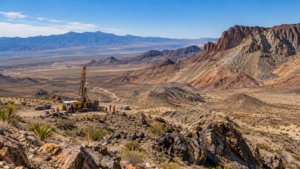
The Colosseum project is not a speculative “greenfield” site; it is a proven asset with a rich history. Originally developed by Amselco (a subsidiary of BP Minerals) and later operated by Barrick Gold, the site produced approximately 344,000 ounces of gold between 1988 and 1993.
Mining ceased not because the gold ran out, but because of a collapse in the gold price: which fell below $350/oz at the time: and Barrick’s subsequent shift toward larger, Tier-1 assets. Today, with the bullion rebound pushing gold toward $4,130, the economics of Colosseum have transformed. Dateline’s current Mineral Resource Estimate (MRE) stands at 1.1 million ounces of gold, with significant upside potential.
Furthermore, the project has emerged as a potential source of Rare Earth Elements (REE). Recent drilling has identified high-grade carbonatite-hosted REE mineralization, positioning Colosseum as a dual-commodity play in the heart of the U.S. This aligns with broader federal goals to redefine domestic processing and secure supply chains for critical minerals.

Valuation Impact and Market Sentiment
The DOJ support has a direct impact on Dateline Resources’ valuation by removing a massive “discount for uncertainty.” In mining, the “permitting risk premium” often keeps valuations suppressed regardless of the quality of the ore. By securing federal backing, Dateline has effectively moved from the “uncertain legal territory” bucket into the “active exploration and development” bucket.
Investors often view the Mojave region with skepticism due to its regulatory history. However, the DOJ’s move indicates that the federal government is willing to defend grandfathered rights to ensure that strategic assets: like gold and rare earths: are not stranded by localized environmental litigation. This could set a precedent for other projects on federal land where historic approvals exist but have been dormant.
Strategic Importance of Domestic Assets
The Colosseum project sits on federal land, which traditionally provides a more predictable (if slow) regulatory path compared to private land in California. The DOJ’s stance highlights the strategic importance of domestic gold and critical minerals. In a volatile geopolitical environment, the ability to produce these materials within the U.S. is becoming a matter of national security rather than just commercial gain.
The project is also benefiting from its proximity to existing infrastructure. Unlike remote projects in the Athabasca Basin, Colosseum is located near major power and transport corridors, further reducing the capital intensity of a potential restart.

2026 Outlook: The Road Ahead
While the DOJ filing is a major win, it is not the final word. The federal court must still rule on the NPCA’s challenge. However, the DOJ’s argument that the court lacks jurisdiction because the NPS letter wasn’t a “final agency action” is a potent legal maneuver. If the court agrees, the lawsuit could be dismissed, leaving Dateline’s federal shield fully intact.
For the remainder of 2026, the industry should watch for:
- Drilling Results: Continued REE and gold exploration at Colosseum to expand the 1.1M oz resource.
- Court Rulings: The final determination on the NPCA v. Interior case.
- State Permitting: How California’s state agencies respond to the federal confirmation of VER.
The Bottom Line: The DOJ’s support for the Colosseum project signals a new era of federal pragmatism. By defending “Valid Existing Rights,” the government is ensuring that historical mining assets can play a role in the modern energy transition and economic landscape. For Dateline Resources, the legal shield is now the primary driver of their development timeline, turning a decades-old plan of operations into a modern competitive advantage.