By Charles Pitts

The global mining industry has entered a transformative period in 2026, where Environmental, Social, and Governance (ESG) reporting has shifted from a marketing-driven voluntary exercise to a strictly regulated, audit-ready financial mandate. For operators and investors, the “glossy PDF” era is over, replaced by real-time data streams and legal accountability structures that mirror traditional financial reporting.
This pivot is driven by three major forces: the full implementation of the IFRS S2 climate standards, the expansion of the EU’s Corporate Sustainability Reporting Directive (CSRD), and the effective date of the GRI 14: Mining Sector 2024 standard on January 1, 2026. Together, these frameworks have redefined the cost of capital and the requirements for maintaining a social license to operate.
The Regulatory Framework: IFRS S2 and CSRD Take Center Stage
As of 2026, jurisdictions representing over 50% of global GDP have adopted the International Sustainability Standards Board (ISSB) baseline. For mining companies, this means emissions and water data now carry the same legal weight as balance sheets. Under IFRS S2, disclosure is no longer about high-level goals; it is about providing specific, granular evidence of climate risk and decarbonization pathways.
The EU CSRD has further complicated the landscape by introducing “double materiality.” This requires mining companies to report not only how climate change affects their business but also how their operations: ranging from land disturbance to community displacement: impact the environment and society. This data is now subject to limited assurance, moving rapidly toward the “reasonable assurance” standard required for financial audits.
More Read
| Metric | 2024 Context | 2026 Mandate |
|---|---|---|
| Emissions Reporting | Voluntary/TCFD based | IFRS S2 Mandatory (Legal Weight) |
| Data Frequency | Annual static snapshots | Real-time IoT-fed streams |
| Materiality | Primary financial focus | Double Materiality (CSRD) |
| Audit Level | Limited/Self-declared | Reasonable Assurance/Audit-Ready |
| Sector Standards | Fragmented (GRI/SASB) | GRI 14 (Effective Jan 2026) |
Technology as the Compliance Engine: IoT and AI-Driven Transparency
To meet these audit-ready requirements, mining companies have moved data capture from manual spreadsheets to integrated IoT sensor networks. In 2026, leading operators use real-time monitoring to track water quality, tailings dam integrity, and air emissions.


AI-driven analytics are now essential for managing the complexity of these datasets. Artificial intelligence is being deployed to automate Scope 3 accounting, which involves tracking emissions throughout the supply chain: from equipment manufacturing to the downstream processing of minerals. As the energy transition accelerates, the demand for transparency in critical minerals and rare earths has made automated compliance a competitive necessity.
More Read

Furthermore, “AI Governance” has emerged as a distinct ESG pillar. As mining technology updates introduce more autonomous systems and algorithmic decision-making, operators must now disclose their digital control protocols, cybersecurity measures, and the impact of automation on their workforce.
Operational Shift: Electrified Fleets and Scope 1-2 Decarbonization
The 2026 outlook for decarbonization is anchored in the mass adoption of electrified haulage. What were pilot projects in 2023 are now operational standards for new Tier-1 assets. The transition to electric fleets is no longer just an environmental goal; it is a financial strategy to mitigate the rising cost of carbon under various global tax regimes.

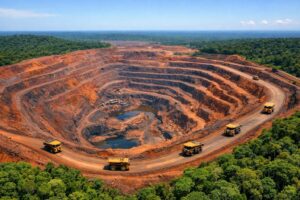
Telemetry-equipped trucks, like the one pictured above, provide the precise energy consumption data required for audit-ready ESG reporting. By linking fleet performance directly to production systems, companies can report “energy intensity per tonne” with near-perfect accuracy, satisfying the demands of institutional investors and ESG-focused lenders.
For many projects, including those in the lithium and battery metals sector, the ability to demonstrate a low-carbon footprint is a prerequisite for securing offtake agreements with automotive OEMs.

Nature-Positive Mandates: Beyond Impact Minimization
Perhaps the most significant shift in mining ESG trends for 2026 is the adoption of the Taskforce on Nature-related Financial Disclosures (TNFD) framework. Mining companies are increasingly expected to be “nature-positive,” meaning they must demonstrate a net gain in biodiversity rather than just minimizing damage.
GRI 14, the first global sector standard for mining, has made land disturbance and closure/rehabilitation formally material topics. Investors now look for clear evidence of progressive rehabilitation: where land is restored continuously throughout the life of the mine, rather than exclusively at the end of operations.

What Operators Need to Know for 2026 Compliance
For mining executives and site managers, the mandate for 2026 is clear: data must be captured at the source.
- Framework Alignment: Companies must map their obligations across IFRS S2, CSRD, and GRI 14. Success requires framework-specific aggregation rules, as what is “material” under one standard may differ under another.
- Audit Trails: Digital systems must provide a traceable chain of evidence from the physical sensor or meter to the final reported KPI. Manual adjustments to data must be logged and justified for auditors.
- Nature-Positive Strategy: Site-level data on water withdrawal, land use, and local biodiversity must be integrated into corporate risk management.
- Fleet Electrification: Transitioning to electric fleets is the primary lever for reducing Scope 1 emissions. This requires not only new hardware but a fundamental redesign of mine power infrastructure.
As we move through 2026, the gap between “ESG leaders” and “ESG laggards” is widening. Those who have invested in the digital infrastructure to provide audit-ready, real-time data are finding easier access to capital and more streamlined permitting processes. For the rest of the industry, the cost of non-compliance is no longer just a reputational risk; it is a financial and operational barrier to growth.