By Charles Pitts

The race to secure the domestic critical minerals supply chain reached a new milestone this week as Nova Minerals (ASX:NVA, NYSE-A:NVA) accelerated development of its Estelle project in Alaska. The move follows a significant shift in U.S. defense policy aimed at decoupling the military industrial base from adversary-controlled resources.
On July 20, 2026, a new Executive Order titled “Securing America’s Defense Supply Chains and Ensuring Domestic Acquisition of Critical Materials” mandated traceable, domestic sourcing for essential minerals, specifically highlighting antimony. For Nova Minerals, this policy environment has transformed the Estelle project from a primary gold play into a dual-commodity asset of national strategic importance.
With US$43.4 million in funding from the Pentagon’s Department of War (DoW) under Defense Production Act Title III, Nova is now engineering a fully integrated mine-to-refinery hub. The objective is clear: restore military-grade antimony production within the United States by late 2026 to mid-2027.
Antimony mining: Why it matters for 2026 defense policy
Antimony has long been the “silent” critical mineral, essential yet often overlooked in favor of lithium or copper. However, the geopolitical landscape shifted dramatically after China banned antimony exports to the United States at the end of 2024. This left the U.S. with a strategic deficit, as the country has not produced antimony commercially since 2016.
More Read

The 2026 U.S. defense minerals strategy identifies antimony as irreplaceable in several high-stakes applications:

- Munitions and Ordnance: Antimonial lead is used to harden bullets and shells. Perhaps more critically, antimony trisulfide (Sb₂S₃) is a primary component in primers and detonators for over 200 types of munitions.
- Flame Retardants: Antimony trioxide acts as a synergist in flame-retardant systems for military textiles, aircraft interiors, and electronic housings.
- High-Tech Hardware: Antimony is used in the production of night-vision goggles, infrared sensors, and precision optics.
Current U.S. demand sits at approximately 50 million pounds annually, while the National Defense Stockpile reportedly holds only 1,100 tons: less than a month’s worth of normal consumption. The July 20 Executive Order addresses this vulnerability by requiring end-to-end traceability and restricting any suppliers linked to adversary nations.
The Estelle Project: Update on Alaska’s strategic resource
Located in the Tintina Gold Province, the Estelle Gold and Critical Minerals Project has historically been viewed through the lens of its multi-million-ounce gold resource. However, recent exploration at the Styx prospect and surrounding areas has confirmed massive stibnite (antimony) mineralization.
More Read

Geological surveys have returned rock samples with antimony grades reaching as high as 54% to 56.7%. This high-grade profile is essential for the economic production of military-spec antimony trisulfide. Under the DoW grant, Nova’s U.S. subsidiary, Alaska Range Resources (ARR), is tasked with bringing this resource into production on an aggressive timeline.

Large-scale extraction and logistical complexity are central to the Estelle project’s development.
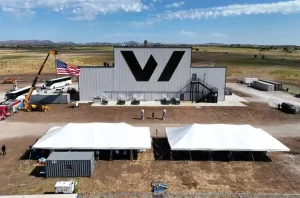
The company’s 2026 winter mobilization program has already delivered the major equipment and supplies required for the upcoming mining and extraction phase. By leveraging its existing exploration and discovery infrastructure, Nova aims to bypass many of the typical “greenfield” delays.
Integrated Mine-to-Refinery: The Port Mackenzie hub
One of the most distinctive aspects of Nova’s strategy is the “mine-to-refinery” model. Traditional mining often involves shipping raw concentrate overseas for processing: a practice the new U.S. defense policy seeks to eliminate.
Nova has secured a land-use permit for a dedicated refinery at Port Mackenzie (Port Mac), Alaska. This facility is designed to process Estelle concentrate into three primary products:
- Antimony trisulfide (for munitions).
- Antimony trioxide (for industrial and defense flame retardants).
- Antimony metal (for semiconductors and alloys).
The Port Mac refinery provides the “traceable” domestic link required by the Pentagon. According to Nova’s recent SEC filings, the company targets the first delivery of military-grade product to the Department of War within 24 months of securing the refinery permit.
Defense minerals: Timeline and key risks
Nova Minerals enters the second half of 2026 in a robust financial position to execute this plan. The company reports access to approximately A$83 million in total funding, including A$17.5 million in cash and the remainder via the US$43.4 million DoW grant. This capital is earmarked for the construction of the processing plant at the mine site and the refinery at Port Mac.
| Milestone | Expected Timeline | Status |
|---|---|---|
| Refinery Land-Use Permit | Q2 2026 | Completed |
| Heavy Equipment Mobilization | Q1/Q2 2026 | Completed |
| Extraction Plant Construction | H2 2026 | Commencing |
| Refinery Commissioning | H1 2027 | Planned |
| First Military-Spec Delivery | Late 2027 | Target |
Despite the strong policy tailwinds, the project faces the inherent risks of sub-arctic mining. Alaska’s short construction seasons and complex logistics require precise execution. Furthermore, while the current U.S. administration is heavily supportive of onshoring base metal mining, any shift in regulatory or environmental permitting frameworks could impact the 2027 production target.

High-grade stibnite samples from the Estelle project are the foundation of the new U.S. antimony supply chain.
2026 outlook for Nova Minerals
As of mid-2026, Nova Minerals has successfully redomiciled to the United States, further aligning its corporate structure with its role as a key defense contractor. The company is also a member of the Defense Industrial Base Consortium (DIBC), which provides a platform for additional DoD grants and long-term procurement contracts.
For operators and investors, the Estelle project represents a rare example of a junior miner successfully navigating the “valley of death” by pivoting toward strategic minerals. The project’s ability to produce both gold and antimony creates a hedge against commodity price volatility while tapping into the high-priority funding pools of the U.S. defense establishment.
The next 12 months will be critical. As construction begins on the Port Mackenzie refinery, Nova Minerals is positioned to become the first fully integrated, domestic supplier of antimony in the United States in over a decade.