By Charles Pitts

The global copper market has crossed a decisive structural threshold. After years of modest surpluses and tightening concentrate balances, refined copper has officially shifted into a multi-year deficit environment. Institutional forecasts for the 2026 balance consistently point to an undersupplied market ranging from 150,000 to over 600,000 tonnes. This pivot is not driven by temporary market noise or speculative trading; it represents the collision of accelerating long-term demand: anchored by aggressive power grid modernization and exponential growth in artificial intelligence (AI) data centers: with persistent, structural supply constraints centered in key producing regions like Chile.
For industrial operators, utility planners, and resource investors, understanding the mechanics of this deficit is critical. As capital expenditures for global energy transition and digital infrastructure surge, copper is no longer viewed merely as a cyclical industrial metal. It is increasingly priced as a strategic asset underpinning the modern technological and energy economy.
The Anatomy of the 2026 Copper Deficit
The transition from surplus to deficit has accelerated faster than most consensus models anticipated. The International Copper Study Group (ICSG), alongside major financial institutions including Morgan Stanley, ING, and J.P. Morgan, has revised its forward balances downward as mine output growth stagnates while consumption continues its upward trajectory.

More Read

The International Copper Study Group now projects a deficit of approximately 150,000 tonnes for 2026, marking the first significant structural shortage since the post-financial crisis era of 2009. More aggressive institution models, such as those from Morgan Stanley and ING, estimate shortfalls approaching 600,000 tonnes, citing slower-than-expected recovery in mined ore grades and rising smelting bottlenecks across Asia.

2026 Refined Copper Balance Projections
| Forecaster | Projected 2026 Balance | Key Driver / Rationale |
|---|---|---|
| ICSG (International Copper Study Group) | ~150,000 t deficit | Mine production growth slowing to 0.9%; steady demand growth |
| ING | ~600,000 t deficit | Deepening concentrate tightness following 2025 shortfalls |
| Morgan Stanley | ~600,000 t deficit | Largest supply shortfall in over two decades |
| J.P. Morgan | ~330,000 t deficit | Persistent structural deficit extending through 2030 |
| Goldman Sachs | ~160,000 t surplus | Bearish demand view offset by recycling gains |
While visible exchange inventories remain relatively robust in absolute terms, physical concentrate markets tell a different story. Treatment and refining charges (TC/RCs) for copper concentrate have plummeted to historic lows, signaling acute raw material scarcity for smelters. This disconnect between exchange warehouse stocks and underlying concentrate tightness forms the foundation of the structural price floor supporting copper values.
The Dual Demand Engine: Grid Upgrades and AI Data Centers
Historically, copper consumption was dominated by traditional construction, plumbing, and general manufacturing. Today, the demand profile is being redrawn by two massive, capital-intensive infrastructure waves: electrical grid modernization and hyper-scale AI data center construction.
More Read


Power Grid Modernization and the IEA Investment Imperative
The global energy transition requires unprecedented overhauls of transmission and distribution networks. Integrating utility-scale solar, offshore wind, and millions of electric vehicle charging stations demands thousands of miles of new high-voltage cabling and heavy-duty transformers.
According to International Energy Agency (IEA) framework assessments, global electricity network investment must scale toward approximately $750 billion annually through 2035 to meet net-zero targets and avoid severe grid congestion. In China alone, the State Grid Corporation has earmarked multi-trillion-yuan expenditures for 2026–2030, representing a substantial upward revision in copper-intensive grid spending.
The Rise of AI Data Center Metal Intensity
Compounding traditional electrification demand is the explosive growth of artificial intelligence and cloud computing infrastructure. Hyperscale data centers designed to host dense graphic processing unit (GPU) clusters require immense amounts of electrical power, advanced grounding networks, and robust cooling systems.
The Copper Development Association estimates that data centers consume between 20 and 40 tonnes of copper per megawatt of operational power. For large-scale AI facilities operating at massive capacity, total copper requirements per campus can exceed tens of thousands of tonnes. J.P. Morgan and associated sector trackers project total data center copper consumption to scale rapidly toward nearly half a million tonnes annually by 2026, creating a brand-new, price-inelastic demand pillar that competes directly with automotive and renewable sectors.
Supply Constraints: Chile’s Production Crisis and Project Lag
While demand accelerates, the supply side of the equation remains constrained by geological depletion, regulatory hurdles, and operational bottlenecks. Chief among these pressures is the ongoing production crisis in Chile, the world’s largest copper-producing nation.

For years, Chilean state-owned Codelco and major private operators have grappled with declining ore grades, aging pit infrastructure, and acute water scarcity in the Atacama Desert. Major legacy deposits are seeing falling recovery rates, requiring miners to move significantly more rock and ore to produce equivalent amounts of copper concentrate.
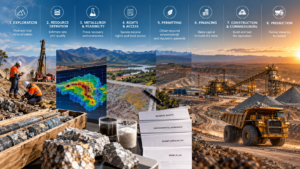
Furthermore, capital expenditure cycles across the global mining sector have been historically conservative. Major producers have prioritized shareholder returns, debt reduction, and disciplined capital allocation over risky, long-lead greenfield exploration projects. Obtaining environmental permits, securing social license to operate, and bringing a new large-scale copper mine from discovery to first production now takes an average of 15 to 20 years. Consequently, even with elevated commodity prices, near-term mine supply cannot respond quickly enough to bridge the emerging deficit.
Price Scenarios: Base, Bull, and Bear Case
As the market navigates this structural deficit, pricing dynamics will be dictated by macroeconomic growth, inventory drawdowns, and supply-side disruptions.
Base Case (Probability: 55%)
- Price Range: $9,500 – $10,800 per metric tonne ($4.30 – $4.90 / lb)
- Market Conditions: The ICSG deficit of ~150,000 to 300,000 tonnes materializes as expected. Grid investments proceed steadily in North America, Europe, and China, while AI data center build-outs absorb incremental production. Refined prices remain elevated above historical medians, supported by low TC/RCs and persistent concentrate tightness.
Bull Case (Probability: 25%)
- Price Range: $11,500 – $13,000+ per metric tonne ($5.20 – $5.90+ / lb)
- Market Conditions: Severe operational disruptions at major South American or African mines push the deficit toward the 600,000-tonne ceiling projected by Morgan Stanley and ING. Accelerating AI infrastructure deployment and aggressive fiscal stimulus in major economies drive consumption higher, forcing a rapid depletion of visible exchange inventories and triggering a supply-crunch rally.
Bear Case (Probability: 20%)
- Price Range: $8,200 – $9,000 per metric tonne ($3.70 – $4.10 / lb)
- Market Conditions: Broader macroeconomic deceleration in key industrial economies dampens traditional copper demand, while secondary scrap recycling exceeds expectations. The market approaches a near-balanced state or very mild surplus, alleviating immediate pressure on smelters and causing a cyclical retracement from peak valuation levels.
Strategic Outlook for Industry Participants

The structural copper supply deficit projected for 2026 highlights a fundamental reality for the global mining and industrial sectors: decades of underinvestment in greenfield exploration cannot be quickly reversed. With power grid modernization and AI-driven data center expansion establishing a permanent, high-volume demand floor, the industry faces a protracted period of resource tightness.
For mining executives, capital allocators, and industrial procurement strategists, navigating this environment requires a disciplined focus on operational efficiency, technological innovation in ore sorting and extraction, and long-term supply chain security. As global electrification deepens, copper’s strategic valuation will continue to reflect its indispensable role in the modern economy.