Aerial view of tailings slurry extending from the failed facility near Brits.

South African authorities are investigating the collapse of a tailings storage facility at Samancor’s Dikwena Chrome mine near Brits after mining sludge damaged roads, railway infrastructure and power lines and polluted an unnamed tributary.
The failure occurred at about 5:30 p.m. on Thursday, Aug. 13, when the northern wall of Compartment 1B collapsed, according to the Department of Water and Sanitation (DWS). Almost all of the tailings stored in the compartment were released.
No fatalities or injuries have been reported. However, the incident disrupted access to nearby mining operations, damaged vehicles and infrastructure at Northam Platinum’s Eland Mine, and caused power interruptions affecting Brits, Hennops and surrounding areas.
The event has placed renewed attention on tailings storage facility oversight in South Africa, where failures can create immediate safety risks while also raising longer-term questions about water quality, land rehabilitation and community health.
More Read

What happened at Dikwena
The failed facility is located near Brits in South Africa’s North West province, close to the Eland Mine and associated rail and power infrastructure.

According to the government’s official account, the northern wall of Compartment 1B gave way on Aug. 13. The resulting flow carried tailings sludge across an access route used by the neighbouring mine.
A railway embankment and containment berms at Eland Mine helped prevent the material from reaching the R566 provincial road, DWS said. The flow nevertheless damaged a railway line, mine infrastructure and Eskom power lines.
More Read

Daily Maverick reported that several vehicles at Eland Mine were swept away or damaged and that access to the mine’s Maroelabult shaft was temporarily affected. Eskom technicians required assistance from the mine to reach damaged poles and begin repairs in muddy and slippery conditions.

Tailings material spread across mine infrastructure after the Dikwena facility failure.
Incident timeline and immediate response
| Time or stage | Reported development |
|---|---|
| Aug. 13, about 5:30 p.m. | Northern wall of Compartment 1B collapses at the Dikwena tailings storage facility |
| Shortly afterward | Tailings sludge flows toward adjacent Eland Mine operations |
| Following the failure | Access roads, vehicles, railway infrastructure and power lines are damaged |
| Aug. 14–17 | Authorities assess the site and collect water samples |
| Aug. 17 | DWS confirms an investigation and orders a precautionary halt to further tailings deposition |
| Aug. 18 | Mineral and Petroleum Resources Minister Gwede Mantashe and Water and Sanitation Deputy Minister David Mahlobo conduct an oversight visit |
The timeline remains subject to revision as investigators document the failure and determine the full extent of the release.
Government investigation focuses on dam safety and water impacts
The DWS is leading the investigation with the Limpopo-Olifants Catchment Management Agency (LOCMA), the water-management institution responsible for the area. Engineers from the DWS Specialist Unit: Dam Safety Regulation were dispatched to the site alongside LOCMA officials.
The Department of Mineral and Petroleum Resources (DMPR) is also involved. On Aug. 18, Mantashe and Mahlobo visited the facility, met mine management and inspected the affected area.
Mantashe said the absence of fatalities was fortunate but stressed that tailings facilities must be treated as part of mining operations rather than as a separate water-management issue.
“Managing slime dams cannot be treated as a water issue,” Mantashe said during the visit, according to Mining Weekly. “It is a mining issue, inherently linked to the core mining operations and structural accountability.”
The authorities are examining the facility’s structural condition, operational practices, containment measures and environmental effects. Mining Weekly said the technical and operational causes of the sidewall failure remain under investigation.
DWS has issued a verbal directive requiring Samancor to stop depositing tailings into its tailings dams while the investigation is under way. The department has also called on mining companies with qualifying tailings facilities to ensure that those dams are registered under South Africa’s dam-safety framework.
The directive is significant because continued deposition can affect the stability, freeboard and water-management conditions of facilities that may already be under scrutiny. Whether the halt will apply only to Dikwena or have wider operational consequences for Samancor will depend on further regulatory instructions and the condition of its remaining facilities.
Environmental impact is still being assessed
The government has confirmed pollution of an unnamed tributary near the mine. DWS and LOCMA have collected water samples, but laboratory results were still pending as of Aug. 18.
That means the immediate physical extent of the spill is clearer than its chemical and ecological consequences. Investigators will need to determine whether metals, process residues or other contaminants entered surface water, in what concentrations and whether the material moved beyond the area contained by railway embankments and mine berms.

Tailings slurry accumulated in drainage areas below the failed storage facility.
Tailings are finely ground materials left after valuable minerals have been separated from ore. Depending on the ore body and processing method, tailings can contain residual metals, reagents and highly alkaline or acidic water. A visible sludge flow does not by itself establish the presence or concentration of a specific hazardous substance.
For that reason, health and environmental conclusions should wait for laboratory analysis and follow-up monitoring. The key questions include:
- Whether the unnamed tributary remains affected after the initial flow;
- Whether downstream water users, livestock or agricultural areas are exposed;
- Whether contaminants have entered soil or shallow groundwater;
- Whether drying tailings could create dust risks;
- What containment, removal or rehabilitation measures are required.
Authorities have not reported a public-health emergency or confirmed toxic exposure linked to the incident. The absence of reported injuries is important, but it does not resolve possible longer-term environmental risks. Those risks depend on the composition of the material, exposure pathways, rainfall, drainage patterns and the effectiveness of cleanup work.
Community and infrastructure consequences
The collapse occurred in an active mining district where multiple operations depend on shared roads, rail links and electricity infrastructure.
The sludge blocked or covered an access road leading from the R566 toward Eland Mine’s Maroelabult shaft. Damage to Eskom infrastructure caused power interruptions in Brits, Hennops and nearby areas. Restoration work was slowed by difficult ground conditions, according to Eskom comments reported by Daily Maverick.
Infrastructure impacts can extend beyond the initial cleanup period. Roads and railways may require removal of deposited material, geotechnical inspections and repairs before normal use resumes. Power restoration also requires safe access, assessment of damaged poles and confirmation that the surrounding area is stable enough for technical crews.
For local communities, the central concerns are likely to be access, electricity reliability and confidence in water monitoring. Clear communication on sampling locations, laboratory results, restrictions on water use and rehabilitation plans will be important while the investigation continues.
Samancor’s cleanup and repair activities are expected to proceed alongside regulatory assessments. The final allocation of responsibility for remediation, compensation or additional engineering work will depend on the findings of the authorities and any subsequent enforcement action.

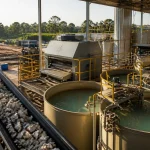
Tailings containment infrastructure and drainage channels at a chrome mining operation.
Cause remains unconfirmed
Several preliminary explanations have appeared in media and technical commentary, including the possibility that recent rainfall affected the facility or that deposition and water conditions changed the stability of the wall.
Those possibilities have not been established as the cause of the Dikwena failure.
Daily Maverick reported that rainfall of approximately 4.2 to 4.8 millimetres fell at the site between Aug. 10 and Aug. 12. The same report said experts were examining whether delayed water infiltration or over-deposition may have contributed to the failure.
The information is relevant to the investigation, but it is not a finding. Establishing cause will require a technical review of the facility’s design, construction history, deposition methods, drainage, water balance, surveillance records, maintenance and recent operating conditions.
Until that work is completed, attributing the collapse to rainfall, overfilling, design, maintenance or contractor performance would be premature.
Why the probe matters for South African mining
The Dikwena incident comes after previous high-profile tailings failures, including the Jagersfontein disaster in 2022. Those events have kept regulatory fragmentation, dam registration and emergency planning on the national agenda.
South Africa’s tailings oversight involves the National Water Act, dam-safety regulations, mining codes of practice and environmental legislation. The framework covers registration, structural safety, pollution prevention and rehabilitation, but responsibility is distributed across several institutions.
The investigation will therefore matter beyond the Dikwena facility. Operators, investors and regulators will be watching for findings on:
- Facility classification and registration: Whether the failed compartment and related dams were appropriately registered and assessed as safety risks.
- Engineering and surveillance: Whether design, construction, inspections and monitoring met applicable requirements.
- Water management: Whether freeboard, drainage and containment systems were adequate.
- Operational controls: Whether deposition and material-management practices complied with approved procedures.
- Emergency response: Whether neighbouring operations and infrastructure providers had effective warning and access plans.
- Remediation: How contaminated water, deposited tailings and damaged infrastructure will be managed.
Skillings has previously examined the wider tailings management and dam-safety landscape, including the growing focus on facility monitoring, closure planning and risk allocation. The Dikwena failure is likely to add pressure for more detailed disclosure and stronger assurance around tailings facilities across the sector.
For now, the confirmed facts are that a wall at Compartment 1B failed, a large volume of tailings was released, infrastructure and a watercourse were affected, and no casualties have been reported. The technical cause, full environmental impact and regulatory consequences remain to be determined.
Sources: South African Government News Agency, Mining Weekly, and Daily Maverick.