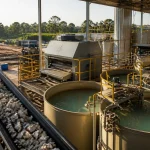
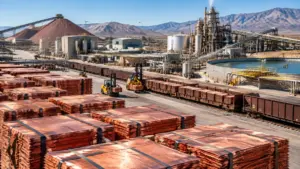
Tailings storage facility with environmental monitoring infrastructure at a modern mine.

By Charles Pitts
For mining companies, ESG compliance is moving from a separate sustainability exercise into the core financial and operating control system. Carbon emissions, water use, tailings integrity, biodiversity and community relations are increasingly being assessed alongside production, costs and reserves.
The shift is being driven by two overlapping developments. The IFRS Sustainability Disclosure Standards are establishing a global investor-focused baseline through IFRS S1 and IFRS S2. In Europe, the Corporate Sustainability Reporting Directive requires companies within its scope to report under the European Sustainability Reporting Standards.
For miners, the practical question is no longer whether ESG information will be requested. It is whether the data can be produced consistently, verified independently and connected to decisions about mine plans, capital allocation and financing.
More Read

Why mining ESG compliance matters now
IFRS S1 and IFRS S2 are effective for annual reporting periods beginning on or after January 1, 2024, although whether they are mandatory depends on adoption by individual jurisdictions. IFRS S1 covers sustainability-related risks and opportunities that could affect a company’s cash flows, access to finance or cost of capital. IFRS S2 focuses specifically on climate-related risks and opportunities.

The standards require reporting across four familiar areas:
- Governance
- Strategy
- Risk management
- Metrics and targets
They also require companies to consider industry-specific information. For mining, that means generic corporate sustainability statements are unlikely to be sufficient. Investors want data that reflects the operating realities of open-pit and underground mines, processing facilities, energy use, water stress, mine waste and closure liabilities.
More Read
IFRS S2 also requires disclosure of Scope 1, Scope 2 and Scope 3 emissions using the GHG Protocol. Scope 3 is particularly difficult for mining companies because it can include downstream processing, shipping, refining and the eventual use of certain commodities.
CSRD adds a wider impact test
The EU framework differs from ISSB in a significant way. ISSB is primarily concerned with financial materiality: how sustainability issues affect enterprise value. CSRD uses the concept of double materiality, requiring companies to report both:
- How environmental and social issues affect the company; and
- How the company’s activities affect people and the environment.
This is important for miners because many of the sector’s most material issues are location-specific. A mine may face water scarcity, biodiversity loss or community opposition even if those risks have not yet appeared as a direct financial loss.
The current EU framework has also evolved. Following the simplification measures described by the European Commission, direct CSRD obligations are concentrated on larger companies and groups. A non-EU mining company that simply exports into Europe may not be directly in scope. However, EU customers, lenders and downstream manufacturers may still request detailed emissions, water, labour, traceability and biodiversity data from their suppliers.
That indirect pressure may be commercially significant even when a company has no immediate legal obligation to publish a CSRD report.
The key compliance areas for miners
1. Scope 1–3 emissions
Scope 1 emissions come from sources controlled by the mining company, including diesel equipment, processing plants and onsite power generation. Scope 2 covers purchased electricity. Scope 3 extends across the value chain.
The first challenge is establishing consistent boundaries across sites, subsidiaries, contractors and joint ventures. The second is explaining the assumptions behind the numbers. A credible report needs to show which Scope 3 categories were included, where estimates were used and how the methodology has changed.
For investors, emissions data becomes more useful when linked to production intensity, energy costs, capital expenditure and asset life. A reduction target without a clear operational pathway provides limited insight.
2. Water stewardship
Water is both an environmental impact and an operating dependency. Mines may rely on water for ore processing, dust suppression and community infrastructure while operating in basins already under stress.
Compliance systems increasingly need to track:
- Freshwater withdrawals and consumption
- Recycled and reused water
- Discharge quality
- Water availability by site and basin
- Community and Indigenous interests
- Long-term water treatment obligations
A water dashboard that only reports total consumption can conceal material risk. Investors and regulators are more likely to ask where the mine operates, how competing users are affected and whether water availability could constrain production.
3. Tailings dam safety
Tailings facilities remain one of the sector’s highest-consequence ESG risks. Compliance requires more than publishing a policy. Companies need documented governance, independent technical review, monitoring systems, emergency preparedness and clear accountability.
Useful data can include:
- Facility consequence classification
- Engineer-of-record arrangements
- Independent review frequency
- Pore pressure and deformation monitoring
- Seepage controls
- Closure and post-closure plans
- Community emergency communication procedures
The cost of prevention is visible in the operating budget. The cost of a major failure can include fatalities, environmental remediation, litigation, compensation, permit restrictions, insurance issues and prolonged production disruption. That asymmetry is why tailings governance is increasingly examined by lenders and insurers as well as regulators.

Mine water treatment and recycling equipment in an industrial facility.
4. Community relations and human rights
A mining permit is not the same as a durable social licence to operate. Community relations reporting is becoming more evidence-based, with greater attention to consultation quality, grievance resolution, Indigenous rights, local employment, resettlement and benefit-sharing.
Companies should be able to show not only how many meetings were held, but also:
- Which groups were consulted
- What issues were raised
- How decisions changed in response
- How grievances were resolved
- Whether commitments were tracked over time
This information is relevant to project schedules and valuation. Delays caused by community conflict can defer revenue, increase construction costs and weaken the credibility of production guidance.
5. Biodiversity and closure
Biodiversity reporting is moving beyond broad statements about habitat protection. Mining companies are expected to assess baseline conditions, identify sensitive ecosystems, apply the mitigation hierarchy and report on progressive rehabilitation.
Closure planning is central to this process. Investors increasingly want to understand the timing, assumptions and funding of closure liabilities, including long-term water treatment and monitoring.
Progressive rehabilitation can spread costs over the life of a mine and provide evidence that closure commitments are operationally achievable. Delaying the work until the end of production can leave companies with a larger financial and regulatory burden.
Key reporting frameworks
| Framework or standard | Main focus | Relevance to mining in 2026 |
|---|---|---|
| IFRS S1 | Sustainability-related financial information | Identifies material sustainability risks and opportunities affecting enterprise value |
| IFRS S2 | Climate-related disclosures | Covers governance, transition plans, physical risk, targets and Scope 1–3 emissions |
| CSRD/ESRS | Financial and impact reporting | Requires double-materiality reporting for companies within EU scope |
| SASB Metals & Mining guidance | Industry-specific investor metrics | Helps identify relevant emissions, water, safety and operating indicators |
| GRI 14: Mining Sector | Wider stakeholder impacts | Supports detailed reporting on communities, land, waste and closure |
| GISTM | Tailings governance and safety | Provides a widely used benchmark for tailings risk management |
| TNFD | Nature-related dependencies and impacts | Increasingly relevant to biodiversity, water and land-use risk |
The most effective approach is not to produce separate data sets for every framework. Companies should build a controlled underlying data model and map the same verified information to different reporting requirements.
Cost of compliance versus cost of non-compliance
ESG compliance carries real costs. Mining companies may need to invest in emissions measurement, water treatment, tailings instrumentation, biodiversity studies, community engagement, reporting software, staff training and external assurance.
Those costs can be substantial for smaller operators and development-stage companies. They also compete with sustaining capital, exploration and expansion spending.
However, compliance spending can protect value in several ways:
- Better water and energy management can reduce operating costs.
- Progressive rehabilitation can reduce future closure risk.
- Reliable data can shorten financing and due-diligence processes.
- Stronger controls can reduce the likelihood of regulatory breaches.
- Transparent community engagement can lower permitting and delay risk.
- Audit-ready records can improve confidence among lenders and offtakers.
Non-compliance can result in fines, permit conditions, remediation costs, litigation, production stoppages and higher insurance premiums. It can also reduce the pool of investors willing or able to hold the company’s securities.
The financing effect is not always a simple discount for companies with strong ESG scores. Cost of capital is also shaped by commodity prices, jurisdiction, balance-sheet strength and asset quality. But weak ESG performance can create a clear penalty through higher perceived risk, restricted access to capital or additional lender conditions.
Base, bull and bear cases for mining ESG compliance
Base case: compliance becomes an operating discipline
In the base case, major mining jurisdictions continue adopting or referencing ISSB standards, while EU-linked customers extend data requirements through supply chains. Companies standardise ESG controls across sites and integrate sustainability metrics into enterprise risk management.
Reporting becomes more comparable, but implementation remains uneven among junior and mid-tier miners. Investors focus less on polished sustainability narratives and more on assurance, trend data and evidence that targets are funded.
Bull case: digital systems reduce the burden
In the bull case, mining companies rapidly adopt connected ESG data platforms, remote sensing, IoT monitoring and automated assurance controls. Sensors feed emissions, water and tailings data into systems that can be reconciled with production and financial information.
That would make compliance more timely and could expose operational savings that were previously hidden in manual reporting processes. The strongest operators would use ESG data to improve mine planning rather than treat it as a year-end disclosure task.

Mining environmental team monitoring biodiversity on rehabilitated land.
Bear case: fragmented rules and weak data widen risk
In the bear case, regulatory changes create overlapping requirements while companies retain fragmented spreadsheets and inconsistent site-level definitions. Scope 3 estimates remain disputed, assurance costs rise and smaller operators struggle to keep pace.
A serious tailings, water or community incident could then expose gaps between public commitments and operational controls. The result would be higher financing friction, slower permitting and greater pressure from customers seeking traceable, lower-risk mineral supply.
What mining executives should prioritise
The most practical 2026 response is to build an ESG control framework around the company’s highest-value dependencies and highest-consequence risks.
That means:
- Map which ISSB, CSRD and local rules apply to each entity.
- Establish a single source of truth for site-level ESG data.
- Assign ownership of metrics to operational managers, not only sustainability teams.
- Reconcile ESG data with production, capex, reserves and financial forecasts.
- Document assumptions, estimates and methodological changes.
- Test tailings, water, biodiversity and community controls under adverse scenarios.
- Prepare for external assurance before it becomes mandatory.
- Link ESG performance to capital allocation and procurement decisions.
The companies best positioned for 2026 will not necessarily be those with the largest sustainability departments. They will be those that can demonstrate a direct connection between ESG information, operating decisions and financial resilience.
Bottom line: Mining ESG compliance is becoming a test of data quality, operational control and access to capital. The cost of building credible systems is material, but the cost of unreliable information: or a preventable environmental or social failure: can be far greater.