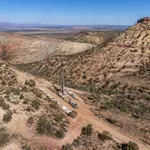
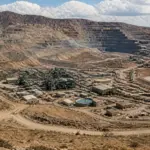
The Lac des Iles mine and processing facility in Quebec, Canada.

By Charles Pitts
Northern Graphite has delayed the planned restart of its Lac des Iles graphite mine in Quebec after the province suspended the mine’s lease over a disputed site-restoration payment, leaving Canada’s only operating natural graphite mine without an active production timetable.
The company said the suspension notice, issued by Quebec’s Ministère des Ressources naturelles et des Forêts (MRNF) on Aug. 10, followed an outstanding payment connected to an increase in the financial guarantee required for future mine restoration. Northern disputes the province’s interpretation of the guarantee calculation and payment deadlines and plans to challenge the decision before the Quebec Court.
The lease suspension will be stayed while the court considers the matter, Northern said in an Aug. 19 update on the Lac des Iles restart. That means the lease remains in effect until a final judgment, but the legal dispute has added another obstacle to a restart that was already under pressure from financing constraints and weaker-than-expected graphite market conditions.
More Read

What happened at Lac des Iles
Northern placed the mine and mill into temporary care and maintenance in November 2025 to complete maintenance, plant upgrades and preparatory work for a planned pit expansion.

The company had been targeting a restart in the third quarter of 2026. That plan depended on building an ore stockpile from the expanded pit before returning the processing plant to full operations. Northern now says the target is unlikely to be met.
The lease issue emerged after Quebec approved an updated restoration plan for Lac des Iles in November 2025. According to Northern, the revised plan increased the total financial guarantee from about C$8.2 million to approximately C$10.1 million, an increase of roughly C$1.8 million.
More Read

The company said the additional security was to be paid in installments:
| Item | Amount or status |
|---|---|
| Previous restoration guarantee | About C$8.2 million |
| Revised total guarantee | About C$10.1 million |
| Additional security requested | About C$1.8 million |
| First additional installment | C$0.9 million |
| Further installments | C$0.45 million each |
| Existing surety bond cited by Northern | C$8,232,941 |
Northern said it disagrees with the MRNF’s interpretation of the Quebec Mining Act and related regulations, including how the guarantee should be calculated and when individual payments were due.
Chief Executive Officer Hugues Jacquemin said the company takes its restoration obligations seriously and has already provided more than C$8.2 million in security. Northern also said it believes the existing surety bond covers the first two prescribed installments and that the final portion should not be payable until Nov. 28, 2027.
The company has 30 days from the Aug. 10 notice to contest the decision. Northern said it intends to file its challenge by the Sept. 9 deadline.

Processing equipment at a graphite operation.
Environmental authorization did not resolve the restart
The lease dispute is separate from the environmental authorization required for the planned pit expansion.
On July 9, Quebec’s Ministère de l’Environnement, de la Lutte contre les changements climatiques, de la Faune et des Parcs authorized Northern to begin mining activities associated with a staged expansion of the Lac des Iles pit.
The authorization allows the company to expand the existing pit westward by 48,000 square metres, mine to a 209-metre elevation and remove up to 2.2 million tonnes of waste rock through April 9, 2027.
Northern said additional kinetic studies are being conducted to support a future authorization for mining beyond that date. The company’s Phase I plan could produce up to 44,000 tonnes of graphite flake over three years, although that figure remains dependent on further approvals, financing and operating conditions.
The proposed expansion could add as much as eight years to the mine life, according to Northern. However, the environmental approval does not eliminate the separate requirement to maintain a valid mining lease or satisfy restoration-security obligations.
That distinction is significant for operators and policymakers. A project can have permission to undertake a defined mining activity while still facing legal, financial or administrative conditions that prevent a full restart. At Lac des Iles, the company now has environmental authorization but remains engaged in a court challenge over the lease suspension.
Why the interruption matters for graphite supply
Lac des Iles is described by Northern as North America’s only producing graphite mine. Located about 150 kilometres northwest of Montreal, the operation has produced graphite for more than three decades and has an established customer base.
Before the care-and-maintenance period, the mine was producing approximately 10,000 to 15,000 tonnes of graphite concentrate per year. Northern has been upgrading the plant with the goal of reaching nameplate capacity of 25,000 tonnes annually.
The company’s Lac des Iles overview identifies the operation as a source of battery-quality graphite and says it can be expanded through the existing mine, processing plant and tailings facilities. Northern also says the operation currently supplies industrial markets, including refractory, thermal-management and friction applications, while positioning the asset for future battery-material demand.
With mining and milling suspended, current output from Lac des Iles is effectively zero. Northern has not provided a new restart date.
The immediate market effect will depend on customer inventories, alternative suppliers and the duration of the shutdown. Northern has previously said it was assessing demand visibility before restarting because the higher strip ratio associated with the new mining area would make materially lower production levels uneconomic.

Natural flake graphite concentrate prepared for laboratory analysis.
The battery-anode connection
Graphite is a critical input for lithium-ion battery anodes. Natural flake graphite from a mine is not normally used directly in a battery cell. It generally must be upgraded through processes such as purification, shaping and coating before it can become anode material.
That makes mine supply only one part of the battery-chain challenge. North American manufacturers also require processing capacity, technical qualification, long-term contracts and consistent product specifications.
Northern has developed a battery-materials strategy focused on moving from mine production toward higher-value anode materials. The company says its assets contain graphite suitable for battery applications, while its downstream plans are intended to connect concentrate production with battery manufacturers.
A prolonged disruption at Lac des Iles would not remove graphite from global markets, which remain heavily supplied by producers and processors outside North America. It would, however, underscore the difficulty of building regional supply chains around a small number of domestic assets.
That issue has become more important as governments and automakers seek to reduce dependence on concentrated overseas processing. Canada has identified graphite as a critical mineral because of its role in batteries, energy storage and industrial applications. The status of Lac des Iles therefore carries significance beyond the company’s own production plans.
The disruption also illustrates the difference between geological potential and available supply. Northern’s expansion plan points to additional resources and higher future capacity, but those tonnes cannot enter the market until the company resolves the lease matter, secures working capital and demonstrates that the new production level can be sold at viable prices.
Financing and workforce pressures
Northern said the extended shutdown has depleted its financial resources and that additional working capital or financing will be needed before operations can restart.
The company also plans temporary workforce reductions at Lac des Iles as it controls costs during the delay. The scale and timing of the reductions remain subject to consultation and notification requirements.
The financing challenge is linked to the mine plan. Northern says the expanded pit has a higher strip ratio, meaning more waste rock must be removed relative to the ore produced. Operating well below the targeted production level would therefore be difficult to justify economically, particularly while graphite demand and pricing remain uncertain.
The company’s comments reflect a broader challenge across the critical-minerals sector: projects intended to serve future battery demand must often make large capital commitments before customer demand is fully contracted. A project can be strategically important to a jurisdiction while still facing commercial pressure in the near term.
Skillings’ reporting on mining ESG compliance and permitting risk has examined how restoration obligations, environmental approvals and financing conditions increasingly intersect in project development. Lac des Iles provides a current example of those issues converging at an operating asset rather than a greenfield project.

Environmental monitoring infrastructure at a mine restoration site.
What to watch next
The next major milestone is Northern’s legal challenge to the MRNF decision. Until the Quebec Court issues a final determination, the company says the lease remains legally in effect.
Operators, customers and policymakers will also be watching four related developments:
- The court process: Whether the suspension is overturned, modified or upheld.
- Restoration security: How the court interprets the guarantee calculation and payment schedule.
- Restart financing: Whether Northern can secure enough working capital to fund the pit expansion and plant ramp-up.
- Graphite demand: Whether market conditions improve sufficiently to support production near the planned 25,000-tonne annual capacity.
For Canada’s critical-minerals strategy, the outcome will show whether an established domestic graphite operation can move from care and maintenance back into production while meeting environmental, financial and market requirements.
For now, Lac des Iles remains a permitted and strategically important asset, but its production restart is delayed. The mine’s lease is under dispute, its output is halted and the timing of renewed graphite supply remains unresolved.