By Charles Pitts

The global antimony market enters the second half of 2026 caught in a geopolitical pincer movement. While prices have retreated from the historic spikes of late 2024 and 2025, the structural fragility of the critical minerals supply chain remains exposed. As of June 2026, the industry is operating under a temporary reprieve: China’s Ministry of Commerce has suspended its export prohibition on antimony destined for the United States, but that suspension is set to expire on November 27, 2026.
This “ticking clock” has forced Western defense contractors and industrial manufacturers into a frantic race to secure alternative supply. Antimony, a semi-metal often overlooked in the shadow of lithium or copper, is the “glue” of the modern defense industry, essential for everything from armor-piercing ammunition to infrared sensors and flame retardants. With China still controlling approximately 48% of global mine production and a much higher share of refined output, the 2026 outlook is defined by a desperate search for domestic sovereignty.
Antimony price trend 2026: Drivers and market correction
The antimony price trend 2026 is characterized by a “plateau at height.” After the dramatic surge that saw prices nearly triple in late 2024: surpassing $35,000 per metric ton in some spot markets: the first two quarters of 2026 have seen a necessary correction.
Current Market Data (June 2026)
| Region | Price (Estimated USD/kg) | MoM Change | Trend vs. 2024 Average |
|---|---|---|---|
| North America | $27.50 | -3.6% | +143% |
| Europe | $32.96 | -3.6% | +191% |
| Northeast Asia | $20.27 | -12.5% | +79% |
The softening of prices in early 2026 is largely attributed to two factors: the partial normalization of trade flows following China’s temporary suspension of the ban and the aggressive destocking by industrial users who over-purchased during the 2025 panic. However, despite the recent 18% decline from 2025 highs, prices remain structurally elevated. In North America, the premium for “non-Chinese” or “sanction-proof” material remains a significant cost driver for operators.
More Read

As noted in recent Skillings Mining Intelligence reports, the market is no longer pricing in a total blockade, but rather a “geopolitical tax.” Analysts expect prices to find a firm floor around the $25/kg mark as the November deadline approaches, with a “bull case” scenario of a return to $40/kg should China decline to renew the export suspension.


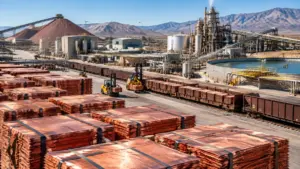
High-purity antimony ingots and stibnite ore samples are central to the current critical minerals debate.
The Geopolitical Siege: China’s strategic leverage
The current crisis began in earnest in August 2024, when Beijing announced strict export controls on antimony ores, metals, and chemical compounds, citing national security concerns. By December 2024, these controls transitioned into a full ban on exports to the U.S. defense sector.
More Read

The leverage China holds is not merely in the ground, but in the processing. While countries like Tajikistan and Vietnam have increased mine output in 2026, the refining capacity for high-purity trioxide: required for high-spec flame retardants: remains concentrated in Chinese industrial hubs. This concentration has turned the critical minerals supply chain into a single point of failure for Western defense logistics.
The temporary suspension announced in late 2025 was a tactical move, likely intended to ease diplomatic tensions while maintaining the threat of a renewed shut-off. For Western buyers, 2026 is not a year of relief, but a year of preparation. The divergence in pricing between Northeast Asia ($20.27/kg) and North America ($27.50/kg) illustrates the “risk premium” Western companies are now forced to pay to ensure continuity of supply.
Defense and the “Ammunition Gap”
For the U.S. Department of Defense, antimony is a non-negotiable input. It is used as a hardening agent in lead-acid batteries for military vehicles and as a critical component in primers and tracer ammunition. Without it, the “arsenal of democracy” faces a literal hardening problem.
Beyond kinetics, antimony is the primary ingredient in flame-retardant synergists (antimony trioxide). In an era of increasing electrification and high-density battery storage, the demand for high-performance flame retardants in aerospace and marine applications has never been higher. The shortage of 2025 forced several defense contractors to look toward recycled sources and “brownfield” reclamation, a trend we have seen mirrored in the copper sector’s push for brownfield expansion.

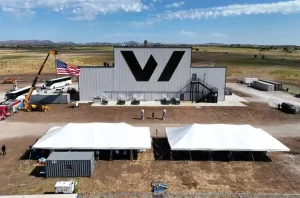
Defense manufacturing facilities are heavily dependent on consistent antimony supply for ammunition hardening and primers.
Domestic Alternatives: The Perpetua Resources factor
The most significant domestic answer to the antimony siege is the Stibnite Gold Project in Idaho, managed by Perpetua Resources. Historically a major producer during World War II, the Stibnite district is now the centerpiece of U.S. critical minerals strategy.
As of June 2026, Perpetua Resources is advancing through the construction phase. Once operational, the project is forecast to provide approximately 35% of total U.S. antimony demand during its first six years. This would represent a tectonic shift in the critical minerals supply chain, effectively neutralizing a third of China’s leverage over the American defense sector.
The project’s importance is underscored by the $1.8 billion NPV breakout discussed in recent market intelligence. However, the “supply gap” remains a concern for the immediate 2026–2027 window. While construction is moving forward, the first commercial-scale output is still on the horizon, leaving the U.S. reliant on stockpiles and the fragile Chinese suspension until domestic production hits the grid.

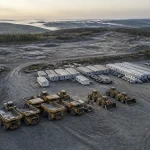
Modern facilities like the proposed Stibnite Gold Project are designed to integrate environmental remediation with critical mineral extraction.
Risks and the 2026–2027 Outlook
The “Base Case” for the remainder of 2026 is one of watchful stability. However, several risks could upend the current price correction:
- The November 27 Deadline: If China does not renew the export suspension for U.S. buyers, we expect an immediate 30–50% jump in North American spot prices.
- Logistical Bottlenecks: Increased production from Tajikistan and Vietnam must be refined. If Western refining capacity does not scale as quickly as the mines, a “refined metal squeeze” will occur even if ore is available.
- ESG and Permitting: Domestic projects like Stibnite face continuous scrutiny. Any delay in the 2026 construction timeline for major Western projects will extend the period of vulnerability.
Operators are increasingly looking at decarbonization and operational efficiency to offset the rising costs of raw materials. Lowering the All-In Sustaining Cost (AISC) at the mine site is becoming the only way to absorb the “geopolitical tax” imposed by the antimony market.
Strategic Summary for Decision-Makers
The antimony price trend 2026 suggests that the “easy” days of cheap, abundant Chinese supply are over. Even with a current price correction, the floor has shifted permanently higher. For investors and operators, the focus should remain on:
- Diversification: Reducing reliance on Chinese-refined trioxide.
- Domestic Resilience: Supporting the development of projects like Perpetua’s Stibnite Gold Project.
- Stockpiling: Managing the risk of the November 27 export suspension expiry.
The antimony siege is a blueprint for the wider critical minerals conflict. As 2026 progresses, the ability to secure these small-volume, high-impact minerals will define the winners in both the industrial and defense sectors.