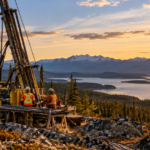
SASKATOON, Saskatchewan : Tuesday, March 17, 2026 : The decades-long regulatory stalemate in northern Saskatchewan has finally broken. In a series of rapid-fire decisions this month, the Canadian Nuclear Safety Commission (CNSC) and federal authorities have fast-tracked major uranium exploration and development permits in the Athabasca Basin, signaling a desperate pivot to secure domestic supply amid a tightening global energy crunch.

For twenty years, the Athabasca Basin: home to the highest-grade uranium on the planet: has been a landscape of “potential” hamstrung by red tape. That ended this week. The Canadian government is no longer just encouraging development; it is clearing the path for it.
The move comes as uranium prices hold steady above $101 per pound, driven by a perfect storm of utility deficits, aggressive Section 232 trade measures, and a sudden, massive demand spike from the tech sector.
The Phoenix and the Rook: A 20-Year Dry Spell Ends
The headline approvals center on two massive projects: Denison Mines’ Wheeler River and NexGen Energy’s Rook I. These aren’t just incremental additions to the supply chain; they represent a tectonic shift in North American energy security.
In February 2026, Denison Mines received its final federal license to prepare, construct, and operate its Phoenix In-Situ Recovery (ISR) mine at Wheeler River. This marks the first time a large-scale Canadian uranium mine has been approved for construction in more than two decades. More importantly, it is the first uranium mine in Canada approved for ISR mining: a lower-cost, lower-impact method that the industry has been trying to prove viable in the Basin for years.
More Read

Fast-forward to March 2026, and NexGen Energy’s Rook I project followed suit. The CNSC issued an environmental assessment approval and construction license for the project located 900 kilometers northwest of Regina. Construction is slated to begin this summer.

Collectively, these two projects represent 39 million pounds of annual U3O8 production capacity. To put that in perspective: that’s enough to nearly double Canada’s total uranium output within the next decade.

More Read

The AI Energy Nexus: Why Big Tech is the New Uranium Floor
The urgency in Ottawa isn’t happening in a vacuum. It is being fueled by a realization that the global energy transition isn’t just about electric vehicles; it’s about the massive power requirements of artificial intelligence.
We’ve seen this coming. As we previously analyzed in The AI Energy Nexus: Why Big Tech’s Nuclear Gambit is the New Uranium Floor, the tech giants are no longer content with intermittent renewables. They need baseload power that doesn’t blink. Microsoft, Amazon, and Google are increasingly looking at Small Modular Reactors (SMRs) and existing nuclear fleets to power their “shiny AI revolution.”
That demand has created a permanent floor for uranium prices. The “chickens-coming-home-to-roost” moment for utilities has arrived. For years, utilities under-contracted, relying on a “just-in-time” delivery model that ignored the brutal reality of mining timelines. Now, they are competing with Silicon Valley for the same pounds of yellowcake.
There is not enough to go around.
Breaking the Regulatory Stranglehold
Historically, the Canadian permitting process has been described as a “black hole” where junior and mid-tier miners go to die. The multi-year timelines for Environmental Assessments (EAs) and the overlapping jurisdictions between provincial and federal bodies have acted as a throttle on the industry.
The fast-tracking of these permits suggests a new “pro-development” stance from the Canadian authorities, likely influenced by the PDAC 2025 sparks a new era for critical minerals investment. The realization is simple: if Canada doesn’t produce it, the West will remain reliant on geopolitical adversaries or unstable jurisdictions for its nuclear fuel.
“This isn’t a rounding error,” says one industry analyst. “This is a crisis of supply. The government finally realized that you can’t disrupt geology. You can only accelerate the paperwork.”

The Strategic Calculus: $101 Uranium and the Supply Gap
The numbers are grim for those hoping for a price retreat. At $101 per pound, the incentive for new production is finally there, but the lead times remain the primary obstacle. Even with “fast-tracked” permits, NexGen and Denison won’t be pumping at full capacity tomorrow.
The market deficit is estimated to be roughly 110 kilotons of cumulative demand over the next decade. Adding 39 million pounds annually helps, sure. But it doesn’t solve the problem.
And here is what makes this particularly nasty: the existing supply is fragile. Kazakhstan, the world’s largest producer, has repeatedly signaled production shortfalls due to sulphuric acid shortages and logistical bottlenecks. When the largest producer in the world tells you they can’t meet their targets, you don’t just wait: you find new sources.
Canada is that source. The Athabasca Basin is the only place on earth with the grade and scale to move the needle in a meaningful way.
Technical Precision Meets Modern Mining
The approval of ISR mining at the Phoenix deposit is a watershed moment for the industry. Traditionally, Athabasca mines have been deep, underground operations requiring massive “freeze-wall” technology to keep out groundwater. It’s expensive, dangerous, and slow.
ISR changes the game. By pumping a solution into the ore body to dissolve the uranium and then pumping it back to the surface, Denison can avoid much of the heavy-duty earthmoving associated with traditional mining.
“It’s efficient. It’s cleaner. And, frankly, it’s the only way to get these pounds out of the ground at the speed the market requires,” notes an engineering lead at the site. This shift toward modular, efficient extraction is a trend we are seeing across the board, similar to the watershed moment for green steel in the milling sector.

The Labor Crisis: A Looming Bottleneck
Even if you have the permits and the capital, you still need the people. Canada’s mining sector is facing a demographic cliff. The skilled workforce required to build and operate these multi-billion-dollar facilities is aging out, and there aren’t enough young engineers to fill the gap.
As we’ve seen in other sectors, such as the African mining job market, the competition for talent is global. NexGen and Denison aren’t just competing with each other for geologists and technicians; they are competing with the entire critical minerals sector, from lithium in Arkansas to rare earths in Sweden.
The strategic calculus here isn’t subtle: permits are just the first hurdle. The second hurdle is the physical reality of building a mine in the sub-arctic wilderness during a labor shortage.
What Happens Next?
The market’s reaction to the fast-tracking has been one of cautious optimism. Uranium equities have surged on the news, but the “smart money” is looking at the long-term production curves.
Both NexGen and Denison are positioned to front-load production in their initial five years of operation. This is a deliberate strategy to capture the current high-price environment and fill the immediate gap left by Russian sanctions and Kazakh underperformance.
However, the industry should remain wary. Fast-tracking permits is a political tool, and political winds can shift. For now, the global energy crunch has forced Ottawa’s hand. But as any seasoned operator in the Basin will tell you: getting the permit is the easy part. Building the mine is where the real work: and the real risk: begins.
2026 marks the inflection point. The transition from “potential” to “production” in the Athabasca Basin is finally underway. But with the world’s power grids hanging in the balance, the question remains: is it too little, too late?