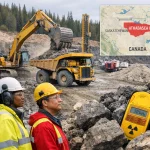
LUSAKA, Zambia : The Zambian government has finalized a sweeping overhaul of its mineral royalty framework, moving to a sliding-scale system designed to stabilize the fiscal environment for Tier-1 copper producers. The shift, which takes full effect as the 2026 fiscal year gains momentum, represents a calculated gamble by President Hakainde Hichilema’s administration to double copper production to 3 million tonnes per year by the mid-2030s.

For years, Zambia’s mining policy was a pendulum, swinging between aggressive resource nationalism and desperate liberalization. This volatility effectively throttled long-term capital expenditure. Now, the government is betting that price-indexed royalties and centralized regulation will provide the “certainty” that majors like First Quantum Minerals and Ivanhoe Mines have long demanded before committing billions to deep-level expansions.
The Fiscal Math: Sliding Toward Stability
The core of the overhaul is the transition to a Mineral Royalty Tax (MRT) that fluctuates based on the London Metal Exchange (LME) copper price. Under the new 2024-2025 schedule, the rates are graduated to prevent the “tax-cliffs” that previously incentivized miners to curb production during price spikes.
The breakdown is specific:
- Below USD 4,000/tonne: 4% of norm value
- USD 4,000–4,999/tonne: 6.5% of norm value
- USD 5,000–6,999/tonne:* 8.5% of norm value
- USD 7,000/tonne and above: 10% of norm value
“That’s not a rounding error. That’s a structural pivot,” says one industry analyst. At current copper prices: consistently hovering in the $8,500 to $9,500 range: most operators will be paying the top-tier 10% rate. While 10% is objectively high compared to some Latin American jurisdictions, the “sliding” nature allows for an automatic relief valve if the market crashes.
More Read

For the Zambian Treasury, the stakes are high. The 2026 budget targets ZMW18.2 billion in mineral royalties. That is approximately 8.8% of total domestic revenue. It is a dangerous reliance on a single commodity, but in the Copperbelt, there isn’t much of a Plan B.


Centralizing Command: The Minerals Regulation Commission
Beyond the tax rates, the Minerals Regulation Commission Act (MRCA), which was assented to in late 2024 and fully staffed by early 2026, has fundamentally changed how business is done in Lusaka.
More Read

Historically, a miner needing a permit or a dispute resolution had to navigate a labyrinth of dispersed departments: Energy, Water, Environment, and Mines: often with conflicting mandates. The MRCA collapses these into a single Minerals Regulation Commission (MRC).
The strategic calculus here isn’t subtle: Lusaka wants to cut the red tape that has historically delayed Tier-1 projects by years. By centralizing governance, the MRC aims to provide a “one-stop-shop” for compliance. But there is a catch. The new law also grants the commission broader powers to audit production data in real-time. The era of “self-reporting” and “trust-but-verify” is over. It’s now “monitor-in-real-time.”
The Local Content Hurdle: 20% or Bust
While the fiscal terms have eased, the operational terms have tightened. The Geological and Minerals Development Act of 2025 has introduced a rigid local content regime that is causing some quiet anxiety in corporate boardrooms in Vancouver and Johannesburg.
Mining rights-holders are now legally mandated to:
- Allocate at least 20% of their procurement budgets to registered Zambian suppliers within the first six months of operation.
- Scale that allocation to 40% over five years.
For a Tier-1 operator, finding local suppliers capable of providing high-spec components: like specialized grinding media or autonomous hauling software: is a tall order. The mining job market in Africa is evolving, but the supply chain for high-tech mining equipment remains stubbornly global.
The government’s stance is firm: If you want the copper, you buy the boots, the food, and the transport from Zambians. It is a “chickens-coming-home-to-roost” moment for an industry that has historically exported its profits and its procurement.

Impact on the Big Players: First Quantum and Ivanhoe
The primary targets of these reforms are the companies with the balance sheets to move the needle on national production.
First Quantum Minerals (FQM):
As Zambia’s largest taxpayer, FQM’s relationship with the state is foundational. The company’s S3 expansion at Kansanshi and the ongoing optimization of the Sentinel mine are the bedrocks of Zambia’s 3-million-tonne dream. The new sliding scale allows FQM to model its 10-year NPV (Net Present Value) with significantly less “political risk” baked into the discount rate. However, the local content requirements will force FQM to aggressively vet and mentor local vendors: a cost of doing business that is now a line item in their annual reports.
Ivanhoe Mines:
While Robert Friedland’s Ivanhoe is synonymous with the massive Kamoa-Kakula complex across the border in the DRC, the company has been quietly increasing its footprint in Zambia’s Western Foreland. For Ivanhoe, the regulatory overhaul is the green light needed to transition from “exploration” to “development.” The prospect of a “Kamoa-style” discovery on the Zambian side of the border is the holy grail for Lusaka.
The strategic alignment is clear: Ivanhoe brings the “Tier-1” exploration DNA, and Zambia is now providing the fiscal “Tier-1” framework.
Why the 2026 Pivot Matters
2026 marks the inflection point for the global energy transition. With the global battery revolution demanding unprecedented volumes of copper for EV motors and grid storage, the “easy” copper has already been found. What remains is deep, complex, and expensive to extract.
“You can’t disrupt geology,” as the saying goes. But you can disrupt the economics of geology. By fixing the royalty structure, Zambia is attempting to decouple its mining sector from the chaos of its internal politics.
The timing is critical. As the U.S. and China race to secure critical mineral supply chains, Zambia finds itself in a geopolitical sweet spot. It is a democracy (mostly) with a pro-business administration (currently) and 6% of the world’s copper reserves (definitively).

The Uncomfortable Truth: The Price of Entry
Let’s be blunt: The 10% royalty at high prices is a “success tax.” The government is effectively saying, “We will protect you when you’re losing money, but we will take our pound of flesh when you’re printing it.”
For investors used to the lithium price volatility or the boom-bust cycles of junior explorers, this trade-off is acceptable. Stability, even at a high price, is better than a low-tax regime that might be torn up after the next election.
However, the 40% local procurement mandate by year five is the real “nasty” clause. It is a massive logistical hurdle. If the local supply chain cannot meet the demand, the MRC will have a choice: throttle production by enforcing the rule or undermine its own law by granting waivers.
The 2026 Outlook
The clock is already ticking. With copper production reaching 820,676 metric tonnes in the most recent counts, the path to 3 million tonnes is steep. It requires more than just better taxes; it requires massive investments in the regional power grid and rail infrastructure to move the concentrate to port.
The overhaul of the mining royalties is just the first domino.
The second domino will be the AI-energy nexus, which is driving demand for copper in data center cooling and power delivery. As Big Tech enters the mining space as an off-taker, they will look for jurisdictions like Zambia that have modernized their rulebooks.
Final Assessment
Zambia has stopped fighting its own industry. By implementing a sliding scale, the Hichilema government has acknowledged that the state and the miner are in a forced marriage. The new royalty structure isn’t perfect, and the local content rules are aggressive, but for the first time in a decade, the rules of the game are written in ink rather than pencil.
The “Tier-1” investment is starting to flow. Whether it stays depends on the MRC’s ability to regulate without strangling the very growth it was created to foster.

For more deep-dives into the critical minerals sector, check out our latest analysis on Trafigura’s lithium deal or explore the Skillings Mining Review archives.