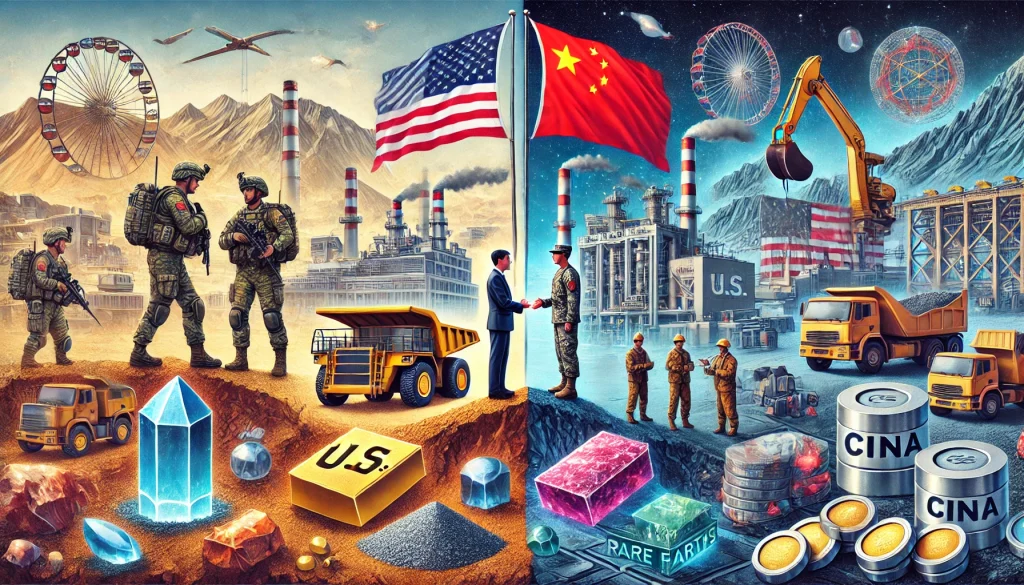
The U.S. Government and private industry are navigating a critical juncture in their acquisition and processing of non-fuel critical minerals. While the U.S. military negotiates prices for its mineral needs based on security concerns, private industry finds itself beholden to prices largely set by the Chinese market. As Western governments continue to debate the legality of Chinese subsidies, their own industries face increasing reliance on subsidies to stay competitive. These dynamics reflect broader global shifts in manufacturing dominance and economic policy that will likely shape the future of the critical mineral supply chain.

The U.S. Government’s Approach to Critical Minerals
The U.S. Department of Defense (DoD) prioritizes securing a self-sufficient supply of critical minerals for national security purposes. Unlike private industry, the DoD negotiates prices based on strategic needs, which do not always align with the broader supply-and-demand dynamics of global markets. The U.S. government has ramped up efforts to secure domestic production of minerals such as rare earths, lithium, and cobalt, essential for modern military technology. There is optimism that a secure domestic supply chain can be achieved by the end of the decade.
Private Industry’s Reliance on the Chinese Market
While the U.S. military focuses on self-sufficiency, private industry remains largely dependent on China for both raw minerals and their processing. China dominates the global critical mineral market, accounting for a majority of rare earth elements and other key materials essential for consumer electronics, renewable energy technologies, and electric vehicles. American manufacturing companies, many of which are financially stretched, are increasingly reliant on government subsidies to compete with China’s scale and pricing. This reliance underscores a major vulnerability in the U.S. supply chain.
Hypocrisy in Western Economic Policies
Western governments have been quick to criticize China’s industrial subsidies, accusing the country of unfair trade practices. However, these same governments are turning to subsidies for their own struggling industries. The U.S. has implemented measures like the Inflation Reduction Act, which allocates billions toward boosting domestic production of critical minerals. Critics argue that these policies resemble the very industrial strategies that Western leaders decry when employed by China. The global race to secure critical minerals has exposed this hypocrisy, highlighting the need for more coherent economic policies.
Impact on the American Economy
Subsidies and tariffs have become central to the U.S. approach in addressing the critical mineral supply issue. However, these interventions carry economic costs. Higher taxes to fund subsidies, combined with stagnant wages, could further erode the American standard of living. The current trajectory suggests that without substantial investment in domestic mineral production and processing, the U.S. will remain vulnerable to external market forces, particularly those dictated by China. As a result, American manufacturing could continue to face challenges in remaining competitive in a global market dominated by lower-cost producers.
More Read

Conclusion: A New Global Order in Critical Minerals?
The global landscape of critical mineral acquisition is undergoing a fundamental shift. The dominance once held by the West, particularly the United States, has given way to rising powers like China and Russia. These countries are not only leading the charge in mineral extraction and processing but are also positioning themselves for long-term dominance by accumulating strategic reserves like gold. As American politicians grapple with the nation’s diminished role on the world stage, it becomes clear that achieving mineral self-sufficiency is vital not just for national security, but for the future of the U.S. economy.