By Penny Langford · Deep-dive analysis

The European Commission’s revised European Sustainability Reporting Standards (ESRS) reduce reporting volume sharply, but they do not remove the operational risks that mining companies must measure, control and explain.
On July 3, 2026, the Commission adopted revised ESRS that cut mandatory datapoints by more than 60% and total datapoints by more than 70%. The Commission also expects reporting costs to fall by more than 30% per company. The changes are part of the EU’s Omnibus I simplification package and remain subject to scrutiny by the European Parliament and Council before they apply. (European Commission)
For mining companies, the practical consequence is not a 70% reduction in environmental, social or governance risk. A copper pit still consumes water, a lithium project still affects land and communities, and a nickel processing plant still has emissions, waste and energy exposure. The reporting perimeter is narrower, but the evidence behind material disclosures must remain credible.
That is why mining ESG compliance 2026 is becoming less about producing a longer report and more about building an auditable connection between site operations, financial controls and external assurance.
The regulatory reduction is real, and material
The Commission’s figures establish the starting point for 2026 planning.

| Revised ESRS measure | Change announced by the European Commission | Mining implication |
|---|---|---|
| Mandatory datapoints | Reduced by more than 60%; technical materials describe the reduction as approximately 61% | Fewer required fields, but greater focus on material topics and consistent definitions |
| Total datapoints | Reduced by more than 70% | Voluntary reporting is less likely to drive internal data collection |
| Expected reporting cost | Reduced by more than 30% per company | Savings will be greater for companies with standardized systems and weaker for fragmented operators |
| Assurance exposure | Not removed by the ESRS revision | Material disclosures still require documented controls and evidence |
The Commission says the revised standards are intended to preserve high-quality disclosures while reducing administrative burdens. The revision also introduces additional flexibility and removes voluntary disclosures from the total datapoint count.
However, the European Commission’s announcement does not say that companies can abandon the underlying operational records. Where climate, pollution, water, biodiversity, workforce or human-rights risks remain material, companies will still need to explain their impacts, policies, targets and performance.

The distinction is important: fewer datapoints do not necessarily mean fewer control requirements.
Mining’s data problem is still site-level
Mining risks are geographically specific. Tailings facilities, water withdrawals, waste rock, biodiversity impacts, worker safety and community grievances occur at assets, not at a consolidated head-office level.
The 2026 EFRAG State of Play report, based on 905 sustainability statements subject to third-party assurance, shows how far current reporting practice remains from that operating reality.
EFRAG found that:
- Global, company-wide reporting accounted for 77% of non-climate environmental metrics across ESRS E2 to E5.
- Regional disaggregation remained marginal, generally between 4% and 8%.
- Site-level reporting was most prevalent for pollution, water and biodiversity, at 25% of relevant metrics.
- Site-level reporting for resource use and circular economy stood at 18%.
- Mining and quarrying companies averaged 104 pages for sustainability statements in the FY2025 sample.
- Mining and quarrying recorded 100% coverage for human-rights policies covering relevant value-chain workers or affected communities.
- Mining and quarrying companies reported ESG criteria in supplier selection at an 89% rate.
These figures suggest a sector with relatively mature policies but uneven operational granularity. A group policy may be complete while the underlying records for individual mines remain inconsistent, manually assembled or difficult to reproduce.

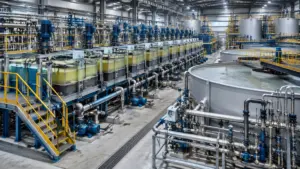
Site monitoring connects environmental performance with the evidence required for assurance.
Why limited assurance remains the pressure point
The revised ESRS changes the content and volume of sustainability reporting. It does not, by itself, eliminate the CSRD’s assurance architecture.
The European Commission’s corporate sustainability reporting framework places sustainability information within a reporting system that includes external assurance. Technical analysis from Deloitte likewise distinguishes between simplifying the standards and changing the assurance obligation.
For mining companies, limited assurance can expose weaknesses that are not visible in a polished annual report. Auditors and assurance providers may test:
- Whether the reporting boundary includes all relevant mines, processing plants and corporate functions.
- Whether diesel, electricity, explosives and production figures reconcile across systems.
- Whether water withdrawals, consumption and discharge data are supported by meters, invoices, permits or laboratory records.
- Whether environmental incidents and corrective actions are recorded consistently.
- Whether estimates and emission factors are documented and approved.
- Whether reported figures can be traced from a site source to the consolidated disclosure.
A company may report fewer datapoints and still face substantial assurance exposure if the remaining metrics are material and poorly controlled.
ESG reporting is converging with operational data
The data required for ESG reporting increasingly originates in systems that operations teams already use: enterprise resource planning platforms, fleet-management systems, SCADA networks, laboratory databases, maintenance records, human-resources systems and permit registers.
For an automation-led mine, the reporting opportunity is significant. Equipment telemetry can support fuel and energy accounting. Automated water sensors can provide continuous readings. Digital work-order systems can record corrective actions. Remote operating centers can bring environmental and production indicators into a common control environment.
But automation does not automatically produce assurance-ready data. A sensor reading still needs a defined owner, calibration record, time stamp, unit of measure, exception process and retention policy. Manual data remains necessary where systems are not connected or where local sampling is required.
The strongest architecture is therefore not “ESG software” in isolation. It is a controlled operational data model that connects:
- Asset and site identity
- Source data and measurement methods
- Responsible personnel
- Validation and reconciliation controls
- Management review
- External reporting and assurance evidence
This approach can be applied across copper, lithium, nickel, gold and silver, and other critical-minerals operations. Skillings’ coverage of tailings rules and audit-ready regimes describes the same shift from corporate narrative to facility-level evidence.
2026–2028 compliance cost and readiness scenarios
The Commission’s projected cost reduction is a useful benchmark, but the financial outcome will vary by data maturity. The following framework is a Skillings analytical estimate for incremental site-level data-readiness spending at a mid-sized or large mining operation. It includes process design, controls, data integration, training and assurance preparation; it is not an audit-fee quotation.
| Scenario | 2026 incremental cost per site / readiness | 2026 readiness | 2027 cost and readiness | 2028 cost and readiness |
|---|---|---|---|---|
| Bull: integrated operator | $75,000–$150,000; 60%–75% ready | Existing sensors, standardized definitions and strong ownership | $45,000–$100,000; 85%–95% ready | $30,000–$75,000; 95%–100% ready |
| Base: controlled transition | $100,000–$250,000; 40%–60% ready | Partial system integration and uneven site controls | $75,000–$180,000; 65%–80% ready | $60,000–$150,000; 85%–95% ready |
| Bear: fragmented data | $150,000–$350,000; 20%–40% ready | Spreadsheet dependence, incomplete ownership and weak lineage | $175,000–$400,000; 25%–50% ready | $150,000–$350,000; 40%–65% ready |
In the bull case, ESRS simplification converts directly into lower reporting effort because the company already has reliable site data. In the base case, the company benefits from fewer required disclosures but still needs to standardize meters, definitions and approvals.
In the bear case, lower datapoint volume can create false confidence. The company may collect less information while remaining unable to substantiate the disclosures that matter most. Remediation costs then rise because systems, controls and historical records must be rebuilt under deadline pressure.
These ranges should be calibrated against mine size, jurisdiction, commodity, number of sites, legacy systems and assurance scope. They are most useful as a board-level planning framework, not as a substitute for a site-by-site gap assessment.
What lenders and investors will continue to ask
Lenders and investors are unlikely to treat the revised ESRS as a reason to stop asking about operational risk. Their questions may become more focused.
For a copper or lithium project, that could include water stress, permitting conditions and community agreements. For nickel and critical-minerals processing, it may include energy intensity, emissions controls and waste management. For gold and silver operations, it may include tailings, cyanide management, closure obligations and security risks.
The key questions are likely to be:
- Which sites generate the reported figure?
- What changed from the prior year?
- Can the number be reconciled to production or financial records?
- Who reviewed it?
- What assumptions were used?
- What happens when a sensor, permit or monitoring program fails?
- Can the company produce the evidence for an assurance provider?
Those questions are not dependent on the final datapoint count. They arise from credit, operational and legal risk.

Operational data systems increasingly support both production decisions and ESG controls.
A practical 2026–2028 roadmap
2026: define materiality and ownership
Mining companies should update their double-materiality assessment, identify the sites within scope and map each material disclosure to a source system. The first priority should be a controlled data dictionary covering boundaries, units, emission factors, measurement frequency and accountable owners.
2027: run a dry report
Companies should produce an internal ESRS-style report using the revised structure and test whether site data can be reconciled to finance, production and permit records. External assurance providers should be involved early enough to challenge definitions and control design before the first formal engagement.
2028: evidence, not narrative
By the first mandatory reporting cycle under the revised framework, management should be able to reproduce material disclosures from site-level records. Gaps should be documented, assigned and tracked through corrective-action plans rather than hidden in narrative explanations.
The central risk remains unchanged
The European Commission has reduced the reporting burden. It has not reduced the physical, environmental or social consequences of mining operations.
For companies with strong operational systems, the revised ESRS may deliver genuine savings. For companies that rely on manual consolidation and corporate-level averages, it may simply reduce the number of fields that expose a deeper data problem.
The practical test for mining ESG compliance 2026 is therefore straightforward: can a company move from a consolidated disclosure to the mine, plant, tailings facility or community record that supports it?
If the answer is yes, fewer datapoints can mean a more efficient reporting system. If the answer is no, the company may still face the same assurance exposure, with less time and less data to explain it.

Integrated control rooms can provide a common evidence trail for operations and sustainability reporting.