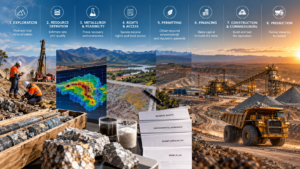
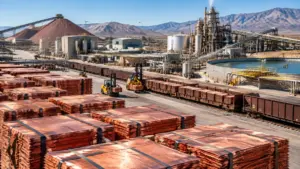
Critical-minerals security is increasingly determined by processing capacity, trade policy and supply-chain control rather than geology alone.

By Charles Pitts
The critical minerals race is moving from mine development to supply-chain control. Governments are directing public finance, export rules, strategic stockpiles and industrial partnerships toward the processing stages that convert ore into battery chemicals, permanent magnets, refined metals and defense components.
That shift matters because supply is becoming more geographically concentrated even as demand expands. The International Energy Agency says the top three refining countries accounted for about 86% of global refining capacity for key energy minerals in 2024, up from 82% in 2020. China is the leading refiner for 19 of the 20 minerals tracked by the IEA, with an average share of about 70%.
The result is a supply chain with more mines in development but relatively few routes to commercially usable material. For operators and investors, the key questions are increasingly practical: Who controls refining? Where are the chemicals and equipment coming from? Can projects secure permits, power, skilled labor and customer qualification before policy support changes?
More Read

The bottleneck has moved downstream
New mine supply remains important, particularly for copper. But for lithium, nickel, graphite and rare earths, the most immediate constraint is often the midstream: chemical conversion, separation, refining, metallization and manufacturing.

The IEA’s latest outlook identifies persistent supply risks for copper and lithium through 2035 under current policy and project pipelines. Rare earths show an even sharper mismatch between upstream and downstream capacity. Announced mining projects outside China could provide nearly 50,000 tonnes of rare-earth capacity by 2035, but planned refining capacity is below 40,000 tonnes. Announced metals, alloys and magnet capacity is lower still, at roughly 18,000 tonnes of rare-earth content.
For lithium, mining growth outside dominant processing centers is advancing faster than refining and cathode-material capacity. China processes approximately 60% of global lithium, according to industry and IEA-linked analyses, while Chile accounts for roughly 15%.
More Read
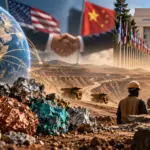
Nickel presents a different concentration pattern. Indonesia accounts for about 43% of global nickel refining capacity, while China and Indonesia together control approximately 70% of nickel processing. This has enabled rapid supply growth but leaves battery manufacturers exposed to policy changes, permitting conditions, environmental requirements and export rules in two major jurisdictions.

Separation and refining capacity remains more concentrated than mine supply.
Policy is becoming part of the physical supply chain
China’s export-control regime illustrates how a regulatory decision can affect downstream manufacturing without directly restricting mined production.
In April 2025, China’s Ministry of Commerce and General Administration of Customs introduced licensing requirements for selected products involving samarium, gadolinium, terbium, dysprosium, lutetium, scandium and yttrium. The covered items included metals, alloys, oxides, compounds and certain permanent-magnet materials. The official announcement states that exporters must apply for licenses and identify controlled goods in customs declarations.
The importance of these measures extends beyond shipment volumes. Export licensing introduces uncertainty around timing, documentation, customer eligibility and technology transfer. For manufacturers using high-performance magnets, even a temporary delay in receiving separated oxides or alloys can affect production schedules.
The United States and European Union are responding with a broader mix of domestic support and coordinated trade policy. In April, Washington and Brussels announced a strategic partnership and Action Plan on critical minerals. The framework covers exploration, extraction, processing, refining, recycling and recovery. It also proposes cooperation on stockpiling, common standards, investment promotion and rapid responses to supply disruptions.
The action plan discusses tools including border-adjusted price floors, price-gap subsidies and offtake agreements. These measures are intended to help higher-cost projects compete with supply from established processing centers. However, the framework does not by itself create a fully funded, binding alternative supply chain.
Critical-minerals concentration and policy exposure
| Mineral | Dominant processing position | Approximate concentration indicator | Main 2026 bottleneck |
|---|---|---|---|
| Copper | China is the leading refiner | China supplied roughly 70%–80% of global refined copper supply growth from 2020–24 | Mine development, permitting and smelting capacity |
| Lithium | China is the leading processor | China processes about 60% of global lithium | Chemical conversion and cathode materials |
| Nickel | Indonesia is the leading refiner | Indonesia holds about 43% of global nickel refining capacity | Indonesia-China processing concentration |
| Rare earths | China dominates separation and magnets | China controls about 90% of rare-earth refining and permanent-magnet production | Separation, heavy rare earths and magnet qualification |
| Strategic minor metals | China is a major supplier and processor | China leads or strongly influences several markets, including gallium, germanium and tungsten | Export licensing, specialist equipment and substitute supply |
Sources: IEA, IEA Global Critical Minerals Outlook, and China’s Ministry of Commerce. Figures are rounded and refer to different stages of the value chain.
The United States is treating waste as strategic supply
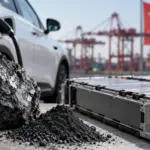
U.S. policy is also expanding the definition of what counts as a strategic mineral resource. A 2026 presidential determination classified recoverable critical-mineral materials such as battery black mass, end-of-life rare-earth magnets, metal swarf and other waste or scrap as important to national defense.
That approach reflects the growing value of secondary feedstocks. Black mass can contain lithium, nickel, cobalt, manganese, graphite and copper. Mine waste and tailings may contain recoverable copper, cobalt, rare earths or tungsten, depending on the deposit and processing history.
The policy opportunity is significant, but recovery is not automatic. Material must be collected, sorted, transported, tested and processed through facilities that can produce consistent, qualified outputs. If domestic processors cannot absorb the material, export restrictions may create inventory buildups rather than immediate supply resilience.
For mining companies and recyclers, the compliance burden is likely to increase. Traceability systems will need to establish where material originated, how it was processed, who purchased it and whether it moved through a restricted jurisdiction.

Strategic inventories can bridge short disruptions but cannot replace operating processing capacity.
Stockpiles can buy time, not independence
Strategic stockpiling is becoming a central policy tool. The IEA’s stockpiling framework recommends assessing more than supply volume. Governments must also consider substitution options, import forms, supply-chain chokepoints, response time and the strategic importance of each mineral.
That distinction matters. A stockpile of refined metal may not solve a shortage of separated oxides, battery-grade chemicals or permanent magnets. The form in which material is stored must match the form required by manufacturers.
A reserve can provide time during a disruption, allowing defense contractors or industrial buyers to continue operating while alternative suppliers are qualified. It cannot resolve a long-term shortage of engineers, chemical reagents, specialized equipment or permitted refining sites.
The IEA’s traceability work, based on input from more than 80 companies across copper, lithium, nickel, cobalt, graphite and rare earths, points to the same challenge: supply-chain visibility is improving, but adoption remains uneven.
Three scenarios for the next phase
Base case: diversification without full independence
In the base case, U.S., European and allied projects advance, but commissioning delays and higher operating costs limit their scale. New mine output grows faster than non-Chinese refining in some commodities, leaving companies dependent on established processors for intermediate products.
Supply chains become more diversified, but not fully independent. Domestic and allied material may command a premium because of higher labor, compliance, energy and financing costs.
Accelerated case: coordinated processing corridors
A stronger outcome would require public finance, offtake agreements, permitting reform and allied coordination to work together. Australia, Canada, the United States, Europe and selected producers in Africa and Latin America could link feedstock supply with regional refining and recycling capacity.
The critical measure would not be the number of announced projects. It would be the tonnes of qualified product delivered to customers, supported by reliable power, reagents, transport and trained personnel.
Fragmented case: funded projects fail to connect
The downside scenario is a collection of partially completed facilities. Projects receive grants or conditional loans but struggle with construction costs, technology validation, weak commodity prices, permitting disputes or a lack of customer qualification.
Export restrictions could worsen the problem if domestic processors are not ready to handle materials that previously moved through international markets. In that case, stockpiles would offer temporary relief while structural bottlenecks remained.
What operators should monitor
The most useful indicators for the critical minerals supply chain are execution metrics rather than policy announcements:
- Final investment decisions and binding loan agreements.
- Construction progress at separation, refining and recycling plants.
- Power, reagent and water availability for new processing facilities.
- Customer qualification for battery chemicals, magnets and advanced alloys.
- Domestic capacity to process black mass, mine waste and metal scrap.
- Changes to Chinese export licensing and controlled-product lists.
- Implementation of the EU-U.S. Action Plan and any binding trade agreement.
- Workforce growth among metallurgists, process engineers, geologists and maintenance specialists.
- The percentage of announced capacity that reaches commercial production.
The central conclusion is straightforward: critical-minerals security will be determined by the weakest link between mine, refinery and manufacturer. Policy can accelerate investment and reduce risk, but it cannot substitute for operating capacity.
For the next phase of the energy transition, the decisive competitive advantage may belong not to the jurisdiction with the largest mineral deposit, but to the one that can consistently turn that deposit into qualified, traceable and deliverable material.