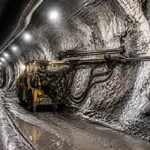
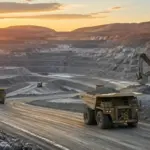
An autonomous ultra-class haul truck moves through a terraced open-pit mine.

By Charles Pitts
Komatsu’s commissioning of its 1,000th ultra-class autonomous haul truck marks a significant change in mining technology. The milestone, reached in April with a 290-metric-ton Komatsu 930E-5AT deployed at Barrick’s Nevada Gold Mines, shows that autonomous haulage has moved beyond isolated pilots and into repeatable production at scale.
The number matters because it places autonomy within the operating model of large mines rather than the research and development pipeline. Komatsu says its FrontRunner Autonomous Haulage System has now moved more than 11.5 billion metric tons of material across mine sites in North America, South America, Australia and Europe. The company also says the system operates across commodities including iron ore, copper, coal, oil sands and gold.
The next question for mine operators is no longer whether autonomous haulage works. It is where autonomy delivers sufficient productivity, safety and cost benefits to justify the capital, infrastructure and workforce transition required.

The 1,000-truck milestone changes the adoption curve
Autonomous haulage has traditionally been associated with large, highly standardized iron ore operations. Those mines offer long haul routes, substantial fleet sizes and controlled operating environments that support the economics of an autonomous haulage system, or AHS.

The Nevada Gold Mines deployment is important for a different reason. It extends the technology into a major gold operation, where pit geometry, haul routes and production schedules can differ from the very large iron ore corridors where autonomy first expanded.
Komatsu introduced FrontRunner commercially in 2008. Its latest milestone indicates that the technology has accumulated nearly two decades of operating experience, site data and integration work. The company is also extending automation to equipment such as water trucks and developing links between autonomous vehicles, fleet management and mine-control systems.

This progression supports a four-stage adoption curve:
| Adoption stage | Typical operating model | Main decision criterion |
|---|---|---|
| Assess | Digital site study and route evaluation | Is the operating domain suitable? |
| Pilot | Limited autonomous fleet or route | Can the system operate safely and consistently? |
| Scale | Multi-truck production deployment | Does it improve cost per tonne and utilization? |
| Optimize | Integrated mine-wide automation | Can autonomy improve the whole value chain? |
The 1,000-truck mark suggests that leading operators are now concentrated in the scale and optimize phases. Smaller and mid-tier mines remain more likely to be in assessment or pilot mode, particularly where haulage volumes, communications infrastructure or fleet standardization are limited.
Productivity gains come from consistency, not just speed
The operational case for autonomous mining technology 2026 is based less on faster truck speeds than on reducing variability.
An autonomous truck does not require a cab change at shift handover, a meal break or a replacement operator for fatigue management. More importantly, the system can maintain consistent speeds, spacing, braking and dumping behavior across a fleet. That consistency allows dispatch software to manage queues and loading equipment with greater predictability.
Industry studies and operator case material commonly place mature AHS productivity gains in the range of 10% to 25%, although outcomes vary significantly by mine design and baseline performance. A University of British Columbia study cited in industry research found a 21.3% productivity increase in one modeled comparison. Rio Tinto has reported productivity gains of about 20% in parts of its Pilbara autonomous fleet, while BHP has reported an 18% increase in ore throughput at Jimblebar following automation.
These figures should not be treated as universal guarantees. A mine with short hauls, frequent interactions with light vehicles or poorly maintained roads may capture less benefit than a large operation with long, repeatable cycles.
The most useful measures for operators are therefore site-specific:
- Effective operating hours per truck.
- Cycle-time variation between loaded and empty trips.
- Queue time at shovels, crushers and dumps.
- Availability of loading and haulage equipment.
- Tonnes moved per truck per operating hour.
- Unplanned stops caused by traffic, weather or road conditions.
Skillings’ autonomous haulage productivity benchmarks provide a broader reference point for these measures, while autonomous haulage ROI analysis examines the cost-per-tonne case.
Safety benefits depend on the operating design
Removing drivers from ultra-class haul trucks reduces direct exposure to collisions, rollovers, dust and other hazards in active pit areas. It also makes machine behavior more standardized, with geofencing, object detection, controlled intersections and remote supervision forming part of the safety architecture.
Komatsu says FrontRunner deployments have recorded no system-related injuries. Other industry studies have reported reductions in haul-truck incidents ranging from roughly 40% to 90%, depending on the site, measurement period and definition of an incident.
The range is wide because autonomous haulage is not a single safety device. Outcomes depend on the entire operating design, including:
- Separation between autonomous and manually operated vehicles.
- Rules for entering and leaving autonomous zones.
- Emergency-stop procedures and recovery protocols.
- Visibility and reliability of communications networks.
- Road quality, berm standards and intersection design.
- Training for supervisors, technicians and field personnel.
Safety gains can be undermined if a mine introduces autonomous trucks without redesigning traffic management. Mixed-fleet operations require particularly clear rules because conventional light vehicles, service trucks and autonomous haul trucks may share parts of the same network.

Control-room staff monitor fleet movements, equipment status and operational data.
Sandvik links autonomous drilling with electrification
The adoption curve is widening beyond haulage. Sandvik has introduced a battery-electric surface drilling concept designed for large down-the-hole blast holes of up to 229 millimeters.
The concept uses a hybrid power arrangement. An onboard battery can support up to one hour of drilling or approximately seven hours of tramming, while a 180-meter tether supplies continuous power for most drilling patterns. Sandvik says the battery allows the rig to move between holes and begin work while the cable is being positioned.
The machine remains a concept platform rather than a standard commercial product. Its significance lies in the systems it brings together: electric power, autonomous movement, remote supervision and mine-wide drilling coordination.
Sandvik is also developing its surface automation platform, including systems capable of managing multiple i-series drill rigs remotely. Trials and technology development in Finland, together with work involving mining customers, are intended to test the equipment in operating conditions rather than laboratory environments.
This matters for open-pit operators because drilling and haulage are closely linked. More consistent drilling can improve fragmentation, shovel productivity and downstream crushing performance. In a fully integrated mine, the value of autonomous drilling may therefore appear in the haul cycle and processing plant, not only in drill utilization.

An electric surface drill works across a patterned blast area in an open-pit mine.
Volvo’s mixed-traffic model lowers the entry barrier
Volvo Autonomous Solutions is taking a different route with Autona/earth, a commercial autonomous haulage ecosystem designed for mines and quarries.
The system combines autonomous Volvo FH trucks, the Volvo Virtual Driver, fleet management, site-control software, infrastructure and operations support. Rather than requiring a mine to purchase and manage every component of the autonomy stack, Volvo offers the system through a transport-as-a-service model in which customers pay based on material transported.
The model is designed for mixed traffic. Autonomous trucks and conventional vehicles can operate within a managed site environment, allowing operators to introduce autonomy by route or production area instead of replacing an entire fleet at once.
At Brønnøy Kalk in Norway, Volvo says seven autonomous trucks have hauled more than 1 million tonnes of limestone. The operation has expanded to 24-hour production, moving material along a route that includes steep grades, difficult weather and dark tunnel sections. Volvo has also reported progress with Boliden at the Garpenberg mine in Sweden.

Autonomous and conventional haul trucks operate along a controlled mine route.
For operators, the commercial significance of Autona/earth is its emphasis on service delivery and uptime. The mine still needs suitable roads, communications, traffic controls and trained personnel, but the technology provider assumes more responsibility for integration and operation.
Cost-benefit framework for open-pit haulage
The economic case is strongest where mines have large fleets, high labor costs, long operating hours and repeatable haul routes. A representative planning range is shown below.
| Cost or operating factor | Conventional haulage | Mature autonomous haulage | Indicative effect |
|---|---|---|---|
| Truck utilization | Baseline | 15%–30% higher | More productive hours |
| Productivity | Baseline | 10%–25% higher | Greater tonnes moved |
| Fuel or energy use | Baseline | 5%–10% lower in some operations | Lower consumption |
| Haul-truck incidents | Baseline | 40%–90% lower in reported cases | Lower exposure |
| Haulage cost per tonne | Baseline | 15%–25% lower in mature deployments | Lower unit cost |
| Payback period | : | Approximately 3–4 years in large-scale cases | Capital recovery |
These are indicative ranges, not a project estimate. Actual returns depend on autonomous-ready equipment, network construction, control-room staffing, fleet size, retrofit complexity and the length of the ramp-up period.
A representative mature operation moving 90 million tonnes a year and achieving a $0.50-per-tonne saving would generate approximately $45 million in annual operating benefit before financing, tax and maintenance assumptions. If incremental capital expenditure were $100 million, the simple payback would be about 2.2 years. A real investment case would need to account for commissioning delays, lower first-year performance, software fees, infrastructure replacement and residual equipment value.
The main risk is not the autonomous truck itself. It is the surrounding system. Poor road conditions, unreliable network coverage, fragmented fleet data and weak change management can prevent a mine from reaching the productivity level assumed in a feasibility study.
The 2026 decision point
The 1,000-truck milestone does not mean every mine should automate immediately. It does mean that autonomy has a commercial reference base large enough for operators and investors to evaluate it against measurable production and cost benchmarks.
The strongest candidates are likely to be large open-pit copper, gold, iron ore and critical-mineral operations with:
- High annual material movement.
- Long or repetitive haul routes.
- Persistent labor or safety constraints.
- A standardized heavy-equipment fleet.
- Reliable private wireless or industrial communications.
- Mine plans that can accommodate controlled autonomous zones.
The next phase will be less about proving driverless movement and more about integrating autonomy across drilling, loading, haulage, road maintenance and processing. Sandvik’s electric drilling concept and Volvo’s mixed-traffic service model illustrate two different paths toward that broader system.
For mine managers, the practical benchmark is not the number of autonomous trucks in the global fleet. It is whether a specific site can convert consistent machine behavior into safer production, higher utilization and lower cost per tonne without creating new infrastructure or workforce risks.
Shareable snippets
Komatsu’s commissioning of its 1,000th ultra-class autonomous haul truck shows that autonomous mining technology has moved from pilot projects into repeatable production at scale. The next adoption phase will connect haulage with autonomous drilling, electrification and mixed-traffic operations. Read the decision framework for operators: https://www.skillings.net/autonomous-mining-technology-2026-the-1000-truck-tipping-point/
X
Autonomous mining technology reaches a new benchmark: Komatsu has commissioned its 1,000th ultra-class AHS truck. Sandvik is linking autonomous drilling with battery-electric power, while Volvo is commercializing mixed-traffic haulage. The question now is site economics: not whether autonomy works. #MiningTech #AutonomousHaulage #Copper #CriticalMinerals