By Salini Krishnan – Skillings Mining Intelligence

The global mining landscape in 2026 is defined by a rapid acceleration in regulatory shifts, high-stakes M&A, and a technological pivot toward autonomous operations. At Skillings Mining Review, our "Operation 100K" initiative ensures that stakeholders remain informed through a rigorous daily publishing schedule of four hard-news reports and three deep-dive analyses. As of April 12th, 2026, the industry is grappling with major permit revocations in South America and a surge in critical mineral legislation in the United States, marking a transformative period for global supply chains.
Regulatory Volatility: Peru and Argentina at a Crossroads
In South America, the regulatory environment for copper and gold extraction has reached a fever pitch. The Peruvian government recently revoked the permit for Southern Copper’s $1.8-billion Tía María copper project. The decision follows a series of legal and technical challenges that have plagued the development for over a decade. For operators, this signifies a tightening of environmental and social governance (ESG) scrutiny, as the government demands a fresh review of the project's impact on local water resources.
Simultaneously, Argentina is moving in the opposite direction. The Argentine Congress, under the administration of President Javier Milei, has approved landmark legislation opening sensitive high-altitude regions to mining activity. While this move is intended to unlock massive lithium and copper potential in the Andes, it has sparked significant pushback from environmental groups concerned about glacial water security. These developments highlight the diverging paths of the region's two mining powerhouses: one tightening its grip on legacy projects, while the other aggressively courts new investment.

More Read

Strategic M&A: Consolidating the Gold Sector
The first quarter of 2026 has seen a flurry of consolidation, particularly in the gold sector. G Mining Ventures recently announced a $3 billion all-share acquisition of G2 Goldfields. This deal is set to merge the Oko West and Oko-Ghanie projects into a singular, Tier-1 operation. Analysts expect this combined entity to produce an average of 350,000 ounces of gold annually over its life-of-mine.

This acquisition follows a trend of "de-risking" through scale. By combining adjacent assets, companies can share infrastructure and streamline permitting processes, which is becoming increasingly critical as capital costs remain high. In Canada, however, project advancement is not without its hurdles. Seabridge Gold has reported delays in its KSM project in British Columbia. The province has withheld permits for tunnel excavation due to an ongoing court dispute with a neighboring operator, underscoring the legal complexities that can stall even the most robust Tier-1 assets.
Technology Deep-Dive: The AI and Electrification Frontier
Beyond the headlines of permits and buyouts, the operational reality of mining is being rewritten by artificial intelligence. At Inner Mongolia’s Yimin coal mine, a fleet of 100 AI-driven electric haul trucks is now fully operational in extreme weather conditions. This deployment serves as a successful proof-of-concept for autonomous systems that reduce diesel consumption and improve safety.
More Read

The shift toward mine electrification in 2026 is no longer a luxury but a financial necessity. With rising carbon taxes and volatile fuel prices, operators are leveraging AI to optimize energy usage in real-time. For instance, the partnership between Codelco and Microsoft has integrated a "digital brain" into copper processing, allowing for predictive maintenance that reduces downtime by up to 15%.

Critical Minerals: The Geopolitical Tug-of-War
The quest for mineral independence is driving legislative action in the West. Two U.S. senators recently proposed the "Mined in America" certification bill. This legislation would provide tax incentives for crypto-mining facilities that utilize domestically sourced minerals and energy, aiming to strengthen the domestic Bitcoin reserve while supporting the U.S. mining industry. This follows the broader U.S. funding bills designed to accelerate project timelines for critical minerals.
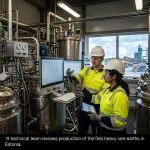
In Europe, the EU’s $50B critical minerals reserve plan is beginning to deploy capital. The goal is to secure the materials necessary for the green transition, such as rare earth elements. A significant milestone was reached recently in Estonia, where Neo Performance Materials produced its first batch of heavy rare earth elements at the Silmet plant, marking a step toward breaking the dependency on Chinese supply chains.
Market Snapshot: Commodity Performance – April 12th, 2026
| Commodity | Price (USD) | 24h Change | YTD Change | Market Sentiment |
|---|---|---|---|---|
| Copper (lb) | $4.85 | +1.2% | +8.4% | Bullish (Supply Deficits) |
| Gold (oz) | $2,410 | -0.5% | +12.1% | Neutral (Inflation Hedge) |
| Lithium (tonne) | $14,200 | +0.8% | -4.2% | Stabilizing (EV Demand) |
| Silver (oz) | $29.40 | +2.1% | +15.3% | Bullish (Industrial Use) |
| Iron Ore (tonne) | $105 | -1.1% | -6.5% | Bearish (China Demand) |

Operational Spotlight: Lithium and Rare Earths
The lithium market is finding a new floor in 2026 after the volatility of previous years. Projects like Century Lithium’s Angel Island are seeing their Net Present Value (NPV) surge as processing technologies mature. Meanwhile, in Texas, MP Materials is nearing completion of its 1.25B magnet plant, a critical link in the domestic rare earth supply chain.
Geopolitical risks remain a primary concern for lithium and silver production. In Mexico, the silver mining security crisis has forced some operators to increase spending on private security, impacting their 2026 production outlook. These regional challenges are forcing investors to look toward safer jurisdictions, such as the Per Geijer rare earth project in Sweden or exploration efforts in Greenland.
Analysis: The ESG Imperative
ESG is no longer just a compliance checkbox; it is a driver of capital allocation. Investors are increasingly prioritizing companies that can demonstrate a clear path to net-zero. This is evident in the funding secured by Nouveau Monde Graphite, which raised $297 million with backing from Italian energy giant Eni. The investment underscores the growing importance of graphite in the global battery revolution.
Companies failing to meet these standards are facing higher insurance premiums and restricted access to equity markets. The "Skillings Power List" recently highlighted the 10 mining companies dominating the 2026 energy transition, all of which have integrated decarbonization into their core business models.

Conclusion: Why Operation 100K Matters
The "Operation 100K" mission at skillings.net is designed to provide the mining community with the data and analysis required to navigate this complex era. By publishing 14 stories daily: 4 hard news and 10 deep-dives: we provide a comprehensive view of the industry that traditional news outlets often miss.
Whether it is the U.S. Steel crossroads or the latest update on the Kinross Gold Chile project, our reporting is grounded in concrete data and expert attribution. As the mining industry moves deeper into 2026, staying ahead of the regulatory and technological curve will be the difference between success and obsolescence.
Social Media Snippet (LinkedIn/X):
? Breaking in Mining: Peru revokes Tía María permit while Argentina opens high-altitude zones. AI-driven fleets hit 100+ trucks in Inner Mongolia. Is your operation ready for the 2026 regulatory shift? Read our full Daily Intelligence Report on Operation 100K. #MiningNews #Copper #ESG #MiningTech #SkillingsMining
About the Author:
Salini Krishnan is a lead analyst for Skillings Mining Intelligence. With over a decade of experience covering global commodity markets and mineral policy, she provides deep-dive insights into the intersection of technology and natural resources.

Upcoming Feature: Presale now open for the '2026 Lithium Power Map' – an exhaustive guide to the global lithium supply chain, featuring over 200 project sites and logistical corridors. Visit skillings.net for details.