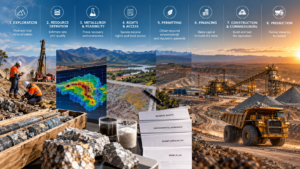
An open-pit copper operation illustrates the scale and infrastructure behind the assets attracting strategic capital.

By Charles Pitts
Mining M&A deals 2026 are increasingly being shaped by control of future copper supply, strategic access to rare earths and financing structures that reduce development risk.
The latest transactions show that consolidation is not limited to conventional takeovers. Companies are also using spin-outs, minority strategic investments, offtake agreements and all-share mergers to secure exposure to scarce mineral assets while managing capital requirements. Copper is at the center of the activity, while rare earths are drawing targeted project-level capital as governments and industrial buyers seek alternatives to concentrated supply chains.
The deal flow also reflects a widening valuation gap. According to Skillings’ recent mining market intelligence coverage, global mining M&A has surpassed $43 billion year to date, although totals vary by methodology and whether broader metals transactions are included.
More Read

Mining M&A deal tracker
| Transaction | Structure | Headline valuation or funding | Strategic focus | Status |
|---|---|---|---|---|
| Anglo American–Teck Resources | All-share merger of equals; 1.3301 Anglo shares for each Teck share | Approximately US$53 billion at announcement | Builds a major copper-focused critical minerals group | Regulatory process ongoing |
| NGEx–Valle Ancho | Spin-out by statutory plan of arrangement; shareholders receive 0.2 Spinco shares per NGEx share | No separate acquisition value disclosed; cash injection planned | Separates an early-stage copper-gold exploration vehicle from NGEx’s advanced assets | Shareholder vote targeted for Q4 |
| Copper Giant–Denarius–Trafigura | C$31 million private placement, minority equity investment and offtake agreement | Denarius investment of C$28.8 million for 15.6% of Copper Giant | Funds Mocoa copper-molybdenum development and secures market access | Expected financing close around Aug. 21, subject to approvals |
| Japan/Toyota Tsusho–Lofdal | Strategic project funding and partnership | C$47.7 million commitment reported by Skillings | Advances Namibia’s heavy rare earths supply potential | Announced project financing |
| Equinox Gold–Orla Mining | All-share combination | Approximately US$18.5 billion | Creates a large Americas-focused gold producer | Completed or advancing through implementation steps |
The table illustrates why headline deal value alone is becoming a less reliable measure of mining consolidation. A multibillion-dollar merger can combine producing assets, while a smaller private placement may determine whether a critical project advances toward a preliminary economic assessment or construction decision.

Copper scarcity is raising the value of strategic control
Copper remains the strongest common denominator across the largest transactions. Demand from grid expansion, electrification, renewable generation and data-center infrastructure is colliding with declining grades, long permitting timelines and a limited pipeline of large new mines.
Skillings’ copper outlook for 2026 identifies a consensus forecast range of roughly $10,000 to $13,000 per tonne among major institutions, with structural supply constraints supporting a higher long-term price floor.

That outlook changes the logic of M&A. Producers are not only buying current output. They are acquiring future tonnes, permitting positions, infrastructure corridors and technical teams capable of advancing complex deposits.
The proposed Anglo American–Teck combination is the clearest example. The companies agreed to combine through a merger of equals, with Teck shareholders receiving 1.3301 Anglo American ordinary shares for each Teck share. Anglo American shareholders are expected to hold approximately 62.4% of the combined group, with Teck shareholders owning about 37.6%.
The combined company, to be headquartered in Canada, is expected to have more than 70% exposure to copper and annual copper production of more than 1.2 million tonnes. The companies have also outlined US$800 million in annual recurring cost synergies and longer-term revenue synergies associated with their Chilean operations.
The transaction remains subject to regulatory approvals. The official Anglo American and Teck merger page describes the proposed structure and provides the companies’ shareholder and regulatory materials. For investors, the important variable is that the transaction is share-based: the final value received by Teck shareholders will move with Anglo American’s share price until closing.

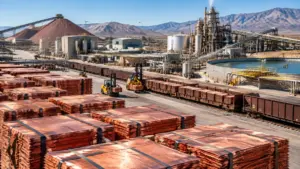
Copper processing infrastructure is increasingly viewed as strategically important alongside mine ownership.
NGEx uses a spin-out to separate exploration risk
NGEx Minerals’ planned spin-out of Valle Ancho shows a different form of consolidation: the creation of a new exploration platform rather than the purchase of an existing company.
Under the arrangement announced by NGEx Minerals, Valle Ancho will be transferred to a newly incorporated subsidiary known as Spinco. NGEx shareholders will receive one Spinco share for every five NGEx shares held, while retaining their existing ownership in NGEx.
Spinco will hold a 100% interest in the Valle Ancho project, a 109,000-hectare land package spanning the eastern side of Chile’s Maricunga Gold Belt and its extension into Argentina. The project includes copper-gold porphyry targets, and previous drilling identified significant mineralization at the La Quebrada target.
NGEx plans to inject cash into Spinco to fund the project transfer and provide at least 12 months of working capital. Spinco intends to apply for a TSX Venture Exchange listing and will be led by Wojtek Wodzicki, who is also NGEx’s president and chief executive.
The structure allows NGEx to focus on its more advanced Lunahuasi and Los Helados projects while giving Valle Ancho a separate equity identity and exploration mandate. It also creates a potential financing vehicle for future acquisitions of South American exploration assets.
The risks are equally clear. The arrangement requires shareholder, court and TSX approval, and the proposed TSXV listing is not guaranteed. Valle Ancho remains an exploration project, meaning its value will depend on drilling, permitting, capital availability and the market’s willingness to fund a standalone explorer.
Copper Giant combines equity, strategic ownership and offtake
The Copper Giant transaction demonstrates how junior companies are assembling project finance before they reach the construction stage.
Copper Giant announced a C$31 million strategic financing led by Denarius Metals. Denarius has agreed to invest C$28.8 million by subscribing for 40 million Copper Giant shares at C$0.72 per share. On closing, Denarius is expected to hold a 15.6% interest in Copper Giant.
The financing is tied to Copper Giant’s Mocoa copper-molybdenum project in southern Colombia. The company reports an inferred resource of 1.1 billion tonnes grading 0.51% copper equivalent, containing approximately 7.6 billion pounds of copper and 1 billion pounds of molybdenum.
The project is also being supported by a 10-year offtake agreement with Trafigura. Once commercial production begins, Trafigura will have the right and obligation to purchase 20% of the copper concentrate and 20% of the molybdenum concentrate produced, subject to minimum delivered volumes.
The structure creates alignment among three different participants:
- Copper Giant receives capital for resource conversion drilling, exploration and technical studies.
- Denarius gains a sizeable minority position in a large copper-molybdenum project.
- Trafigura secures future concentrate exposure and a closer relationship with a potential Colombian supplier.
The Denarius announcement says the Copper Giant financing is expected to close around Aug. 21, subject to definitive documentation, corporate approvals and TSX Venture Exchange approval.

Drill core and resource conversion work are central to determining whether exploration assets can support larger transactions.
Rare earths are attracting targeted, strategic capital
Rare earths are following a different consolidation path from copper. Rather than a large number of broad corporate mergers, the sector is seeing strategic investments, government-backed partnerships and offtake-linked funding directed toward projects that can diversify supply away from dominant processing hubs.
Skillings’ coverage of the Lofdal heavy rare earth project in Namibia reflects this model. Strategic capital from Japan and Toyota Tsusho is aimed at advancing a project with potential relevance to heavy rare earth supply chains.
For rare earths, project value depends on more than the size of a mineral resource. Buyers and strategic investors also assess separation technology, product specifications, processing location, environmental performance and the availability of long-term customers.
That makes partnership structures especially important. An industrial participant may accept a minority position or offtake commitment if it gains greater visibility over future supply. For developers, the benefit is access to technical expertise and market credibility before a project reaches production.
Valuation gaps are driving deal structure
Public-market valuation remains a central factor behind the 2026 M&A cycle. Skillings’ market analysis places indicative P/NAV ranges around 0.3x to 0.6x for discounted junior and development assets, 0.6x to 0.8x for some operating miners, and approximately 1.2x to 2.0x for diversified royalty and streaming platforms.
These ranges are not universal benchmarks. They vary by commodity, jurisdiction, resource confidence, project maturity, balance-sheet strength and permitting risk. A low P/NAV can signal opportunity, but it can also reflect unresolved technical or legal problems.
The most important question for operators and investors is therefore not simply whether a transaction is large. It is whether the structure matches the project’s risk.
- All-share mergers preserve cash and spread commodity exposure across a larger platform.
- Spin-outs separate advanced assets from higher-risk exploration portfolios.
- Strategic equity placements bring capital and technical or regional expertise.
- Offtake agreements provide future market access but create claims on production.
- Project partnerships can unlock rare earth and critical mineral assets before traditional debt financing is available.
The emerging framework for mining M&A deals 2026 is clear: copper assets are being consolidated for scale and future supply, while rare earth projects are being assembled through strategic networks. In both cases, valuation depends increasingly on who controls the next stage of development and how effectively the transaction funds it.
This article is for information and market analysis only. It does not constitute financial advice or a recommendation to buy or sell any security.