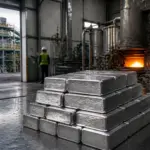
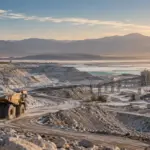
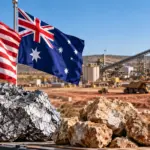
Large-scale copper infrastructure illustrates why miners are pursuing operational scale and supply security.

By Penny Langford
Mining M&A has entered a more selective phase. Copper and gold are attracting the strongest strategic interest, while lithium and other battery metals are seeing buyers focus on depressed valuations, processing access and long-term supply-chain control.
Industry estimates differ because some datasets include joint ventures, royalties and smaller asset purchases while others count only corporate transactions. Even so, the direction is consistent. FactSet counted 180 mining transactions above US$25 million worth about US$89 billion in 2025, while White & Case reported US$93.7 billion across 522 deals. Both measures represented the strongest activity in more than a decade.
The market is also concentrating around larger transactions. According to Bain’s mining M&A analysis, deal value for transactions above US$500 million rose sharply, reflecting a preference for scale, reserve replacement and critical-minerals exposure.

For operators and investors, the important question is no longer simply whether consolidation is accelerating. It is whether a transaction adds low-cost production, improves infrastructure use or strengthens supply-chain positioning without transferring excessive execution and regulatory risk.

Why miners are consolidating
Four forces are shaping the current mining M&A cycle.
1. Copper supply is becoming harder to replace
Large copper projects require lengthy permitting timelines, significant infrastructure and substantial development capital. Existing producers can therefore gain faster access to future supply by acquiring advanced projects or competitors rather than relying solely on greenfield exploration.

Copper-focused transactions have also become a way to assemble regional operating clusters. Combining mines, concentrators, ports, power systems and technical teams can create value that is not visible in a standalone asset valuation.
Skillings’ analysis of copper consolidation and supply risks shows how corporate mergers, brownfield restarts, project-level partnerships and exploration acquisitions are being used at different stages of the mine-development cycle.
2. Gold companies need reserve replacement and scale
Gold producers have generated stronger cash flow during a period of elevated prices, but many still face declining reserves, aging operations and rising costs. Acquisitions can extend mine life, diversify production and improve access to capital markets.
Gold also remains attractive to buyers seeking cash-generating assets rather than long-dated development exposure. According to S&P Global Market Intelligence, gold deal value reached a 15-year high in its 2025 dataset.
3. Critical minerals are now strategic assets
Governments are increasingly concerned about dependence on concentrated sources of lithium, nickel, cobalt, graphite and rare earths. That is changing the rationale for transactions.
A buyer may now value a project for its location, processing route, offtake relationships or eligibility for government-backed financing, even if near-term economics are weaker. The transaction becomes part of a broader supply-chain strategy rather than a conventional reserve acquisition.
This is particularly relevant to lithium, where deal activity has weakened in value terms but selected assets remain strategically important. Rio Tinto’s acquisition of Arcadium Lithium, reported at approximately US$6.7 billion, is an example of a major producer seeking scale during a weaker price cycle.
4. Balance sheets are stronger for some buyers
Higher metal prices have improved liquidity for established producers and royalty companies. That gives larger groups the capacity to acquire assets from smaller developers facing financing pressure.
However, stronger balance sheets can also encourage overpayment. A company that uses a high commodity-price assumption to justify an acquisition may later find that the asset cannot support its purchase price when prices, grades or project schedules change.
Notable mining transactions and risk profile
The table below compares selected transactions and highlights the difference between headline value and deliverable value.
| Transaction | Approximate value | Primary deal driver | Reported premium | Main integration risk |
|---|---|---|---|---|
| Anglo American–Teck Resources | ~US$28 billion | Copper scale, portfolio concentration and regional operating synergies | Nil-premium, all-share structure | Regulatory approval, governance alignment and delivery of mine-level synergies |
| Rio Tinto–Arcadium Lithium | ~US$6.7 billion | Lithium scale, processing capability and supply-chain positioning | Not disclosed in cited sources | Lithium-price volatility, asset integration and capital allocation across operations |
| Northern Star–De Grey Mining | ~A$5 billion | Gold growth and integration of the Hemi project into a large Australian portfolio | Not specified in cited sources | Construction execution, infrastructure requirements and schedule discipline |
| Coeur Mining–New Gold | ~US$7 billion | North American gold and silver scale, diversification and cash-flow growth | ~16% to New Gold’s prior closing price | Combining operating cultures, share issuance and maintaining production performance |
| Gold Fields–Osisko Mining | ~US$1.6 billion | Access to a major Canadian gold development project | ~55% to Osisko’s 20-day average price | Development capital, permitting, technical studies and premium recovery |
| OceanaGold–Ausgold | ~A$776 million | Expansion of Australian gold production and project pipeline | ~27.7% to prior close; ~44% to 20-day VWAP | Advancing a development asset while protecting balance-sheet flexibility |
| BHP–Lundin Mining–Filo Corp. transaction | ~US$2.8 billion | Copper-gold district consolidation in Argentina and Chile | Not disclosed in cited sources | Joint-venture governance, permitting, infrastructure and country risk |
Values and premiums are approximate and reflect company disclosures or industry reporting. A nil or undisclosed premium does not mean a transaction has no economic cost; consideration may be transferred through exchange ratios, assumed debt, dilution or contingent payments.
The Anglo American–Teck combination illustrates the scale-led model. The companies have described a future copper producer with annual output of approximately 1.35 million tonnes and more than 70% exposure to copper. Reported potential benefits include approximately US$800 million in annual corporate synergies and longer-term operational improvements from the optimisation of adjacent Chilean assets.
The risk is that corporate scale does not automatically create operational value. Integration teams must coordinate mine plans, processing capacity, procurement, technology platforms and workforce structures without disrupting production. Regulatory review adds another layer of uncertainty, particularly where a combination changes market concentration or involves strategic minerals.
By contrast, Gold Fields’ reported 55% premium for Osisko Mining demonstrates what buyers may pay for scarce, high-quality gold development assets. That premium can be justified if the project adds long-term production at competitive costs. It becomes harder to defend if construction capital rises, permitting slows or the orebody performs below feasibility assumptions.
Premiums are becoming more uneven
Mining M&A premiums vary widely by commodity, jurisdiction, project stage and transaction structure.
Large all-share mergers may be completed at little or no premium when both companies believe the combination can create value through scale. The Anglo-Teck structure is a prominent example. The absence of a cash premium reduces the immediate cost to the acquirer but does not remove the risk of dilution or post-merger underperformance.
Gold transactions involving defined resources, existing infrastructure or low-risk jurisdictions can attract much higher premiums. OceanaGold’s proposed acquisition of Ausgold, for example, was reported at a premium of approximately 27.7% to the prior close and about 44% to the 20-day volume-weighted average price.
The highest premiums often appear in smaller transactions where the target has limited liquidity or where competing buyers want strategic access. Central Asia Metals’ reported premium of approximately 96% for New World Resources is an example of how a specific copper asset can command a price well above its undisturbed market value.
Premiums should therefore be assessed against the asset’s development stage and the buyer’s expected benefits. A 15% premium for a producing mine may carry less risk than a 50% premium for an undeveloped project, but it may also offer less upside from operational improvement.
Integration risk is more than a financial issue
Mining assets are difficult to integrate because their value depends on physical systems and local relationships.
A transaction may require the buyer to combine:
- Mine plans and reserve models.
- Processing and maintenance systems.
- Mobile equipment fleets.
- Environmental and tailings-management programmes.
- Community and Indigenous-partner agreements.
- Local procurement and workforce arrangements.
- Automation, data and operational-control platforms.
The operational challenge is particularly significant when a buyer acquires an asset with a different mining method, orebody profile or processing route. A company experienced in large open-pit copper operations may not immediately transfer the same systems to a remote underground gold mine or a lithium brine project.

Control systems, data platforms and operating procedures must be aligned after a transaction.
Technology integration is becoming more important as miners deploy autonomous haulage, remote operations and predictive maintenance. A company pursuing autonomous mining technology may need to standardise communications networks, fleet-management systems and data architecture across sites. That can create long-term productivity benefits, but it also introduces cybersecurity, training and implementation risk.
Lithium and critical minerals require a different framework
Lithium transactions are often harder to evaluate through conventional mining metrics because the value chain extends beyond the mine.
A buyer may be acquiring:
- Brine or hard-rock resources.
- Chemical-conversion capacity.
- Refining or separation technology.
- Customer qualification agreements.
- Logistics and port access.
- Government relationships.
- A position in a preferred jurisdiction.

Processing access and location can be as important as resource size in lithium transactions.
S&P Global reported that lithium M&A value fell sharply in 2025, even as individual strategic transactions remained significant. That divergence suggests a more selective market: buyers are willing to commit capital, but only where they see a credible route from resource to battery-grade product.
Nickel faces a similar tension. Indonesia has expanded its influence over nickel supply and processing, while changing export, ownership and downstream policies can alter project economics. A transaction may provide access to low-cost resources but expose the buyer to regulatory or market-concentration risk.
A practical framework for evaluating a mining deal
Decision-makers can test a proposed transaction through five questions:
-
What production is genuinely added?
Separate new tonnes and ounces from production already held indirectly or consolidated on a larger balance sheet. -
What is the source of value creation?
Identify whether benefits come from cost synergies, infrastructure sharing, reserve replacement, processing access or geopolitical positioning. -
How much capital remains required?
The acquisition price may be only the first commitment. Development, remediation, expansion and sustaining capital can materially change the effective cost. -
What assumptions support the valuation?
Stress-test metal prices, grades, recoveries, treatment charges, permitting timelines and foreign-exchange assumptions. -
What could prevent integration?
Review regulatory conditions, labour agreements, community commitments, technical compatibility, executive turnover and systems integration.
Outlook: selective consolidation rather than indiscriminate buying
Mining M&A is likely to remain active, but the strongest transactions will be those that solve a specific strategic problem.
Copper buyers are seeking scale and future supply. Gold producers are replacing reserves and expanding cash flow. Lithium and rare-earth companies are pursuing control over processing and downstream links. Smaller developers are using joint ventures, options and royalties to transfer funding risk to better-capitalised partners.
The market will continue to reward credible execution more than headline size. A large transaction can improve bargaining power and reduce duplication, but it can also magnify cost overruns, integration failures and regulatory exposure.
For operators and investors, the central measure is deliverable value: permitted tonnes, reliable production, competitive costs and cash flow that survives a weaker commodity cycle. Deal premiums, resource size and projected synergies matter, but they are only starting points for assessing whether consolidation creates durable value.
Shareable social snippets
LinkedIn: Mining M&A is being driven by copper supply constraints, gold reserve replacement and critical-minerals security. This analysis compares major transactions, reported premiums and the integration risks that determine whether scale becomes durable operating value.
X: Mining M&A is no longer just about buying tonnes. Copper scale, gold reserves, lithium processing and jurisdictional access are driving deals: but premiums, permitting and integration risk determine what value is actually delivered.
Sources
- Bain: Mining M&A report
- FactSet: Metals and mining M&A and equity capital markets insights
- S&P Global: Mining M&A in 2025
- White & Case: Mining and metals outlook
- Reuters: Anglo American and Teck Resources merger
- Reuters: Rio Tinto and Glencore merger talks
- Skillings: Copper consolidation, deals, supply and valuation risks
- Skillings: Critical-minerals supply-chain analysis