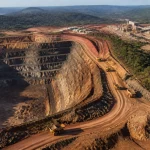
Hero Image Prompt: A cinematic aerial view of the Tarkwa open-pit gold mine in Ghana, showing the massive tiered benches and deep excavation, with several ultra-class yellow haul trucks moving along the haul roads.

Secondary Image Prompt: A view of the Tarkwa processing plant at night, illuminated by bright floodlights, with complex piping, conveyor belts, and massive grinding mills in operation under the Ghanaian stars.
By Charles Pitts
The government of Ghana has signaled a definitive shift in its approach to mineral tenure, publicly ruling out the automatic extension of mining leases for major international operators. At the center of this regulatory pivot is Gold Fields’ Tarkwa mine, a cornerstone asset for the South African miner and one of the largest gold-producing operations in West Africa.
As the industry looks toward 2027, the year Tarkwa’s current lease expires, Accra has made it clear that the renewal process will be subject to rigorous technical committee reviews and ministerial scrutiny. This move forms part of a broader 2026 mining permits reform agenda aimed at maximizing the state’s share of mineral wealth and ensuring that large-scale mining operations align more closely with national development goals.
More Read

Beyond Business as Usual
For decades, the renewal of mining leases for Tier-1 assets in Ghana was often viewed as a procedural formality, provided the operator maintained basic compliance. However, Isaac Andrews Tandoh, CEO of Ghana’s Minerals Commission, recently clarified that the environment has changed. “It won’t be business as usual where we just automatically renew the lease,” Tandoh stated in a recent briefing.

Gold Fields is now required to submit comprehensive, multi-year development plans for Tarkwa. These plans must first be defended before a specialized technical committee before a final presentation is made at the ministerial level. The government’s objective is to move away from “blanket” approvals toward a model based on “value maximization” and “sovereign oversight.”
While Ghana’s Minister for Lands and Natural Resources, Emmanuel Armah Kofi Buah, has emphasized that the state is not pursuing outright nationalization, the new requirements reflect a “resource nationalism by regulation” strategy. The goal is to secure partners who leave behind deeper expertise and create more substantial opportunities for Ghanaian businesses and workers.
More Read

The 2026 Mining Law Overhaul
The scrutiny of Tarkwa is occurring against the backdrop of significant legislative changes. Ghana is currently moving to amend the Minerals and Mining Act, 2006 (Act 703), with the 2026 reforms expected to be introduced in Parliament by the end of the first quarter. These amendments represent the most substantial overhaul of the country’s mining code in twenty years.
Key features of the proposed 2026 mining permits reform include:
- Price-Indexed Royalties: Moving away from the current 3%–5% flat rate, the government proposes a tiered royalty structure ranging from 9% to 12%. The rate would be indexed to global gold prices, effectively creating a windfall tax mechanism.
- Reduced Stability Periods: Current stability agreements can protect a miner from fiscal changes for up to 15 years. The new reforms propose cutting this to a maximum of five years.
- Abolition of Bespoke Development Agreements: Large projects (those exceeding $500 million in investment) previously negotiated individual development agreements. The reform suggests abolishing these in favor of a standardized, regulation-prescribed framework.
- Mandatory Local Contracting: A new requirement would mandate that all mining activities be carried out by Ghanaian-owned contractors, creating a legal separation between the license holder and the operational entity.

The Damang Precedent
Investors are closely watching the Tarkwa negotiations because of the recent precedent set at the nearby Damang mine. In early 2026, the Ghanaian government rejected Gold Fields’ request for a standard lease extension at Damang. Instead, the company was granted a 12-month transitional lease intended to facilitate an orderly handover of the asset to the state or a state-approved Ghanaian entity.
The Damang outcome sent a clear signal through the boardrooms of West African mining houses: the state is prepared to let leases expire if the revised terms sought by the government are not met. While Gold Fields’ leadership has maintained that the Damang and Tarkwa processes are separate, the market views the former as a trial run for the latter.
Market Snapshot: Gold Fields (GFI) and the Ghana Portfolio
To understand the stakes, one must look at the production and reserve data for Tarkwa. Despite the regulatory hurdles, Tarkwa remains a highly productive and high-potential asset.
| Metric | Tarkwa (2025 Data) | Notes |
|---|---|---|
| Gold Production | 427,000 oz | Primary contributor to regional output |
| Managed Mineral Reserves | 7.4 Moz | Increased from 4.3 Moz in 2024 |
| Managed Mineral Resources | 11.2 Moz | Inclusive of Reserves |
| All-in Cost (AIC) | $1,927/oz | Up 26% YoY due to inflation and royalties |
| Lease Expiry | April 2027 | Subject to 2026 review process |
Data Source: Skillings Market Intelligence / Gold Fields Annual Filings.
The significant increase in reserves: managed reserves grew by over 70% in 2025: provides Gold Fields with a strong argument for a long-term extension. However, it also increases the government’s negotiating leverage, as the long-term value of the “prize” at Tarkwa has grown substantially.
Jurisdictional Risk in West Africa
The development in Ghana is not an isolated event. Across West Africa, mining jurisdictions are tightening their belts and their laws. From Mali’s new mining code to the Democratic Republic of Congo’s increased scrutiny of copper and cobalt exports, the trend is toward shorter stability windows and higher state participation.
For investors, this “contract sanctity” risk is the new baseline. The era of 20-year frozen fiscal regimes is ending. Operators are increasingly viewed not just as extractors but as partners in a national industrial strategy.

“The risk is no longer that the government will seize the mine,” says one Accra-based mining analyst. “The risk is that the price of keeping the mine: the royalties, the local content requirements, the shorter lease terms: erodes the net present value to a point where new capital becomes harder to justify.”
Operational Implications for Gold Fields
If the Tarkwa lease is renewed under the 2026 reform terms, Gold Fields will face a significantly different operational landscape. The requirement to use Ghanaian-owned contractors for all mining activities could introduce execution risk, as the company would have less direct control over the day-to-day operations of the pit.
Furthermore, a doubling of the royalty rate (from 5% to 10% or higher at current gold prices) would put immediate pressure on margins. In 2025, Tarkwa’s AIC already rose 26% year-on-year. While high gold prices provide a cushion, any significant price correction could make the new fiscal terms punitive.
Gold Fields has already begun preparing for this new reality. In November 2025, the company submitted a comprehensive lease renewal application that reportedly included significant commitments to local procurement and infrastructure development.
Looking Ahead to 2027
As the technical committee begins its review, the mining industry will be looking for clues as to how “strict” the new conditions will truly be. If Ghana can successfully navigate this transition: increasing its state benefit without driving away foreign direct investment: it may provide a blueprint for other resource-rich nations in the region.
For Gold Fields, the path to 2027 is now a high-stakes diplomatic and technical exercise. Tarkwa is too big to lose, but the cost of staying is set to rise.

Internal & External Resources
- Skillings Mining Intelligence: 2026 Lithium Price Forecast and Drivers
- The 2026 Resource Realignment: Deep Dive Analysis
- Gold Fields Investor Relations: Ghana Operations Update
- Ghana Minerals Commission: Policy Guidelines